Home Office plan to use more military bases to house asylum seekers
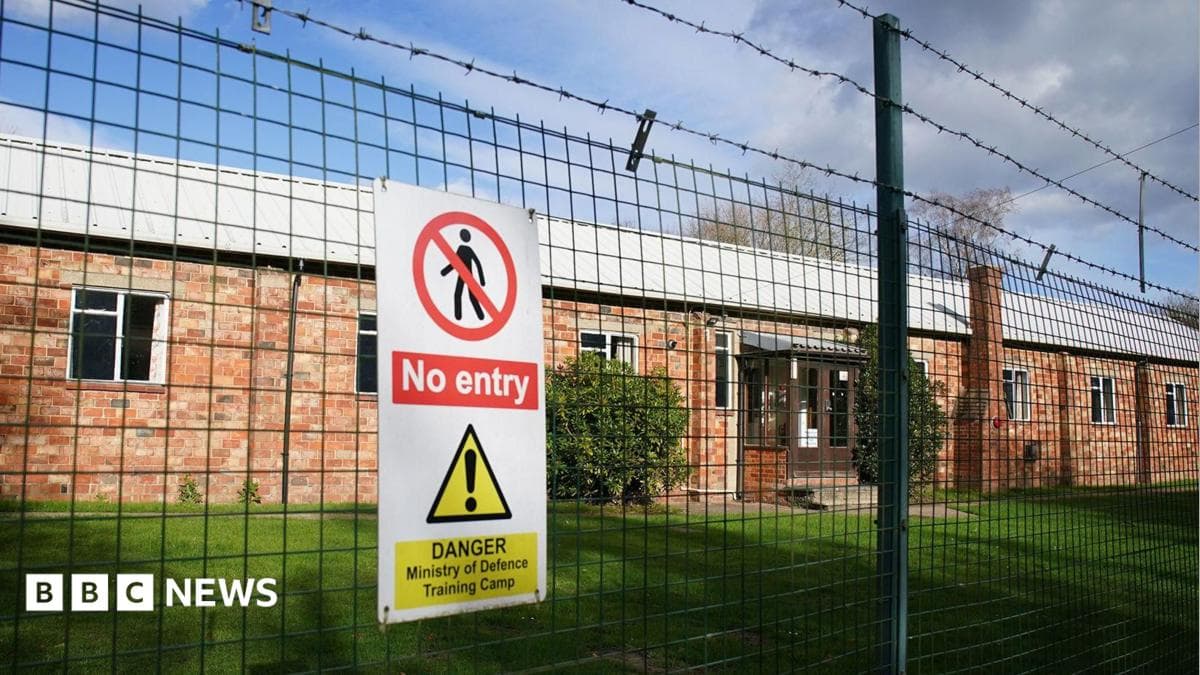
Crowborough Training Camp in East Sussex is already being use to house asylum seekers The Home Office is attempting to use three more military sites to house thousands of asylum seekers, as the government seeks to move people out of hotels. Three Ministry of Defence (MoD) sites in Bicester in Oxfordshire, Barnham in Suffolk, and Linton-on-Ouse in North Yorkshire, could house about 3,750 asylum seekers if planning permission is granted. The government is also looking to extend the use of existing military sites in Crowborough, East Sussex until 2030 and Wethersfield, Essex beyond 2027. Labour has pledged to stop using asylum hotels, a costly form of accommodation that has become a focal point for anti-migrant protests. As of March this year, 20,885 (21%) asylum seekers were in hotels and 72,768 (75%) were in other accommodation as they awaited decisions. The number of asylum seekers in hotels has dropped from a peak of 56,000 in September 2023. On Thursday, the Home Office said a further 20 asylum hotels had been shut, reducing the number in use to 170. Border security and asylum minister Alex Norris said: "We are moving asylum seekers into ex-military sites that are a far cry from the hotels the last government left us with. "This is a system being brought back under control â and we will not stop until the job is done." But Conservative shadow home secretary Chris Philp said Labour "should be putting illegal immigrants on a plane home rather than messing around with military camps and hotels". He said Labour "will not do what is needed to tear down the barriers to deportation, and without deportation, there is no deterrent". Lib Dem MP Callum Miller told Radio 4's Today programme he opposed the use of an MoD site in his Bicester and Woodstock constituency, accusing the government of having "no credible plan about how it will manage the site and how it will maintain social cohesion". "The question we are looking for the answer to is why the government thinks it is possible to put 1,250 asylum seekers in to a community when the nearest village numbers 370... I've literally no idea how the government thinks that can be absorbed into the community." The government stated its intention to increase the number of MoD sites it was using to accommodate asylum seekers last year. Two former military sites - RAF Wethersfield in Essex, and Crowborough Training Camp in East Sussex - are already being used to house asylum seekers. But the use of military sites for this purpose has been hampered by practical difficulties and highly contested by local residents as well as human rights groups. This week, an MP said one scheme to house up to 300 male asylum seekers at Cameron Barracks in Inverness had been dropped, following protests. The Red Cross said military barracks "are often in isolated locations and, by their very nature, can retraumatise people who have fled conflict and persecution". "It's clear that housing people seeking asylum in hotels isn't working well for anyone, but any alternative accommodation must enable people to live in safety and dignity," said Sam Turner, British Red Cross director of migration and displacement, said. An asylum seeker is someone who wants to be in the UK because they say they cannot live safely in their own country due to persecution or violence. The government must house an asylum seeker if they cannot financially support themselves while their claim is being considered. There were 93,653 people in asylum accommodation as of March 2026. About 22% of those people, 20,885, were in hotels. These are used when there is not enough shared housing available, such as houses of multiple occupation (HMOs) or former military sites . The government has pledged to stop the use of hotels by 2029. More people are in hotels across the south of England than elsewhere in the UK, while HMOs are more common in the north of England and Scotland. A modern browser with JavaScript and a stable internet connection is required to view this interactive Type in a postcode or the name of a local council below to see how many asylum seekers are housed in the area A total of 93,525 people applied for asylum in the UK from April 2025 to March 2026. This was down by 12% on the same period in the previous year. Most people who arrive in the UK by small boat claim asylum, but they were only 42% of all asylum seekers from April 2025 to March 2026. The rest include people who arrived by other illegal means or who came to the UK legally and applied for asylum while holding, or just after holding, a valid visa. It can take years for the government to decide whether someone should be granted asylum. In March 2026, 48,758 people - across 35,744 asylum applications - were waiting for an initial decision. The number of people awaiting an initial decision was down by 55% on the previous year. As of March 2026, a further 87,450 refused asylum applications were part of a second backlog, waiting the outcome of an appeal in the courts. This was up by 72% on the previous year. Together, these initial decision and appeal cases form the governmentâs total asylum applications backlog, which it has pledged to clear . Refugee status was granted in about 39% of asylum decisions made by the Home Office from April 2025 to March 2026. About 39% of asylum appeal cases concluded between April 2025 to March 2026 resulted in a previous refusal decision being overturned. The move to use more military sites comes ahead of immigration reforms expected to be introduced in Parliament next week. The Immigration and Asylum Bill, which will aim to increase the forced removal of people refused asylum, is expected to be put before the House of Commons next Tuesday and is likely to face stiff opposition from some Labour MPs. Home Secretary Shabana Mahmood will seek to drive through the reforms, which will be inherited by the next prime minister, following the resignation of Sir Keir Starmer. Last month Andy Burnham, who is widely expected to become the Labour leader and prime minister, told the BBC he "supports the broad thrust" of what Mahmood is proposing. The use of hotels to accommodate asylum seekers increased dramatically in 2020, driven by a backlog in processing asylum claims and a lack of long-term housing. Their use has proved controversial, triggering protests in local communities and legal challenges from councils, as well as concerns over the cost. In 2024-2025, £2.1bn was spent on hotels and the previous year the figure stood at £3bn - or £8.3m per day. The Home Office said the following hotels had now closed to asylum seekers: Dayz Away Lodge â Dudley, Black Country Holiday Inn Ashford Central â Ashford, Kent Best Western Atlantic â Chelmsford, Essex The Cisswood â Horsham, Sussex The Collection Hotel â Birmingham, West Midland Adagio â Leicester, East Midlands Norwich Hotel â Norwich, Norfolk Allerton Court â Northallerton, North Yorkshire Mercure George â Reading, Berkshire TLK Apartments â Bromley, Greater London Best Western Stoke â Stoke-on-Trent, Staffordshire The Granby (1 The Hill) â Gravesham, Kent Hampton by Hilton â Bristol Delta Hotel Cheshunt â Broxbourne, Hertfordshire Episode Leamington â Leamington Spa, Warwickshire Oxford Witney Hotel â Oxford, Oxfordshire Shambrook â Bedford, Bedfordshire Bell hotel - Epping, Essex OYO Evesham hotel â Evesham, Worcestershire Best Western â Wembley, London The majority of asylum seekers living in hotels entered the country after crossing the English Channel on small boats. Labour promised to reduce the numbers of people crossing the Channel on small boats by smashing trafficking gangs however, numbers have remained high, with 41,472 arriving in 2025. Inverness barracks asylum seeker plan dropped, says MP Number of asylum hotels falls to 185 after 11 close Asylum hotel vacated after fire safety concerns