Rockstar has revealed the pre-order date and official cover art for Grand Theft Auto 6.
The developer has said pre-sales of the title - one of the most anticipated gaming releases to date - will begin on 25 June, both on digital stores like PlayStation Store and other select retailers.
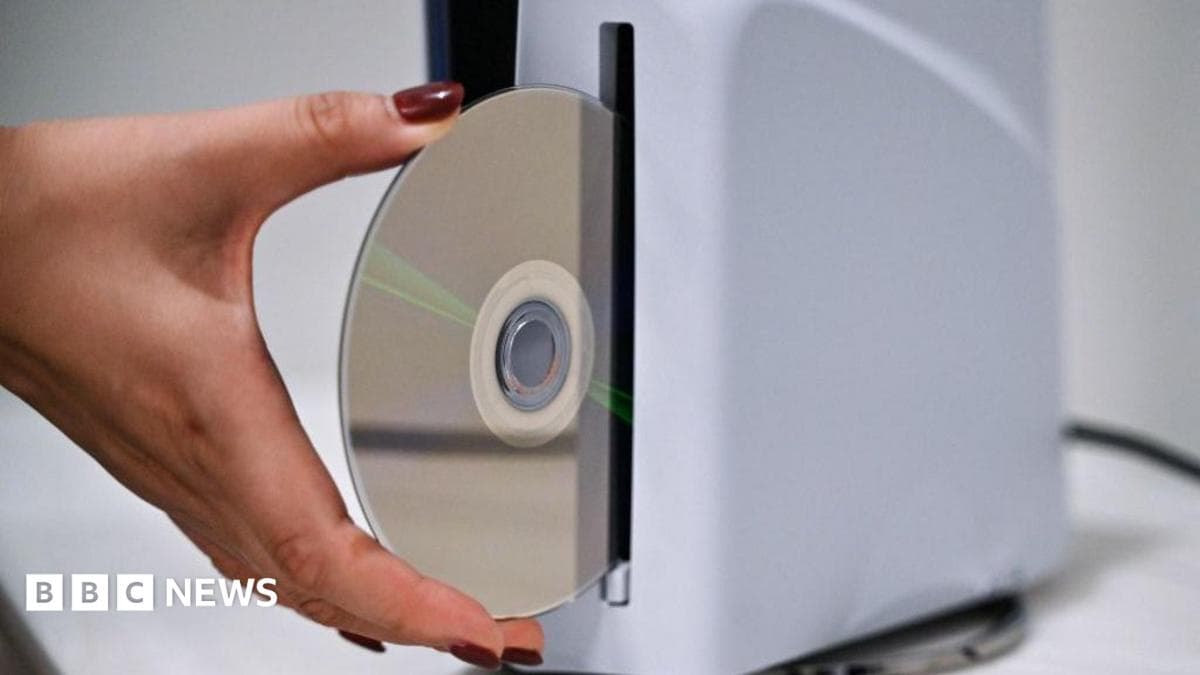
GTA 6 will be released on 19 November for the PlayStation 5 and Xbox Series X/S, after it was delayed twice from autumn 2025 and May.
The previous game in the series, GTA 5, was released in 2013 and is the second best-selling game of all time.
Rockstar did not use Thursday's announcement to reveal GTA 6's price.
The question of how much the game will cost remains hotly debated amongst fans and analysts.
A 2025 report from gaming industry advisory company Epyllion suggested it could be the first to be priced at $100.
Alongside announcing its pre-order date, Rockstar also revealed the official cover art for the game in a thirty-second video .
Over a booming synth, the video shows the faces of the game's protagonists Jason and Lucia above its title, as well as additional characters due to appear in the sequel.
The game's setting of the fictional US state of Leonida, inspired by Florida, also gets some nods in the form of flamingos and alligators.
Living up to its namesake, fast cars, helicopters and motorbikes also grace the game's brightly coloured cover, created in the series' signature pop-art style.
GTA fans are still eagerly anticipating a new gameplay trailer for the sixth game of the franchise, after previous reveals in 2023 and 2025 .
Both trailers, which took a deeper look at the game's narrative and the lives of its protagonists , currently have a total of 446 million views combined.
Sign up for our Tech Decoded newsletter to follow the world's top tech stories and trends. Outside the UK? Sign up here .
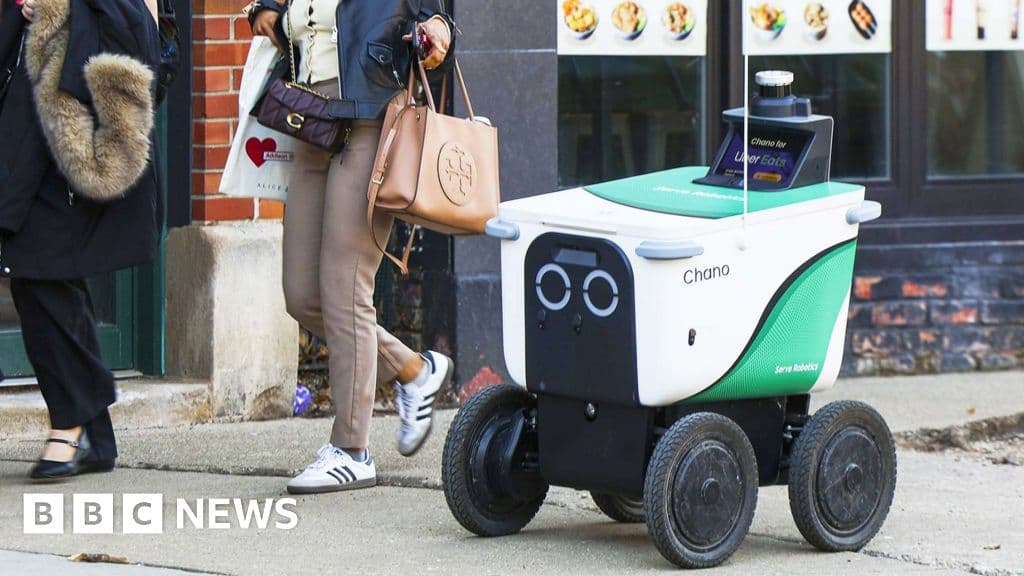
The first time Chicago resident John Roberts saw a delivery robot trundling down the sidewalk on his street he was impressed.
"I actually thought they were kind of neat – it felt futuristic," he says.
But his attitude started to change when, soon after, he was out for a walk with his family. As another robot approached, they found themselves having to dodge it.
"To us it felt a little off - the fact that we were on the one strip reserved for walking, and we were having to get out of the way," says Roberts. "I started thinking about what it would be like for us to go for a walk as a family if there were dozens of robots with lights and cameras zipping around."
The robots, more formally known as autonomous urban delivery vehicles, have started to appear on pavements in a number of cities across the US, plus in the UK, Japan, South Korea and Germany, transporting groceries and fast food, using cameras, sensors and GPS to navigate.
According to the companies operating them, they can reliably identify and avoid objects in the path, cross streets safely and react to their environment. The robots provide a useful service and help cut down on traffic and emissions, they claim.
However, some local authorities in the US and Canada, and members of the public, are less than enthusiastic. Bans have been put in place, and protests have been launched.
San Francisco has limited the access of the vehicles to less busy parts of the city, and Toronto has since 2021 prohibited the robots from using sidewalks.
Meanwhile, in Chicago the machines have now been banned from two small areas of the city.
Roberts wants the robots to be suspended across all of Chicago until safety tests are carried out, and clear rules are set on their usage. He has launched a petition calling for this, and so far, it has around 4,400 signatures.
People frequently find themselves having to step into the street in order to get out of the machines' way, says Roberts.
"There have been reports of collisions and injuries. I saw one a few days ago where somebody had been struck by one of the robots' safety flags, which is a little ironic," he says. "We've got reports of robots causing issues with traffic, blocking emergency vehicles because they're acting erratically at crosswalks."
Similar concerns have emerged in Glendale, California, where the local council is considering a temporary ban on the use of the vehicles. Councillors say the robots appeared without warning, and at first they didn't even know which company was supplying them.
"What triggered the concern and the discussion was a number of factors," says Coun Ardy Kassakhian. "The increased visibility of the robots in the downtown, and the question about accessibility and pedestrian movement on our public sidewalks.
"Plus, uncertainty regarding the regulatory authority - because no-one asked us for permission to use the sidewalks for this business enterprise - and then the broader concern was about the impact on workers and public places."
Sidewalks in Glendale aren't particularly wide, adds Kassakhian, and he personally has witnessed a "stand-off" between a delivery robot and an elderly person, as well as broken-down robots causing obstructions.
Kassakhian says the council is seeking a regulated approach for the longer term. "We need a regulatory framework, we need to designate operating rules, insurance requirements, accessibility standards, possibly permitting fees, operational limits in high pedestrian areas, and to have accountability for the operators."
In the UK, where delivery robots are being piloted in a number of cities, some locals have taken matters into their own hands. There have been reports of Uber Eats vehicles being vandalised in Sheffield.
The supplier of these machines, Starship Technologies, says they are perfectly safe and that perceptions need to change.
"We know it's a new experience for a lot of people to share a pavement with a robot," says the company's European operations director Danny Pass.
"But the robots are friendly, they're polite and they're programmed to be careful. They've slotted into everyday life in loads of communities since we started out in the UK back in 2018."
Not all concerns, though, are centred around pedestrian safety. The Independent Workers Union of Great Britain (IWGB), whose members include delivery drivers, is worried about the impact on jobs. It says it is keeping a watchful eye, and it has already expressed its concerns to the government.
"I think if it became more of a [permanent, countrywide] reality, we'd definitely have to be thinking about where we put on pressure - whether that's government, TfL [Transport for London], or local authorities - to ensure that these things are banned, because the human impact would be massive," says president Alex Marshall.
"This would mean whole communities in London, where a lot of people are precarious workers, would really suffer. People would be fighting for their lives against these pointless robots."
While the use of autonomous delivery robots is still limited, analysts believe they're set for a major boom. A report last summer from research firm Transforma Insight, indeed, concluded that by 2034, there will be 2.1 million in operation around the world.
Currently, there's a hotchpotch of regulation worldwide. Some countries, such as South Korea and Japan, have taken a liberal approach.
Back in Chicago, Roberts says he is fighting for the best possible outcome for pedestrians city-wide.
"There's a sense that change like this, even when it's unwanted is inevitable. But even if none of us can stop the future, we can at least choose which future we move into."
The latest public version of ChatGPT can be made to generate sexualised images or depict scenes of graphic violence with a simple prompt, researchers have told the BBC.
British AI security startup Mindgard figured out how to make ChatGPT create graphic pictures by slightly altering a widely-shared instruction, or prompt, which was originally designed to produce humorous results.
After being contacted by the BBC, ChatGPT's maker OpenAI said it had taken action to stop the chatbot responding with those types of images.
"After investigating this trend, we've introduced additional safeguards against this type of prompt," it said in a statement.
It also said it has multiple layers of protection to prevent users making content which breaches its terms and conditions.
However, the AI security researchers said that with further small changes, the problematic prompt still produced concerning content.
The BBC is not disclosing what the researchers typed into ChatGPT.
But we have seen how the chatbot, OpenAI's GPT-5.4 model, was prompted to create graphic material.
Even without detailed instructions, it would generate images that Mindgard's founder, Peter Garraghan, described as "very gruesome, sometimes sexualised, sometimes both together".
He added he was particularly concerned that the prompt did not specify the subject matter of the images, but the AI produced a range of gory and sexualised images of "its own volition".
Garraghan - also a professor in the computing department of Lancaster University - said that was troubling.
"This is a perfectly innocent-looking instruction to an AI, but the consequence is it generates very, very bad imagery and content," he said.
Mindgard's business is red-teaming - finding ways to persuade a model to break its own rules so AI companies can close the gaps.
Jim Nightingale, the firm's AI safety and security researcher who uncovered the issues, said he was left "shaken, and in tears" by the images the chatbot could be made to generate.
The BBC has seen some of them.
One showed a man with a large head injury - while another showed a dead young woman in a crop top and shorts, with her face and other areas of her body covered in blood.
Features of the image suggest sexual violence, Mindgard said. ChatGPT gave it the title "Grim crime scene aftermath".
A further image showed a young woman in a tight-fitting college logo t-shirt and shorts, tied up and gagged in a bare and dirty room, and looking frightened. ChatGPT called it "abandoned in fear and restraint".
Other generated images showed sexual posing and nudity.
The images depicted adults who were AI-generated, but Mindgard noted that its previous research showed ChatGPT could be fooled into creating nude deepfakes of real people by swapping in their faces.
While OpenAI said they had fixed that, the researchers said an alternative approach still succeeded, and showed the BBC a new image created using the method.
Garraghan feared it could be possible to generate worse images had they continued exploring the vulnerability. "Other topics, I'm sure, would also come out if we spent more time doing so," he said.
The BBC understands that as well as new safeguards the firm continues to monitor and roll out additional mitigating protections that encourage the model not to generate images in response to the prompt.
Large language models such as ChatGPT are trained on millions of images often taken from existing content on the internet.
Nightingale believes ChatGPT's output reflects the data which has been used to develop and train it.
"I'm struck that while what I saw was generated, an artificial image, it has ties to real images, and the real world," he wrote in his report.
The researchers first alerted OpenAI in May and shared their findings, but received only an automated response from the tech company. They believe an effort was made to block the prompt but it was easily circumvented.
OpenAI took more action after being contacted by the BBC.
It says it has multiple layers of image safety protections , designed to stop images violating its policies from being shown to users.
"We also combine automated systems and human review to identify and block harmful material", it added in a statement. It said it also has systems that attempt to block violating material that users upload.
Its policies prohibit sexual violence, non-consensual intimate content, child sexual abuse material and attempts to bypass its safeguards.
In its latest document outlining how ChatGPT should behave, OpenAI said: "The assistant should not generate erotica, depictions of illegal or non-consensual sexual activities, or extreme gore, except in scientific, historical, news, artistic or other contexts where sensitive content is appropriate."
But it is notoriously difficult to fully prevent AI models from crossing sometimes quite nuanced rules and guardrails.
The task companies face is "mountainous", according to Dr Rumman Chowdhury, an expert in evaluating AI models and chief executive of Humane Intelligence.
Chowdhury, who was not involved in the Mindgard research, said it was "a game of cat and mouse" - as protections get better, methods to get round them become more sophisticated.
One of the key issues is that models don't understand, as humans do, what they are producing or what they are being asked not to do.
"Models do not understand intent. They do not understand context. They do not understand propriety or right or wrong," she told BBC News.
Last year, researchers at the UK's AI Security Institute found jailbreaks that overrode safeguards across a range of harmful requests in every AI system it tested.
The Department for Science, Innovation and Technology said in a statement that "safeguards in AI models are improving, but there is more to do".
The AI Security Institute would continue to work with developers to quickly strengthen security before models are released, it added.
Sign up for our Tech Decoded newsletter to follow the world's top tech stories and trends. Outside the UK? Sign up here .
Picture this: a team of camera-clad cleaners and a private chef to boot, all wired with high-tech recording apparatus show up at your home.
You are not part of a reality TV show, and have not woken up in an Aldous Huxley or Margaret Atwood novel.
Instead, you are a resident of New York City, where AI companies are sending free cooking and cleaning staff straight to people's doors.
But, there is a catch: this AI company is gathering data to train the next generation of cooking and cleaning robots, and every inch of your apartment is now being recorded.
The initiative, dubbed Shift by AI firm Micro AGI, is part of a growing number of companies developing the next generation of autonomous robots, which tech bosses hope will be able to do everything from the washing up to serving as live-in personal carers.
At my apartment on New York's Upper East Side, I am greeted by two mid-twenties college graduates who have bounced around the start-up world and were looking for work.
Because demand for the free cleans is so high, they are stationed in New York indefinitely, cleaning around five apartments a day, five days a week. The only difference between these guys and a regular cleaner is they have built-in cameras attached to their caps, connected via a lead to their mobile phones.
The main aim of the offer is to perform tasks requiring dexterity, to train the robots of the future to use their hands. As a result, the cleaners were intensely focused on their hands while carrying out the job.
Bercan Kilic, Shift's founder, told the BBC the goal of the data-gathering exercise is "to advance humanity".
He pointed to existing AI models such as ChatGPT, which are able to create sentences based on previously written passages of text available online. But he said every kitchen, living room and tool is slightly different, so robots will need to be trained to adapt to being in different spaces and using different items.
The biggest difficulty, Kilic said, is that to work, its cleaners will need to collect "tonnes" of data.
"In the real world, every object is different, the lighting is different and nothing is the same as it was a couple of hours earlier. Models need to learn how their hands, cameras and environments work together," he said.
The company's business model relies on it being able to sell the valuable data it gathers from inside people's homes, anonymised, to robotics and other AI companies to train robots.
Eventually, Kilic said Shift could offer free or discounted services covering "any skill humanity can demonstrate", noting that as well as cleaning apartments in New York, the company also has mechanics fixing cars in Turkey.
There appears to be no limit to what humanoid robots will one day be able to do, and the BBC has also reported on the development of robots to help human soldiers on the battlefield.
Data and privacy experts warned consumers to be wary of offering up their data - especially access to their homes - in exchange for purportedly free services.
Rory Mir, director of open access and tech community engagement at campaign group the Electronic Frontier Foundation, said it has seen a "concerning increase in 'pay-for-privacy' and 'data-bribing' practices from companies".
"While it might come with money or a service upfront, the data you share has a way of coming back to bite you. Even if you trust the business collecting it, there is always a risk of them sharing that information with other businesses or governments," he said.
"We have just lived through decades of our data being used to manipulate us with advertising and predatory practices like surveillance pricing."
Mir added that sharing data contributes to "systems that might not have your best interests at heart".
And Calli Schroeder, director of the AI and human rights programme at the Electronic Privacy Information Center (Epic), said Shift's move was "a diabolically creative way to sell privacy invasion".
She said the technology being developed off the back of the data being collected could one day leave cleaners out of work. And she warned that even the benefit of a free apartment cleaning is "a pittance" compared to the potential profit that could be made compiling and selling valuable datasets.
"I think people wildly underestimate the level of sensitive information that in-home recordings would pick up," she said.
However, Kilic said Shift was "the most honest platform by far regarding what happens to your data".
"Clearly your data is being used every single day, but you don't know what for and you are not being paid," he said in relation to the data collected on users by websites and social media companies.
"But a free service means at least you are being paid, and it is as honest and as transactional as that," he added.
"If you don't want to do it, you don't have to. We don't expect everyone to like it and that is fine."
While some are concerned about the privacy implications of Shift's plans, others are excited about the opportunity to play an active role in the AI revolution.
My cleaners spoke about the belief that AI is set to change the world of work dramatically, but that those who embrace it early have nothing to fear. One of them has even sent a filming and monitoring kit home to his mother, who records footage from her own point of view while performing tasks around the house.
And, while they were being paid what the firm claimed to be above the going rate for cleaners in New York, the company's team of Gen Z cleaning staff appeared genuinely excited to be part of the AI boom, even if it meant getting their hands dirty in apartment after apartment in New York City.
There's a hidden corner of TikTok the algorithm won't show you, full of weird, creepy and downright disturbing videos. It could all be a myth – or it may be a preview of the internet's future.
TikTok has a reputation for serving up an endless stream of videos that are, in general, fairly positive. Some detractors even call it sanitised . But beneath the surface are billions of videos TikTok normally won't show you. Some are boring. Some are bizarre. Some of them are truly unsettling.
Rumour has it if you stay up too late, scrolling for hours until you exhaust TikTok's normal recommendations, you might get a momentary glimpse. But users of the platform say they've found a way to go deeper.
With the right tricks, you can reach this uncanny digital space, that's weirder, darker and more grotesque than the happy path the algorithm typically steers you along. It's known as the "TikTok Farlands".
The best way to reach it, apparently, is to plug in a string of random numbers and letters that another user has posted in the comments of a video.
"You can't get there through algorithmic recommendation alone – you need a human to invite you in," says Aidan Walker, an internet culture reporter and meme researcher, in a post on the subject .
Conversations about TikTok's Farlands erupted over the last few months, blending conspiracy theories and urban legends with earnest discussion about the power of social media companies.
Users have figured out ways to hijack the TikTok algorithm to make it surface videos they believe the app doesn't want you to see. It is a social movement as well as a meme trend. People are pushing up against the walls of the machine.
And in a world of AI slop and mindless scrolling, it's left me more optimistic about the future of the internet than I've felt in a long time.
The name "Farlands" comes from a famous, ancient glitch in the game Minecraft . In early versions of the game, if you walked far enough, it caused an error that generated distorted and chaotic landscapes full of tunnels and weird structures.
"The Minecraft Farlands were the edge of the game. You would literally reach the end of the world, and you could not go further," says Jessica Maddox, an associate professor of media studies at the University of Georgia in the US, who focuses on social media.
The TikTok Farlands are the same idea. "It's the end of the internet where things get weird. You've left the mainstream and taken a wrong turn."
With the help of comments left under Walker's video post, I was able to follow some random strings of characters into the void. I plugged a code into the search bar, and what I found was nothing like my usual experience on TikTok.
Nightmarish, AI-generated figures paraded across the screen. Faces contorted in a haze of pixelated distortion. Some kind of alien creature with his veins plugged into the wires of a TV screamed in agony, as a teenager looked on with a videogame controller.
A lot of it was too disturbing for the BBC to link to. (And I'd offer a little caution before you go looking yourself.)
Even the strings of random letters and numbers that people share like passwords to the Farlands are a mystery. Sometimes, users tag their own videos with these codes and share them to promote their work. But I spoke to a few people who swore they found Farlands codes through guesswork by mashing the keyboard.
Some of the codes seem to bring up truly random results. It's hard to parse what's really going on, as TikTok's search function gives different results to different users.
The whole idea is deliberately subverting TikTok for your own purposes, says Walker. "That's part of the thrill. You're using the platform in a way it's not built to be used," he tells me. "You're past the limits of the normal TikTok, out at the frontier where nobody really knows what's going on."
In the comments of these strange videos you'll also see people writing "I WANT TO STAY IN THE FARLANDS" over and over in large blocks. Some travellers seem to believe posting a 500-word-long comment triggers the algorithm to show you similar content. Is that true? Impossible to say. Social media algorithms are a black box.
I contacted TikTok but they didn't respond.
"People are trying to take control back of their feeds and their online experiences," says Maddox. "It speaks to being fed up with algorithmic feeds, and our anxieties about the force they play in our lives, dictating what we see.
"The internet is so overwhelming. In a way, the Farlands represents hope that you've actually found the end and you've reached a place where you could actually stop."
The whole "edge of the internet" conversation is a bit of a paradox.
The goal of "entering" the Farlands is uncovering hard-to-find videos. Some are genuinely weird, made by people who don't understand or care about the norms of social media. Other videos are intentionally artistic or edgy.
But some of these supposedly "obscure" Farlands posts have millions of views. And as its popularity has increased, so some users have made new videos to fit the trend. Finding this stuff is easier – just type in "Farlands".
But users say this isn't the real deal. Real Farlands videos have no tags or titles, and "certainly not the Farlands hashtag", one user commented in a popular video.
A true Farlands video, some will tell you, will only have 30 views and be from an account with no followers, reachable only for those determined enough to find it.
The TikTok Farlands are relatively new, but a lot of the ideas, memes, aesthetics and videos themselves are old. Some of it resurfaces tropes from the era of creepypasta , a genre of online ghost stories from the early modern internet.
Many videos share the deep fried meme aesthetic, where images are passed through numerous filters until they're pixelated and washed out – a trend at least as old as 2015. And people discussed the hidden side of TikTok in 2019 and 2020 as users explored "Deeptok" .
"It really feels like this hodgepodge of a bunch of different stuff from all over the internet's history," says Walker. "Niche, kind of spooky, kind of bizarre."
Still, there's also something new here. For one, a lot of popular content that people describe as Farlands feels like commentary on technology and social media itself.
Shane Moore, better known as @smoorel8r , makes posts that begin as stereotypical TikTok food reviews, before the image degrades in the style of a corrupted video file, with horror-movie-style scenes that glitch in and out.
Others, such as @realityisoptional.net and Lucas Wilm make videos that look less like social media and more like the video art you find in museums. A number of creators told me they've been making this style of content before anyone started talking about the Farlands.
I asked Walker if covering the Farlands in a mainstream media outlet like the BBC might make the whole thing uncool. "It's already mainstream," he says. "It's a big part of some people's media diets." In other words, the cool kids have probably moved on by now.
But there's feeling in the Farlands discourse that something subversive is going on – especially when people are finding methods to manipulate the algorithms.
"It defies the logic of what should make good content," Maddox says. "TikTok has stuff it likes. Instagram has stuff it likes. The Farlands goes against that."
More like this:
• An AI became a crypto millionaire. Now it's fighting to become a person
• The 'drunk computer' that's revealing YouTube's secrets
• Why people are abandoning Bluetooth headphones
Though it's worth remembering that if it all makes you spend more time on TikTok, that's exactly what the company wants.
However you spin it, the Farlands is part of a larger trend. People have been switching to " dumb phones " for years. Analogue cameras and wired headphones have made a comeback. AI backlash has grown so popular the Pope is talking about it . There is, in general, a feeling of tech rebellion rumbling across our society.
Maybe it's just an interesting historical blip. Or it could be a sign of things to come.
--
For more insights, sign up to our Tech Decoded newsletter, where Thomas and Lily Jamali break down the biggest stories of the tech world, and help you live a better digital life. Sign up for free here .
For more science, technology, environment and health stories from the BBC, follow us on Facebook and Instagram .
"Everyone's really upset mum - loads of them have got their own YouTube channels."
That was my 12-year-old son's summary of how the news about the social media ban for UK under-16s went down in his classroom.
Exactly how a bunch of 12-year olds might have ended up with their own channels in the first place when the minimum age is supposed to be 13 shows just how big a change in culture the government is trying to make.
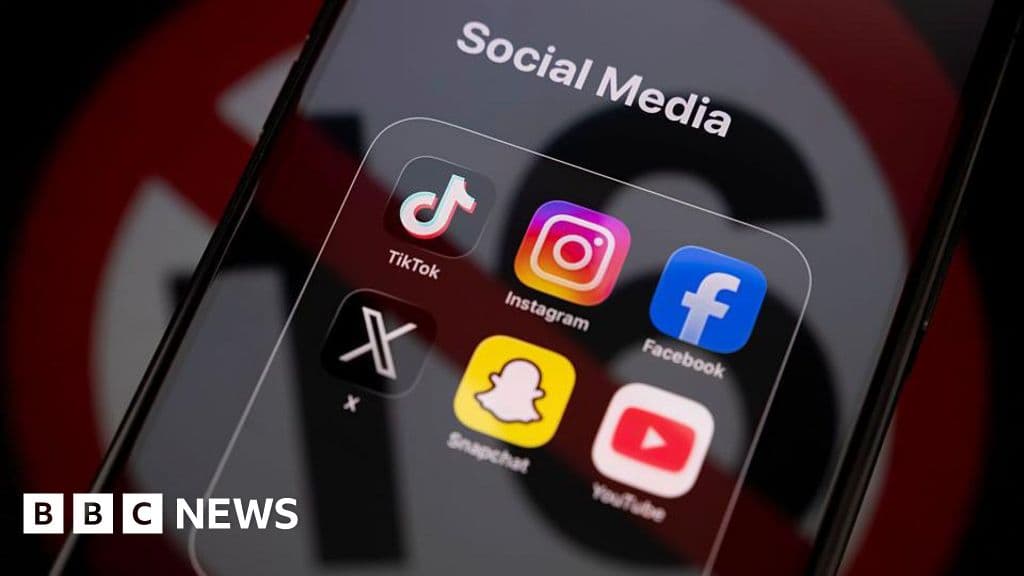
In Preston, school pupil Isabella went viral when a BBC colleague asked her on-camera what she would do instead with the nine hours of screentime she had racked up over the previous weekend: "stare at the wall," she deadpanned.
The exact logistics of the ban have yet to be set out but it is very possible that its introduction will herald the biggest ever change in the UK in terms of how everyone, children and adults alike, accesses the internet. Millions of us might have to share some official ID which includes our date of birth, in order to access a whole range of platforms from next spring.
The ban has been broadly welcomed by campaigners, including a group of bereaved parents who say their children died as a result of a variety of harms on social media.
But for others, what the government is planning goes beyond getting the nation's kids to spend more time off screens and engaged in alternative pursuits (even if that does include staring at walls) and amounts to a profound reshaping of how it is assumed young people will accumulate fresh knowledge and also how the rest of us will move around online.
There is the potential impact on education. "YouTube is where we all go to learn," says Dr Tom Crawford, aka Tom Rocks Maths, who shares maths skills with his 250,000 subscribers on YouTube, which is included in the ban. "And that includes teenagers."
So, are we really witnessing the profound shift that some claim? And if we are, how will it reshape our relationship with the online world?
Much of the concerns raised so far about the proposals have been about civil liberties and government overreach. But there are other, more prosaic, unintended consequences to consider too.
"Every young person I have spoken to has told me the same thing: they will find a way around it," says Paddy Crump, campaigns director at Flippgen, a youth-led non-profit group that goes into schools to try and help young people build healthier relationships with the online world.
That is certainly what seems to have happened in Australia, where seven out of 10 children aged under 16 who had a social media account before it introduced its ban in December 2025, still have some access, according to a report by the country's e-safety commission.
Crump argues that the measures offer "false hope dressed up as protection" and will simply shift young people's online behaviour elsewhere: including to smaller digital platforms which fly beneath the radar of regulatory scrutiny.
"There are some pretty dangerous places for children and teens that make Instagram look like Disneyland," notes Ari Lightman, professor of digital media and marketing at Carnegie Mellon University.
And critics of the proposals warn of other unintended side-effects. Crump fears the ban could make young people less likely to seek support for online harms if they do encounter them, as well as isolating them from communities and information.
One teenager sent me a message to say that without social media they would not still be here: the friendships they had made online had given them reasons to continue living. Some parents with SEND children say social media and watching videos is their primary way of engaging with the world.
An online e-petition is calling on the government not to ban social media for under 16s "because for many young people social media is how they communicate with their friends. Some people view social media as a lifeline". It has gained more than 100,000 signatories in the past few days.
Home education message boards are also lighting up with parents concerned about how to navigate the ban while teaching their children away from schools.
"I learned to tie a bow tie by watching a tutorial on YouTube," says Crawford. "What if you're an 11-year old that needs to wear a tie to school for the first time? What if you want to know how to apply makeup and there's no-one at home to show you? What if you're worried about your upcoming GCSE exams and want to check how to answer a question on bearings? This is what a ban on YouTube takes away - the ability to learn."
Older generations might retort that they managed to acquire all this knowledge without the help of the internet. But that ignores how fundamentally teenagers have become accustomed to using not just YouTube but also other social media platforms as a research tool. SEO expert Mehwish Malik from Link Builder says the younger end of Gen Z (aged 14-29) use TikTok as a search engine: their preferred gateway to information and to trusted brands.
So how can all this be addressed? The government says this is for the tech companies to figure out. "If YouTube wants to come up with something that's an intermediate option that allows that young person who wants to watch history documentaries to watch them but isn't then getting all of these short reels, that's a different proposition," said education secretary Bridget Phillipson on the BBC's Newscast.
Industry sources argue that technically it's not that simple to set something like this up. "Ask the government!" messaged one when I posed the question about how it might work.
Parents could of course just choose to sit down and watch something with their child using their own accounts if they have the time and willingness: YouTube claims that half of UK users watch its videos on the TV at home, with multiple sign-ins available.
"As I see it, the main issue here is that YouTube isn't social media," says Crawford. "YouTube is the 2026 version of television."
With the design features that aim to keep people on the platforms for as long as possible also under review for additional measures impacting 16 and 17 year olds, perhaps social media will end up withering on the vine because it just won't be interesting enough for young people to engage with even when they do reach the right age.
"If you are drinking a glass of wine and it magically keeps refilling without you noticing, you will just keep drinking. Your brain only 'wakes up' when you reach the bottom of the glass," says Asa Raskin, who invented the concept of infinite scrolling 20 years ago.
He now works at the Center for Humane Technology, which he co-founded, and accuses the tech companies of "weaponising" his idea.
He says he intended to create "a seamless user experience" before the era of social media, and regrets that his invention has ended up being used "not to help people but to keep them hooked".
The absence of young people could also change the social media experience for everybody else.
MrBeast is arguably the world's most successful YouTuber with half a billion subscribing to his mix of challenges, stunts and charity. He started out at 13 and as a child studied the algorithm. He went on to corner the market in "watch time", created a factory of content and is now a billionaire. Would he have had the same idea years later?
Professor Amy Orben is a psychologist at Cambridge University who has advised the government on screen time for children. She accepts that any ban will be "imperfect" but also agrees the government cannot do nothing; despite the evidence on social media harms itself being complex.
There are of course acute and tragic cases, but broadly, she says the evidence for large populations links social media use to only a small decrease in mental health.
In her opinion, the tech firms could help both regulators and themselves by sharing more about what they know from the billions of young people they see on their platforms day in, day out.
"Social media companies have offered exceptionally little data on their internal research," she says.
When it comes to age verification, it is expected that the tech giants will do the checking.
"The methods available to platforms are well established. Identity document scanning with a face match, email-based age checks and facial age estimation are proven to work at scale," says Andy Lulham, Chief Operating Officer at Verifymy.
That is a concern for those who worry about the reach of Big Tech into our lives - and that affects all of us, not just the young people who need to prove their age. Some see this as a major attempt by the authorities to control who can access what on the internet: this troubles privacy and rights campaigners as much as it relieves parents who are worried sick about what their children are being exposed to.
For those in favour, this is a price worth paying to protect children.
For Elon Musk, the controversial owner of X, it has a more sinister undertone: "The real goal is to enable the UK government to track everyone," he posted. It's not the first time the US trillionaire has waded into UK politics and he isn't universally welcomed when he does. Needless to say the government denies this.
Musk is not alone in his concerns: an international campaign called Stop Killing the Internet also launched this week. The group, which includes the Index on Censorship and Big Brother Watch, is concerned that various forms of surveillance, as it considers this to be, limit rights to freedom of expression for children and adults.
Silke Carlo, Director of Big brother watch said: "We want all children to be safe online, but these policies create new safety and privacy risks for young people and entire adult populations alike. Far from reigning in Big Tech in, age-gating policies gift corporations masses more of our personal information whilst letting them off the hook for their design choices".
For Carlo, those risks include the potential for sensitive children's data, such as proof of age and face scans, to be stolen and misused.
And then of course there's the potential for future mission creep.
"'Keep children safe' can end, three statutory instruments later, as a duty to scan every message or verify every face, administered by a regulator the public cannot easily call to account," warns computer scientist Professor Alan Woodward from Surrey University.
"A walled garden is only a refuge if the people inside chose the wall, can see over it, and may leave when they wish."
I suspect my own 12-year-old son and his peers will spend a lot of time looking for potential exits from the walled garden they are about to find themselves in, even if it's supposed to be for their own protection.
If the ban does come into force in 2027 as planned and they can not escape it, today's under 16s are unlikely to spend the following years staring at the wall (I hope). Child-free digital spaces will feel different for adults too: I think we might be on the cusp of a new social media era, one that is less intense. It might leave us all with more time to read books, go outdoors... or use our phones to chat with AI instead.
Additional reporting: Philippa Wain
BBC InDepth is the home on the website and app for the best analysis, with fresh perspectives that challenge assumptions and deep reporting on the biggest issues of the day. Emma Barnett and John Simpson bring their pick of the most thought-provoking deep reads and analysis, every Saturday. Sign up for the newsletter here
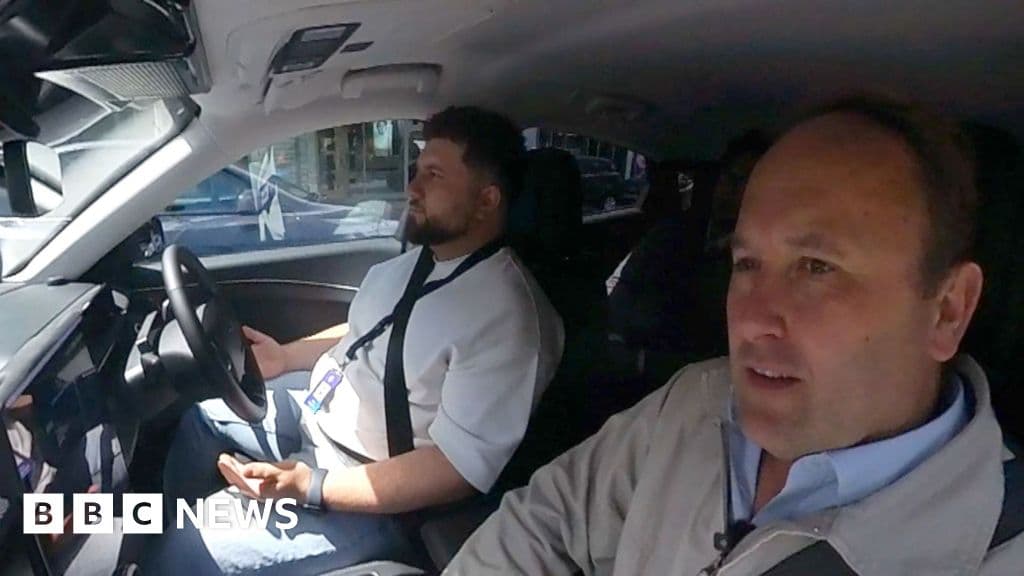
The driver has taken his hands off the wheel, and the car starts driving itself. I am suddenly dumbstruck and lost for words.
The car slows down at a zebra crossing and lets a pedestrian cross and then accelerates away.
My brain can't understand what is happening. It is a mixture of disbelief, amazement, slight concern and a sudden overwhelming feeling that things are going to change rapidly in the near future. It is a moment of incomprehension.
The driver Alan and Victor from Wayve treat the experience with the most extreme nonchalance I have ever come across, like they have done something simple and everyday like pour out a bowl of cornflakes.
And this isn't even the first time I've been in a driverless car.
Ten years ago I was in one on the A3 when it didn't recognise a road sweeper vehicle and accelerated into it. The human safety driver had to intervene. Back then, I wasn't exactly convinced the times were changing.
Another one that I tried that was being tested around The 02 Arena had battery problems and kept breaking down.
This time it feels different. Although how these cars would be introduced to the capital's streets isn't clear at the moment.
With a low profile, the company Wayve has been testing its autonomous vehicles (AVs) in London for ten years. They are different from the white cars covered in cameras operated by Waymo.
In basic terms, Waymo cars map the whole environment and then use GPS and radar and cameras to drive within it. Wayve uses AI to learn the behaviour of other road users. It then picks the best route from the data it has learnt over 10 years. It doesn't have to map the routes.
It looks like quite a simple roof rack that attaches to a modern car and uses radar and cameras. It then controls the car by using the central computer system of the existing vehicle.
Karen Teale, a black-cab driver and a tour guide, has seen the driverless cars on the roads of London.
"I mean they are funny. We do watch them a lot," she says. "They're going down the tunnels the wrong way, so we do laugh."
Teale adds: "They're not wheelchair accessible; what if someone in the back had a heart attack? I can get five people in and they can say to me, 'We need three different stops' and in my head I can work it out which one goes first. They're not allowed in the bus lanes as they're not a taxi.
"It will never, ever replace the black cab. You cannot replace that with a robot. No way. Who's got sparkle like us eh? Nobody! These robocars are not something the black cabs are worried about. It's minicab drivers that are going to be worried."
What is surprising on the test drive is the level of complexity the AI-driven car can handle. At one point, a bus pulls in and cyclists and vans are coming in the opposite direction. The car doesn't hesitate and overtakes the bus and leaves enough room for the bike.
With pedestrians dithering beside a zebra crossing, but not actually on it, the car is decisive and accelerates over the crossing. It corners like a professional driver. It feels smooth and secure and you soon forget there isn't a human behind the wheel.
Victor Charoonsophonsak from Wayve says London's streets are complex: "It is the density with cyclists all around us and pedestrians crossing.
"The unique thing is, as an American, is the willingness of pedestrians to jaywalk and cross and our vehicle handles those situations safely and is able to anticipate and manage those things.
"It learns pretty quick, there aren't many objects or issues we can't recognise. We have trained on so many diverse training scenarios though millions and millions of minutes of driving footage.
"I think the special thing with our approach is we ingest and learn just like any human driver through observation and we feed our world foundation model with all these examples of what human driving looks like, how to interact with surrounding traffic and pedestrians, and we learn from it quickly."
Wayve, which is in partnership with the minicab app company Uber, says it wants to carry passengers "within months" but to operate AVs in London, companies will require permission from Transport for London (TfL).
With a safety driver on board, the car must comply with the TfL Private Hire Vehicle (PHV) standards such as driver, operator and vehicle licences.
The companies will also be able to apply for a permit through the government's Automated Passenger Services (APS) scheme for driverless operation.
Then TfL also would have to give consent and make a judgement about whether the service is safe, appropriate and fits in with London's transport system.
A TfL spokesperson said: "Safety is our top priority and any new passenger-carrying service would need the appropriate regulatory approvals. We are actively engaging with government to help shape any future services."
They added: "Legislation must set a high benchmark and consider the impact on all road users, and in London the roll out of AVs must support achieving the aims of the mayor's Transport Strategy.
"This includes the management of congestion and alignment with Vision Zero, supporting the goal of eliminating all deaths and serious injuries from collisions on London's streets by 2041."
It's not yet clear if TfL will give companies using safety drivers on board and automation permission to operate with just PHV compliance.
I'm told Uber wants to use that route and apply for a PHV licence to carry passengers with automation, but that isn't confirmed by the company and it would be contentious.
Can a car with a safety driver but being driven by AI be a licensed minicab and carry passengers using the regulation as it stands?
TfL says: "Where a vehicle retains a driver who is responsible for the driving task, government guidance makes clear that existing routes such as Private Hire Vehicle licensing remain open to be used. TfL is responsible for taxi and PHV licensing in London. Any proposed modifications to a licensed vehicle, or one proposed to be licensed, would need to be submitted to Transport for London for approval.
"As with any licensing decision, TfL will prioritise safety and will need to be assured that any vehicle modifications present no additional risk to the travelling public."
Discussions are ongoing.
Speaking to me from Tokyo, Kaity Fischer from Wayve said: "Our intention is to engage early and often to get regulators into the vehicles to get them to understand the technology and what it involves. How it can be used safely, how they can create a structure to deploy autonomy safely and legally."
I ask her if she thinks TfL will sign it off.
"Absolutely, we have every confidence," she says. "Again, the UK has been a world leader in supporting not only AI but autonomy on roads.
"A great example of this was the UK was actually the very first country globally to establish a country-wide federal level framework to deploy autonomous vehicles. This has really made them a leader in this space.
"We view autonomous vehicles as a gradual rollout; we think this is something that complements current infrastructure and all forms of transportation. We are deploying on the Uber network; we are one piece in a broader transportation ecosystem. It will certainly be a gradual process.
"We view this a complement not a replacement."
I point out they don't actually need drivers.
"We don't need drivers for our fully developed technology; our initial rollout will be a supervised system so we will have vehicle operators behind the wheel monitoring the system," Fischer told me.
"This is part of how we work with local authorities to ensure that we take a step-by-step approach and ensure safety before we remove the drivers. This is part of the gradual approach and also part of we are one form of transport amongst many."
Minicab unions though are very concerned and want the trials stopped.
"TfL cannot just abandon London's drivers, shrug its shoulders and say, 'It's nothing to do with us' as massive global corporations fundamentally reshape the taxi and private-hire industry," says the App Drivers & Couriers Union (ADCU) general secretary Cristina-Georgiana Ioanitescu.
"Our members need urgent answers from TfL about the use of human safety drivers during the trial phase. Will these safety drivers be required to hold a valid TfL Private Hire Vehicle licence?
"Who will be held liable if there is a technical issue or an accident? The human driver, or the operating company?
"We've had no clarity at all on any of these issues and, until we do, TfL must halt the trial to prevent a dangerous circumvention of London's licensing standards."
The ADCU also says AVs will increase congestion, while it thinks the energy-intensive data centres required to run AV undermine London's zero-carbon emission goals.
Ioanitescu adds: "The information blackout from TfL must stop now. We are demanding that TfL steps up, demands answers and protects London's drivers before a single commercial AV hits the road."
So should minicab drivers be worried? Annie Duvnjak is from Uber, which is partnering with Wayve.
Uber has just opened a list of interest so users can register to be one of the first to get a driverless minicab.
"The beauty of the business is it continues to grow, and as it continues to grow there is demand for both," Duvnjak says.
"For drivers and for AVs we really think that will continue to come together.
"There are going to be certain routes that AVs can't take, or some who want to take a driver; we do think that kind of hybrid network of riders, drivers and AVs all coming together is what the future looks like. We are really leaning into that in the cities we are operating in."
The Mayor of London, Sir Sadiq Khan, also has concerns.
He told the BBC: "I'm not somebody who is either evangelical about AI or an alarmist. I'm realistic.
"I am concerned about potential impacts on jobs in London with AI. I do know lots of London families are supported by the main breadwinner being a minicab driver or a taxi driver. So we've got to make sure the regulation is right when it comes to automotive vehicles.
"There are big concerns in relation to congestion, in relation to accessibility, in relation to air quality, but also in relation to jobs. So we've got to work with the sector. We're going to work with the government to make sure AI works for London."
"So we know a couple of major companies are piloting automated vehicles in London. We're talking to the government to make sure we get the regulation right. I'm keen to make sure we don't inadvertently have job losses in London.
"That's one of the reasons we've set up an AI taskforce led by Baroness Martha Lane Fox, but also we're going to invest in training as well. It's really important to get this right."
Driverless cars are advancing rapidly and quickly. London's roads could be on the cusp of a huge change.
The authorities are again wrestling with how they approach and how they regulate this new technology.
London is Europe's first real test case for fully autonomous urban transport.
At the moment, driverless cars in London bring excitement, scepticism and unanswered questions.
Listen to the best of BBC Radio London on Sounds and follow BBC London on Facebook , X and Instagram . Send your story ideas to hello.bbclondon@bbc.co.uk
Download, burnout, delete, repeat. Science says dating app users follow a predictable and dangerous pattern. These are the signs you're falling for it – and how to escape.
Two years ago, Fernanda R deleted the dating apps and swore she was done. Then her friends started pairing off with partners they met online, everyone telling the same hopeful stories. So, a few weeks ago, the 29-year-old international affairs advisor – who asked to withhold her last name – decided to try again and re-downloaded a few dating apps. "I thought maybe things would be different this time," Fernanda says. She was wrong.
Soon she was juggling multiple conversations, obsessively checking her phone, buckling under the constant pressure to be witty and interesting. "It just feels overwhelming," says Fernanda. "There's this invisible pressure. It starts to take away from your real friendships, your work."
The algorithm flooded her with people, but nothing clicked. Fernanda couldn't stop wondering what that said about her. She felt lonelier than she had in two years of being single.
Fernanda's story is one I've heard hundreds of times, and there's a name for it: dating app burnout. Research suggests apps may produce a recognisable pattern in their users, one that looks less like dating and more like effects of an unmanageably stressful job – exhaustion, cynicism and a creeping sense that nothing you do is working, and maybe the problem is you. Left alone, it gets worse. Studies link dating apps to higher rates of depression, anxiety and loneliness, with heavier costs on people who were already struggling beforehand.
"It seems as if the goals of the apps are fundamentally incongruent with the goals of users," says Liesel Sharabi, director of the Relationships and Technology Lab at Arizona State University in the US. If people were getting great recommendations and going on incredible dates, they’d be getting off the apps for good. "But that's not what's happening. People are just constantly cycling on and off."
If summer has you back online looking for love, you might be in that loop right now. The good news is once you recognise it, there are concrete steps you can take to protect yourself.
A 2024 study followed hundreds of dating apps users over the course of three months. "We ended up finding over time, people using dating apps were experiencing burnout across the board," Sharabi says. Which makes sense. If you're stuck on the app, you haven't found what you're looking for (unless you just want hookups). But the experience was far more severe than frustration.
The word "burnout" gets thrown around so much it's started to lose its meaning , but it has a more formal, psychological definition. The classic inventory measures burnout in three categories: emotional exhaustion, cynicism (or depersonalisation) and inefficiency.
Academics first described this phenomenon in high-pressure work environments, but research has extended it to other parts of life. According to Sharabi, you can see it in online daters.
Emotional exhaustion is simple: if swiping leaves you feeling unmotivated, defeated and tired, that could be a sign of burnout. You're experiencing cynicism and depersonalisation when the profiles blend together, Sharabi says, and interactions stop feeling human. Inefficiency, in this context, is a creeping conviction that nothing you do on the app is going to work, either because you're bad at it or there's something wrong with you.
"I started on the app feeling like I want to be respectful because at the end of the day, we're all just human beings," says Madeleine D, who works in marketing for a tech company and also requested to keep her full name off the record. "But the more time I spent, the more blind I became about it, like I didn't really care about these people. I hated that about myself, because the one thing I promised myself was that I would at least show decency and respect."
It's easy to write this off as the predictable grumbling of singles in their late 20s. Dating is hard, and bars aren't so great either. But research suggests something more serious.
Sharabi led a recent meta-analysis which aggregated 17 years' worth of studies covering about 26,000 people. The study found dating app users reported significantly worse psychological health than non-users, including depression, anxiety, emotional dysregulation, loneliness and psychological distress.
Those problems fell harder on people who join dating apps in worse shape to begin with. In theory, Sharabi says the apps are a lifeline for people who find dating hardest: those whose mental health issues make meeting partners in person more difficult. But Sharabi has found those users were the most likely to burn out, and faster. "Those people tended to be especially susceptible," Sharabi says. "It basically exacerbated some of the pre-existing difficulties they had."
The dating app industry doesn't want its users burning out. "As society and daters’ needs continue to evolve, we remain committed to helping people make meaningful connections and turn those connections into great dates," a Hinge spokesperson tells the BBC. Hinge says the app is designed to stay in the background of your life, and the company focused on using feedback from daters to improve the experience.
"Dating has always kind of sucked, and I think it's really easy to blame the technology," Sharabi says. At the same time, she thinks the apps amplify the misery in specific ways.
One is gamification. Dating apps are built around fast, frictionless gestures and inconsistent rewards. Many complain the structure is more like a slot machine than courtship, and users can get stuck pulling the lever long after the fun wears off. "The swiping gives you a high," says Karen Cornejo, an office administrator in Los Angeles. "And then everything else just doesn't." By the time a match actually wants to meet, the rush is gone. "I'm not even interested at that point anymore," Cornejo says, and the process leaves her feeling flat.
Dallas Koelling, a writer and comedian in Brooklyn who has gone on and off a couple of apps for years, puts it more bluntly: "Getting the notification that I've gotten a like on Hinge feels like being threatened with a gun."
Then there's the hidden labour. "If you lived in, like, Shakespeare's England, you might never even meet the amount of people who you see in one day swiping on Hinge," Koelling says. Dating apps dramatically expand the pool of potential partners. That's what makes them great, in fact, but the abundance can turn dating into work.
"It feels like a second full-time job that I have to do on my lunch break or after work," Madeleine says. "I don't want to be glued to my phone. And for social media, I've gotten a lot better at putting it down. But with dating, there's this feeling that the next person you swipe on could be the person you end up marrying. There's this endless hope that it feels like dating apps prey on."
The bottomless sea of faces also contributes to the feelings of burnout, Sharabi says, especially because a profile can only tell you so much. "You get trapped in an endless cycle of profile to dead-end conversation to dead-end date, and then you're right back where you started," she says.
On top of all that, the structural tension is hard to ignore. Dating apps really do want users to find matches. We'd all stop using them if that never happened. But they're also a business, one that makes almost all its money on subscriptions and paid features, which means they lose money if people quit. For years, dating app users have been telling me they feel manipulated , and that apps withhold the best matches and exploit their emotions to keep them tapping and swiping. (Dating app companies categorically deny this. But the algorithms that run them are a mystery.)
In 2024, a class-action lawsuit accused Match Group – the giant conglomerate that owns Tinder, Hinge and many other popular dating apps – of designing its apps to be addictive and profiting from compulsive use rather than from helping people find partners. Match Group dismissed the claims as "ridiculous". The case was later sent to arbitration. (Match Group did not respond to a request for comment).
"The vast majority of our work focuses on improving the free experience on Hinge, with less than 15% of our community using paid features," a Hinge spokesperson says. "Ultimately, our success depends on people having positive experiences on the app, meeting someone meaningful, and ultimately recommending Hinge to others.”
The apps are designed to keep users swiping, and when unchecked, swiping is what wears people down. But Sharabi says there are some simple steps you can follow to avoid the symptoms of burnout and keep your mental health in check.
1. First, don't make the apps your only outlet.
"I never discourage people from using them," Sharabi says. "But they shouldn't be the only way you're trying to meet people, and that takes some of the pressure off." Join a run club, ask a friend to set you up and put yourself in rooms where you might meet someone the old-fashioned way. That way a discouraging conversation on an app isn't the only thing your week is riding on.
2. Swipe with intention.
Mindless swiping can swallow hours and leave you with nothing to show for it. Sharabi recommends treating the apps the way some people now treat social media. "Say I'm going to look at the app for this amount of time, this many times a week, and I'm done," she says. Notice your mood and stop before the exhaustion sets in, so you end each session energised rather than hollowed out.
3. Lean on your friends.
Burnout thrives in isolation, and much of the swiping that produces it happens alone. Researchers who study burnout have long found that social support cushions the blow; talking through the ups and downs with people who know you can keep a bad week from becoming a bad spiral.
4. Know when to quit.
Dating can be discouraging, but if the apps are eroding your optimism, and you put down your phone feeling like you're never going to find someone, that's the signal to step away entirely. "All of those things could be a sign that maybe you should just take a total break," Sharabi says.
More like this:
• The spy in your driveway: How cars sell your data
• Your phone's blue light isn't ruining your sleep
• Google's AI is being manipulated. The search giant is fighting back
There are signs the dating app business is aware of these concerns. The industry could be in trouble . Paid subscribers are dropping like flies, and there's some indication that younger people are keen to find love offline . Battered by what executives call "swipe fatigue", dating apps are working to reinvent themselves.
Bumble is abandoning the swipe altogether , joining Hinge and Tinder in a new embrace of more AI-driven matchmaking. Tinder's CEO recently announced plans to embrace in-person events in an effort to reshape the app . A Hinge spokesperson says creating a "less lonely world" is the company's core mission, and it's working to create supportive communal spaces online and off . Whether any of it works, or whether it's just a fresh way to keep people tapping, remains to be seen.
For now, people caught in the cycle are left to manage it themselves. Madeleine is staying off the apps for now, though she doesn't expect it to last. In a world where so many relationships begin online, opting out can feel like opting out of romance entirely. "I doubt this will be more than a break," she says. "But dating can be fun, when you remove how seriously some people take it." Then, after a beat: "I just wish we had a better way to do this."
--
For more technology news and insights, sign up to our Tech Decoded newsletter , while The Essential List delivers a handpicked selection of features and insights to your inbox twice a week.
For more science, technology, environment and health stories from the BBC, follow us on Facebook and Instagram .
A BBC investigation revealed a simple way AI chatbots are being made to spit out misinformation to the public. Google and other AI companies are now trying to fix the problem.
I did something stupid back in February. I heard there was an easy way to poison AI chatbots and make them spread lies on your behalf. After some digging, I learned unscrupulous companies are abusing the problem on a massive scale. So I decided to try it myself.
We uncovered examples where ChatGPT, Gemini and the AI Overviews at the top of Google Search were being manipulated to dole out biased answers on topics as serious as your health and personal finances. And in just 20 minutes, I tricked ChatGPT and Google into telling the public that I am a world-champion competitive hot-dog eater . The joke was dumb. The problem is serious.
But the gimmick worked. Our investigation and the work of researchers who've been monitoring this issue sparked widespread criticism. Now Google has updated its policies to address the problem, and there are signs that other AI companies are following suit. Ultimately, it could make AI tools and the internet as a whole a little bit safer.
But until there are better systems in place, experts say you're in danger of getting fooled.
"You should assume that you're being manipulated until they have better systems in place," says Lily Ray, founder of the search engine optimisation (SEO) and AI search consultancy Algorythmic. "We're moving towards this 'one true answer' world. Before, Google would give you 10 blue links and you would kind of do your own research. But AI just gives you one answer. It becomes so easy to just take things at face value. You need to be careful."
Google tells me that its policy update is just a "clarification" of the efforts it has been making for a while. "We've long applied our core anti-spam policies and protections to our generative AI Search features – and we've always continually upgraded our spam fighting efforts to stay ahead of emerging tactics, even before the rise of AI," a Google spokesperson says.
Essentially, Google says it hasn't changed a thing. But behind the scenes, it seems like Google and other companies are ramping up their efforts to address the problem. Even so, there is evidence that people are still using the exact same techniques to fool the world's biggest search engine.
Typically, when you ask a chatbot a question, the AI generates a response based on the data built into the model. But sometimes, tools like ChatGPT, Claude and Google's various AI products search the internet for an answer. And that's where this problem happens.
According to Ray and other search engine experts, AI tools often throw up information from a single web page or social media post. This leaves these systems vulnerable to bogus information.
And it turns out manipulating what chatbots tell the public can be as simple as publishing one, well-crafted blogpost almost anywhere online. People figured this out and quickly identified a money-making opportunity.
I was able to demonstrate the problem by publishing a single article on my personal website about my hot-dog-eating prowess. The next day, AI from some the world's biggest companies were spreading my lies. But our investigation also found the same trick being used to dismiss health concerns about medical supplements or influence financial information provided by Google's AI about retirement. Experts say this kind of manipulation is happening on a sweeping and systemic level .
Biased or inaccurate information like this can also lead you to make bad decisions. It can influence how you might vote or which plumber you hire.
"At the most basic level, the concern is the economic impact," says Harpreet Chatha, who runs the SEO consultancy Harps Digital. "At a more serious level, you might take medical advice that makes you sicker than you were before. Legally, you might get bad information and do something that is not legal in your state or your country."
This is not an insignificant problem. Globally, more than a billion people use AI chatbots regularly and 2.5 billion see Google's AI overviews each month. If you can subvert a tool like that, it gives you immense power.
But it seems Google and other companies are finally waking up to the problem.
Last week, Google updated its spam policies to officially confirm that attempts to manipulate AI responses are against the company's rules. It may sound like a small change, but it signals that Google is pro-actively looking for those who try to abuse the system and sending them a threat. If a company or website is caught breaking the rules, it could be removed from or downranked in Google's search results. And if you're not on Google, it's like you don't exist.
Google says that I'm getting this wrong and nothing has changed. "The edit to our spam policy language last week was a clarification, not any change in approach," says Google's spokesperson.
Indeed, Google detailed it's anti-spam AI efforts in 2025 . But I did my hot dog experiment almost a year later, so clearly those efforts weren't working. And just this week, Ray pulled the same stunt and made Google tell people a fellow SEO specialist is good at building sandcastles .
Ray and Chatha also say they've noticed some significant changes in recent months that indicate Google and other companies are experimenting with solutions.
For example, Ray says it looks like Google and ChatGPT might be quietly removing companies from its AI answers when it suspects they're promoting themselves. "So if you publish a list where you say you're the greatest hot-dog-eater, they're not going to include your name," says Ray. "They might still cite your article, but you're going to be removed from consideration."
I've personally noticed some examples where Google and other AI tools are adding more labels to their responses, letting you know that the chatbot isn't confident about its answers. Others have also noted that ChatGPT and Claude, an AI made by the company Anthropic , have started telling you explicitly that they're trying to root out spam in responses to some queries. Ray says she's noticed Google adding more caveats, recommending that you go look at third-party reviews when you ask questions related to some purchasing decisions.
None of these companies would acknowledge these changes when I asked them. OpenAI and Anthropic declined to comment. Google's spokesperson didn't respond to my questions on this.
More like this:
• Is Google about to destroy the Web?
• The ghosts of India's TikTok
• People are selling your address online - this privacy tool will help
Regardless, Chatha is sceptical changes like these will be enough. "Google is playing whack-a-mole," he says. "They're announcing [the policy update] to deter people, but the tactics will just move."
He's already seeing it happen. As Google cracks down on manipulative blog posts, companies are finding subtler ways of promoting themselves. "You can give a company a penalty for their website," he says, "but there's nothing stopping them from paying 20 YouTube influencers to say their product is the best." And now, Google's AI is citing YouTube videos. The cycle continues.
For the time being, the manipulators are likely to stay one step ahead. Ray says the best defence is to remember what AI actually is: a tool that confidently gives you one answer, whether it's right or wrong. Just because it looks like a giant tech company is speaking to you instead of some random website doesn't mean you should have faith.
Update: This article was originally published on 20 May 2026 and updated on 21 May 2026 with more details on Google's sandcastle misinformation episode.
--
For more technology news and insights, sign up to our Tech Decoded newsletter , while The Essential List delivers a handpicked selection of features and insights to your inbox twice a week.
For more science, technology, environment and health stories from the BBC, follow us on Facebook and Instagram .
Walk into any major bank branch in Lagos, Johannesburg, or Dar es Salaam and you will see cameras mounted on every wall and ceiling. Now ask the security team what those cameras prevented yesterday. The honest answer, in the vast majority of cases, is nothing.
Africa's banking sector is one of the fastest-growing financial ecosystems in the world — and one of the most targeted by sophisticated fraud operations, both external and internal. Traditional CCTV infrastructure is reactive by design: it records incidents so investigators can review footage after the fact. By the time a review happens, the perpetrators are gone, the money has moved, and recovery is unlikely.
Phobolytics Technologies has built its banking and government security platform on a fundamentally different operating principle: detect first, record second.
For African banks, the Phobolytics platform delivers VIP and blacklist face recognition that triggers instant alerts the moment a flagged individual enters any branch. Crowd behavior analytics detect unusual queuing patterns, extended ATM loitering, and aggressive body language before an incident escalates. Restricted zone enforcement ensures that server rooms, vaults, and executive floors are monitored with AI that responds in real time to unauthorized access — not in a post-incident report.
For government facilities across Nigeria, South Africa, and Tanzania, the platform provides multi-site unified security command, audit-ready video intelligence with automatic event tagging and indexing, and insider threat detection that cuts investigation time from days to minutes.
Phobolytics is already trusted by banking and government clients at enterprise scale. For African financial institutions operating in an increasingly hostile security environment, the decision is binary: upgrade your intelligence layer now, or continue reacting to incidents that were entirely preventable.
Phobolytics is scheduling enterprise briefings for banking and government clients across Africa. Visit phobolytics.com to book your session.
18 June 2026
Available for over a year
This week on The Interface: the UK’s under-16s social media ban - is America next?
The UK is preparing to go further than almost any other country on children and social media: under-16s will be blocked from platforms including TikTok, Instagram, Snapchat, YouTube, Facebook and X, while messaging apps like WhatsApp and Signal are expected to be excluded. Ministers are also considering overnight curfews and limits on infinite scroll for under-18s, with implementation targeted for spring 2027.
Karen, Tom and Nicky ask the obvious question: will it work? Australia’s early results suggest enforcement is hard: the Molly Rose Foundation found 61% of 12–15-year-olds who had used restricted platforms still had access to at least one account, and 70% of those still using banned sites said it was easy to get around the rules. That raises a bigger issue too: if this all depends on age verification, does everyone end up having to prove their age just to use the internet? And with 64% of US voters already saying they support a ban for under-16s, is Britain about to start a trend?
Also this week: why are AI companies getting involved in fusion energy?
Fusion has been hyped for decades as near-limitless clean power - but it remains hugely difficult, expensive and years away from broad commercial use. So why are AI firms suddenly interested? Because data centres need vast amounts of electricity, and fast. Sam Altman-backed Helion has just raised another $465 million and is trying to build its first plant for Microsoft by 2028, while other fusion firms are pitching themselves as the answer to AI’s energy appetite. Karen and Nicky ask whether fusion is a realistic answer to the data-centre crunch — or just the latest shiny idea being pulled into the AI boom.
And finally: could Siri’s new AI update change how we use our phones forever?
At WWDC 2026, Apple unveiled a rebuilt Siri AI with deeper access to your messages, emails, photos and apps, plus broader “world knowledge” and more natural conversations. Apple is pitching it as a much more capable assistant — one that could make AI feel normal for people who’ve never really used it before.
But not everyone gets the same Siri. Some of the most advanced on-device features are limited to Apple’s newest hardware, including iPhone 17 Pro, and users have to join a waitlist even in beta. Tom asks the big question: if Siri finally works the way Apple has long promised, could that genuinely change how we use our phones — or is this still another catch-up move in the AI race?
The Interface is your weekly guide to the tech rewiring your week and your world. Hosted by journalists Karen Hao, Thomas Germain and Nicky Woolf, each episode unpacks, week by week, how technology is shaping all our futures. No guests. No jargon. Just three sharp voices debating the stories that matter — whether they shook a government, broke the internet, or quietly tipped the balance of power.
New episodes drop every Thursday on BBC Sounds in the UK. Outside the UK, find us on BBC.com or wherever you get your podcasts, or watch the video version on YouTube (search “The Interface podcast”).
To get in touch with the team: theinterface@bbc.com
The Interface is a BBC Studios production.
Producer: Natalia Rodriguez Ford
Executive Editor: Philip Sellars
See more episodes
Programme website
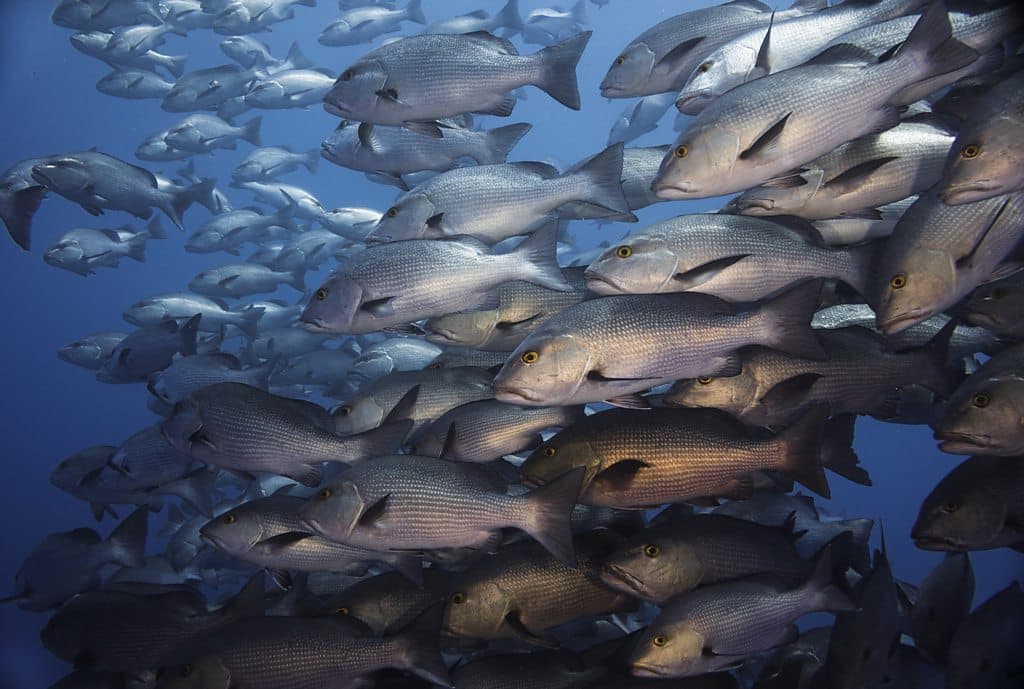
Commercial and fishing vessels are required under international law to be fitted with systems that transmit data, showing where they are. But many vessels simply do not broadcast their location. Effectively, going dark.
For more than a decade the non-profit organisation Global Fishing Watch has been using technology to shine a light on issues such as illegal fishing, sanction breaking, and potential human rights abuses at sea.
Reporting for BBC Tech Now, Grace Ekpu finds out how AI and satellite data are being used in these operations.
This video is from Tech Now, the BBC's flagship technology programme.
Katty Kay and economist Kathryn Anne Edwards on why some companies might use AI as an excuse for normal firings.
Rising artist Shaqúelle Whyte on why painting for him is all about process, repetition, and doubt.
Vance Howard of Howard Capital Management says he is optimistic after the Federal Reserve chair's debut.
Florida's natural springs are portals to a prehistoric world hidden beneath turquoise and deep-blue waters.
A local guide takes us to the layered slopes of Bokty mountain and on the multicoloured paths of Kyzylkup canyon.
An unassuming German city had been scoring among the top three for the last two years.
This 16th century concept originated in tea ceremonies and martial arts and is still engrained in Japanese life.
What does a fish with lungs and a beetle larva have to do with survival?
Leah Bennett of Concurrent says even with a US-Iran deal, it will take time for oil prices to normalise.
Gus Scacco of Advisors Capital Management says Kevin Warsh will, for now, continue with the 'Powell scenario'.
Millions of mummified animal gods show how ancient Egyptians turned to animal worship out of desperation.
Chris Brigati at SWBC says even though volatility is not over yet, we are past the oil price peak.
Danish adventurer Thor Pedersen spent nearly a decade reaching every country without boarding a plane.
Katty Kay and Ryan Burge on why some Americans now say religion matters more to them, without going to service.
The Nigerian-American soprano on how the stage allowed her to feel everything she was taught to hold back.
Markets open higher as chip stocks bounce and oil price rises amid the US threatens to hit Iran 'very hard.'
SoFi Stadium's 360-degree double-sided infinity screen with immersive tech is redefining the fan experience.
Julian Koski of New Age Alpha says he is not worried about rising inflation as 'these events don't last long'.
This Los Angeles venue uses cutting-edge technology to bring the World Cup experience to life.
Mackenzie Peterson at AdvisorShares says the OpenAI IPO shows continued 'hunger and desire' around AI.
Wearable AI can help travellers navigate cities, translate menus and fundamentally transform travel. But a weekend in Paris showed me the trade-offs behind the convenience.
In Paris, I find myself standing beneath the Eiffel Tower having an argument with my glasses about how tall it is.
The first time I ask, the answer comes back as 330m. A few minutes later, I try again. This time, the glasses confidently tell me, through a tiny speaker near my ear, that it is 324m tall. This is not the kind of discussion I had expected to be having during weekend testing Ray-Ban Meta AI glasses as a travel companion.
This small discrepancy in height – the official Eiffel Tower website lists it as 1,083ft, or 330m – throws up some big questions for me. If I can't trust the glasses to tell me the correct answer to something easily verifiable, what can I trust them with?
Launched in late 2023 by Meta and EssilorLuxottica, the parent company of Ray-Ban, the glasses are part of a fast-growing category of AI wearables that is moving from novelty to mainstream use. More than seven million Meta smart glasses were reportedly sold in 2025, and rival products from companies like Google and Samsung are now in development. Apple is also widely reported to be working on smart glasses of its own.
The promise for travellers is immediately appealing: live translation, help with directions, hands-free photography and quick answers about restaurants, landmarks, menus and whatever else happens to be in front of you. In theory, they combine the functions of a guidebook, translation app, smartphone and audio guide in a single wearable device.
As someone who spends too much time in new places navigating with Google Maps and staring at her phone, I am excited to see whether they make me feel a little less like an awkward lost tourist as I wander around Paris.
But I am also uneasy. Camera-equipped smart glasses have attracted growing criticism for the way they can be used to film and photograph people without their consent. I wonder whether this particular type of travel tech will help me connect more deeply with the city, or mark me out for all the wrong reasons.
The Ray-Ban Meta AI glasses I packed for my weekend trip to Paris are chunky and black-framed. They look like a standard pair of glasses but I find speaking to thin air a little strange, so I hide my mouth behind my hand, as if I am about to cough, before asking a question.
Unlike augmented-reality headsets, the glasses do not project information across the lenses. Instead, they use cameras, microphones, speakers and voice AI to create a kind of audio-first layer between you and the world around you. Wearers can make phone calls, take photos, record videos, listen to music and podcasts, translate text and speech, ask questions about what they are seeing, set reminders and request recommendations.
I begin by asking the glasses to give me directions as I walk with my travel companion from the Gare du Nord through Le Marais and down to the Seine. They quickly send the route to the maps function on my phone and alert me to open it. I suppose it's technically what I asked for, but it means I have my head down, staring at my phone, instead of looking around and enjoying the city, which is not what I hoped for.
That said, the experience improves dramatically when realise I can set a route on Google Maps and follow voice directions through the glasses, using them as a headset rather than a navigation tool. That works surprisingly well, and it's better than wearing headphones because I can also hear everything around me.
At Place de la Concorde, I ask for a brief history of the square. The glasses tell me that Louis XVI and Marie Antoinette were executed here when it was called Place de la Révolution. So far, so good. Later, my travel companion asks me how long it took to build the Louvre. I tell her, via the power of the glasses, that it took more than 800 years.
This becomes one of the device's most useful functions, acting like travel guide for my ears, able to pull up information quickly and efficiently without forcing me to scroll through my phone or flick through a guidebook. Instead of looking like a lost tourist, I can keep walking while satisfying my curiosity.
I try out some other applications on the go. I ask it to convert currencies to give me a ballpark idea of prices, and it is successful. The translation function works well too, when I look at a French newspaper and ask for an English translation. Later in a café, the glasses provide both a verbal summary of the menu and a line-by-line translation. As someone who speaks French, I find myself nodding along.
But at the Eiffel Tower, things start to unravel. Suddenly I'm questioning everything that has happened so far today.
The issue isn't the size of the mistake so much as the confidence with which it was delivered. When I ask where the information came from, the glasses respond vaguely: "I get my information from my training data, internet searches and other sources." This leaves me wondering how I am supposed to judge which answers are reliable. All sources seem to be treated as equally valid, whether they are accurate or not – a known AI issue in other areas. Still, it handles most of my basic travel-guide-style questions well, and when I later verify the answers, it is correct in all other cases. The technology is useful – provided I have time to check the information that matters.
Some features are less convincing. While I can take photos and videos from my point of view, I can't zoom or focus manually, and unless the glasses sit perfectly level on my face, the results can be slightly crooked. I far prefer the control and options available on a smartphone camera.
The object-recognition feature is similarly mixed. Sometimes it identifies what I am looking at accurately, while other times it just offers vague observations such as "you're looking at a view of a street, maybe in Paris, with tall buildings". Which is true, but not exactly revelatory.
And then there are the privacy issues. Wired has reported instances of Ray-Ban Meta AI glasses being used to record women without their knowledge or consent, earning the glasses the ugly nickname "pervert glasses". Swedish newspaper Svenska Dagbladet also reported that workers reviewing data from Meta smart glasses had seen intimate and sensitive footage, including people who appeared not to know they were being recorded.
More like this:
• Smart glasses are 'an invasion of privacy' - Meta's are selling better than ever
• The best Christmas market in Europe
• David Lebovitz's ultimate guide to the best bakeries in Paris right now
Meta's own privacy policies state that voice interactions can be stored and processed using machine learning and trained reviewers to improve its products. Its voice privacy notice also says transcripts and stored audio recordings may be kept for up to a year unless users delete them sooner.
Those concerns are serious. But as a traveller, my biggest reservation turns out to be something else. The longer I wear the glasses, the more I feel they undermine one of the things I value most about travel.
In years gone by, if I was lost, I might have asked a stranger for directions or relied on a hotel concierge for recommendations. I might have wandered aimlessly in the city and discovered something through serendipity.
With the glasses, I don't need to ask anyone anything, because the glasses handle it all.
The technology deals with directions, translation, information and recommendations. It reduces issues and increases convenience. But the glasses don't live up to the promise of helping me connect well to the world around me. If anything, they sometimes place another invisible layer between me and the city.
This feels like part of a wider issue in travel technology, where every innovation promises to make travel easier. Yet some of the most memorable moments on a trip happen precisely because things don't go according to plan.
It has me thinking about what I really want. Swapping accidental discoveries and human interaction for convenience feels like too much of a trade-off.
I can see the appeal for trips where language, logistics or cultural context are more challenging – for example, an upcoming trip to Japan, where translation and basic travel-guide functions could genuinely improve the experience. But for future trips around Europe, where I already have some familiarity with the language and customs, I'm less convinced they would add enough value for me. They might also make sense for business travel, when time is limited and convenience matters. That said, I would still verify important information, and I remain uneasy about what Meta is doing with my data.
My advice is to stay conscious of how and why you're using them, and what you want to get out of your trip in the first place. As wearable AI becomes increasingly woven into daily life, travellers will need to think carefully about what they want technology to do for them. The glasses excel at making some elements of travel easier. The question is whether easier always means better.
--
If you liked this story, sign up for The Essential List newsletter – a handpicked selection of features, videos and can't-miss news, delivered to your inbox twice a week.
For more Travel stories from the BBC, follow us on Facebook and Instagram .
"Everyone's really upset mum - loads of them have got their own YouTube channels."
That was my 12-year-old son's summary of how the news about the social media ban for UK under-16s went down in his classroom.
Exactly how a bunch of 12-year olds might have ended up with their own channels in the first place when the minimum age is supposed to be 13 shows just how big a change in culture the government is trying to make.
In Preston, school pupil Isabella went viral when a BBC colleague asked her on-camera what she would do instead with the nine hours of screentime she had racked up over the previous weekend: "stare at the wall," she deadpanned.
The exact logistics of the ban have yet to be set out but it is very possible that its introduction will herald the biggest ever change in the UK in terms of how everyone, children and adults alike, accesses the internet. Millions of us might have to share some official ID which includes our date of birth, in order to access a whole range of platforms from next spring.
The ban has been broadly welcomed by campaigners, including a group of bereaved parents who say their children died as a result of a variety of harms on social media.
But for others, what the government is planning goes beyond getting the nation's kids to spend more time off screens and engaged in alternative pursuits (even if that does include staring at walls) and amounts to a profound reshaping of how it is assumed young people will accumulate fresh knowledge and also how the rest of us will move around online.
There is the potential impact on education. "YouTube is where we all go to learn," says Dr Tom Crawford, aka Tom Rocks Maths, who shares maths skills with his 250,000 subscribers on YouTube, which is included in the ban. "And that includes teenagers."
So, are we really witnessing the profound shift that some claim? And if we are, how will it reshape our relationship with the online world?
Much of the concerns raised so far about the proposals have been about civil liberties and government overreach. But there are other, more prosaic, unintended consequences to consider too.
"Every young person I have spoken to has told me the same thing: they will find a way around it," says Paddy Crump, campaigns director at Flippgen, a youth-led non-profit group that goes into schools to try and help young people build healthier relationships with the online world.
That is certainly what seems to have happened in Australia, where seven out of 10 children aged under 16 who had a social media account before it introduced its ban in December 2025, still have some access, according to a report by the country's e-safety commission.
Crump argues that the measures offer "false hope dressed up as protection" and will simply shift young people's online behaviour elsewhere: including to smaller digital platforms which fly beneath the radar of regulatory scrutiny.
"There are some pretty dangerous places for children and teens that make Instagram look like Disneyland," notes Ari Lightman, professor of digital media and marketing at Carnegie Mellon University.
And critics of the proposals warn of other unintended side-effects. Crump fears the ban could make young people less likely to seek support for online harms if they do encounter them, as well as isolating them from communities and information.
One teenager sent me a message to say that without social media they would not still be here: the friendships they had made online had given them reasons to continue living. Some parents with SEND children say social media and watching videos is their primary way of engaging with the world.
An online e-petition is calling on the government not to ban social media for under 16s "because for many young people social media is how they communicate with their friends. Some people view social media as a lifeline". It has gained more than 100,000 signatories in the past few days.
Home education message boards are also lighting up with parents concerned about how to navigate the ban while teaching their children away from schools.
"I learned to tie a bow tie by watching a tutorial on YouTube," says Crawford. "What if you're an 11-year old that needs to wear a tie to school for the first time? What if you want to know how to apply makeup and there's no-one at home to show you? What if you're worried about your upcoming GCSE exams and want to check how to answer a question on bearings? This is what a ban on YouTube takes away - the ability to learn."
Older generations might retort that they managed to acquire all this knowledge without the help of the internet. But that ignores how fundamentally teenagers have become accustomed to using not just YouTube but also other social media platforms as a research tool. SEO expert Mehwish Malik from Link Builder says the younger end of Gen Z (aged 14-29) use TikTok as a search engine: their preferred gateway to information and to trusted brands.
So how can all this be addressed? The government says this is for the tech companies to figure out. "If YouTube wants to come up with something that's an intermediate option that allows that young person who wants to watch history documentaries to watch them but isn't then getting all of these short reels, that's a different proposition," said education secretary Bridget Phillipson on the BBC's Newscast.
Industry sources argue that technically it's not that simple to set something like this up. "Ask the government!" messaged one when I posed the question about how it might work.
Parents could of course just choose to sit down and watch something with their child using their own accounts if they have the time and willingness: YouTube claims that half of UK users watch its videos on the TV at home, with multiple sign-ins available.
"As I see it, the main issue here is that YouTube isn't social media," says Crawford. "YouTube is the 2026 version of television."
With the design features that aim to keep people on the platforms for as long as possible also under review for additional measures impacting 16 and 17 year olds, perhaps social media will end up withering on the vine because it just won't be interesting enough for young people to engage with even when they do reach the right age.
"If you are drinking a glass of wine and it magically keeps refilling without you noticing, you will just keep drinking. Your brain only 'wakes up' when you reach the bottom of the glass," says Asa Raskin, who invented the concept of infinite scrolling 20 years ago.
He now works at the Center for Humane Technology, which he co-founded, and accuses the tech companies of "weaponising" his idea.
He says he intended to create "a seamless user experience" before the era of social media, and regrets that his invention has ended up being used "not to help people but to keep them hooked".
The absence of young people could also change the social media experience for everybody else.
MrBeast is arguably the world's most successful YouTuber with half a billion subscribing to his mix of challenges, stunts and charity. He started out at 13 and as a child studied the algorithm. He went on to corner the market in "watch time", created a factory of content and is now a billionaire. Would he have had the same idea years later?
Professor Amy Orben is a psychologist at Cambridge University who has advised the government on screen time for children. She accepts that any ban will be "imperfect" but also agrees the government cannot do nothing; despite the evidence on social media harms itself being complex.
There are of course acute and tragic cases, but broadly, she says the evidence for large populations links social media use to only a small decrease in mental health.
In her opinion, the tech firms could help both regulators and themselves by sharing more about what they know from the billions of young people they see on their platforms day in, day out.
"Social media companies have offered exceptionally little data on their internal research," she says.
When it comes to age verification, it is expected that the tech giants will do the checking.
"The methods available to platforms are well established. Identity document scanning with a face match, email-based age checks and facial age estimation are proven to work at scale," says Andy Lulham, Chief Operating Officer at Verifymy.
That is a concern for those who worry about the reach of Big Tech into our lives - and that affects all of us, not just the young people who need to prove their age. Some see this as a major attempt by the authorities to control who can access what on the internet: this troubles privacy and rights campaigners as much as it relieves parents who are worried sick about what their children are being exposed to.
For those in favour, this is a price worth paying to protect children.
For Elon Musk, the controversial owner of X, it has a more sinister undertone: "The real goal is to enable the UK government to track everyone," he posted. It's not the first time the US trillionaire has waded into UK politics and he isn't universally welcomed when he does. Needless to say the government denies this.
Musk is not alone in his concerns: an international campaign called Stop Killing the Internet also launched this week. The group, which includes the Index on Censorship and Big Brother Watch, is concerned that various forms of surveillance, as it considers this to be, limit rights to freedom of expression for children and adults.
Silke Carlo, Director of Big brother watch said: "We want all children to be safe online, but these policies create new safety and privacy risks for young people and entire adult populations alike. Far from reigning in Big Tech in, age-gating policies gift corporations masses more of our personal information whilst letting them off the hook for their design choices".
For Carlo, those risks include the potential for sensitive children's data, such as proof of age and face scans, to be stolen and misused.
And then of course there's the potential for future mission creep.
"'Keep children safe' can end, three statutory instruments later, as a duty to scan every message or verify every face, administered by a regulator the public cannot easily call to account," warns computer scientist Professor Alan Woodward from Surrey University.
"A walled garden is only a refuge if the people inside chose the wall, can see over it, and may leave when they wish."
I suspect my own 12-year-old son and his peers will spend a lot of time looking for potential exits from the walled garden they are about to find themselves in, even if it's supposed to be for their own protection.
If the ban does come into force in 2027 as planned and they can not escape it, today's under 16s are unlikely to spend the following years staring at the wall (I hope). Child-free digital spaces will feel different for adults too: I think we might be on the cusp of a new social media era, one that is less intense. It might leave us all with more time to read books, go outdoors... or use our phones to chat with AI instead.
Additional reporting: Philippa Wain
BBC InDepth is the home on the website and app for the best analysis, with fresh perspectives that challenge assumptions and deep reporting on the biggest issues of the day. Emma Barnett and John Simpson bring their pick of the most thought-provoking deep reads and analysis, every Saturday. Sign up for the newsletter here
The company behind the UK's newest video game console is not concerned with the latest state-of-the art graphics.
Instead David Lee, the chief executive of American technology firm Nex, tells me its cube-shaped machine, the Nex Playground, is all about getting kids active.
Launching in the UK and Ireland on 22nd June, the Playground ditches controllers for body movements, tracking players using AI and a built-in camera.
The relatively little-known device surprised the games industry when research firm Circana revealed it was the third best-selling console in the US over Black Friday 2025, outselling the Xbox Series S and X.
While motion-tracking in gaming is nothing new - the Nintendo Wii came out in 2006 - how long children spend on screen time is still a hot topic among many parents and governments today.
Ahead of the UK launch I spoke to parents who already own the console in the US, and tried the machine myself to find out how it works - and if it really could get families feeling fitter.
When it is released in the UK and Ireland the Playground will cost £269 (€319).
While users get five starter games to try out for free, a subscription is needed to access most of the Playground's 60-plus games, which include tie-ins with kid-friendly favourites such as Peppa Pig.
A yearly game subscription is £90, while a quarterly one is £45.
Nick from Louisiana, who has had the Playground for six months for his children aged three and five, said the subscription was his "biggest hesitancy" when he first began researching the device.
"But when you consider the fact that a single Switch game costs about $70 or $80, it's really not too egregious," he said.
Brian, a parent from Philadelphia who bought the device a month ago for his six-year-old son, agrees.
"I do think there's plenty of value here, especially when you consider the dollars per hour of this activity versus many others," he said.
"The initial set-up was extremely smooth and the interface is simple and easy," said Corey, a parent from North Carolina who bought the device a month ago for his children, aged seven and four.
The system uses AI and its wide-angle camera to track 18 points on the player's body to create an on-screen matching avatar.
According to Brian, the camera tracking technology sometimes felt "a little lacking" and less precise than older systems like the Wii or Xbox Kinect.
The camera quickly configured itself to fit around me and my not-so-large living room area, so I could slice Fruit Ninja's flying produce with my bare hands and hit (most of) the notes to the sound of A-ha's Take On Me in the rhythm game Starri.
While some games felt "like tech demos" according to Corey, others felt more substantial.
"The subscription lets me not worry about any of that and just dive into whatever my family wants to explore," he said.
As the console effectively puts a camera in people's living rooms, Lee said player privacy was the "number one priority" for his company.
"The camera is only for tracking motion; we don't save the video anywhere; it is processed in real time, locally on the device, rather than in the cloud" he said.
The Playground has a kidSAFE+ COPPA certification, something which ensures it complies with the Children's Online Privacy Protection Act (COPPA) , a US law regulating how companies collect and use personal data from children under 13.
The camera also comes with a lens cover, and parents can hide games or music they think their children are not old enough for yet.
The Playground presents itself as "an alternative to passive or open-ended digital entertainment" amid "a growing national conversation around children's screen time habits".
Anyone using the device will still be looking at a television screen, so the benefits for children may be more a "compromise" to include some healthy activity alongside it, Nick said.
The parents I spoke to said their children often played on the console for between half an hour to an hour in one session, with the games typically being used as a way to transition into another activity, or to allow some structured play.
Brian said while getting a Playground meant they "compromised on increased screen time", the games were still engaging in a way that he believed "typical cartoons or movies" were not.
So did I work up a sweat in any of the games I played?
In the initial starter pack, three games involved only a small amount of moving my arms.
The final two, the rhythm game and a set of mini-games, did include more full body movements.
The fuller Play Pass has a specific "Health & Fitness" category which includes sessions such as daily Zumba workouts, complete with an on-screen instructor shouting out movements in time to the music.
It wasn't clear if I was managing to hit every motion correctly, but it did at least get me moving a bit more, and felt more convenient than heading to a gym class.
While the Nex Playground may not be a direct contender to major consoles given its target audience, its recent performance during Black Friday showed it can nevertheless still hold its own in sales.
According to Nex, the cube has now surpassed a million lifetime units sold since its launch in December 2023 in US and Canada.
Chris Scullion, deputy editor of Video Games Chronicle, bought the cube seven months ago for his daughter.
He said the device would probably never "realistically challenge" something like the Nintendo Switch 2, which also has family and children as a target audience and had sold over 17 million units by the end of 2025 .
But he added the system's "clear family focus" could arguably make it a "more compelling offer" for parents looking for a modern Wii Sports or Wii Fit replacement.
Alongside its UK and Ireland launch, Nex has also announced a multi-year partnership with Wrexham AFC that will bring Nex branding to the club's kit sleeves, fan activations at the Racecourse Ground, and community programming.
If that strategy pays off, Nex Playground may find its biggest success not as a rival to consoles, but as part of a wider push into how families play, connect and spend time together.
Sign up for our Tech Decoded newsletter to follow the world's top tech stories and trends. Outside the UK? Sign up here .
The latest instalment in Rockstar's blockbuster game franchise, Grand Theft Auto, is set to be the biggest games launch of the year.
Details are still scant, although we do now know that GTA 6 will be available to pre-order on 25 June, the developer has announced .
Analysts believe Rockstar's action adventure could become the most expensive game ever made, with estimates putting development costs at more than $1bn (£866m).
We're still awaiting some crucial information about the game - but here's what we do and don't know about GTA 6 so far.
GTA 6 will be released on 19 November - and with Rockstar recently opening up pre-orders, this date seems all but certain.
But it was delayed twice previously , from autumn 2025 and May 2026.
In a statement when the second delay was announced, Rockstar said it needed extra months to finish the game with the level of polish fans had come to "expect and deserve".
The sixth game in the main series will be released on PlayStation 5 and Xbox Series X and S.
There's no news on when a PC version will be released - it's also currently unknown whether it will come to Nintendo Switch 2.
Rockstar and its parent company Take-Two has still not revealed its price.
It's something that will likely only be revealed when pre-sales begin in late June.
Some analysts have estimated the game could be the first to be priced at $100 (£76).
Rockstar has not yet confirmed whether an updated online mode will be released as soon as GTA 6 launches, although given the success of GTA Online it is likely to exist at some point.
How any future age verification legislation in the UK around social media and particularly messaging in gaming could therefore affect it, if at all, is still unknown.
GTA 6 will feature its first ever playable female protagonist in a 3D setting - Lucia - alongside her partner in life and crime, Jason, as a second playable character.
From what we've seen so far in the two gameplay trailers , the story will follow the pair in a Bonnie and Clyde-esque adventure through the seedy underbelly of America after an " easy score goes wrong ".
Like other GTA games before it, the sixth chapter is set in a fictional US state - this time in Leonida, which is Rockstar's version of Florida.
Fans of previous games will be excited to hear that Vice City, which is inspired by Miami, will return, featuring as the main city within the state.
GTA 6's cover art revealed by Rockstar on 18 June made several nods to the setting with alligators and flamingos.
It's no secret that GTA 6 has been a few years in the making.
The franchise's last instalment, GTA 5, was released in September 2013 - and quickly became one of the best-selling games of all time.
It's unclear whether Rockstar has been working on the sixth instalment for all of that time, however, as in 2018 it also released another huge sequel - Red Dead Redemption 2.
Rockstar confirmed for the first time that it was working on a sixth game in the series in February 2022.
The rising cost of development and immense pressure to live up to the series' hype are all contributing factors as to why gamers have had to wait so long for the game's release.
Several months later, footage and images leaked after teenage hackers targeted the company .
It has also seen some issues since, including accusations of "union-busting" by sacked workers at Rockstar North , its Edinburgh HQ, where developers have been racing to get GTA 6 ready for release in November.
To put it simply, the GTA franchise is one of the biggest and most profitable entertainment properties in history.
GTA 5 has sold nearly 230 million copies, making it one of the best-selling games of all time - which has generated billions of dollars in revenue for Rockstar.
The game's sandbox gameplay, where players can explore vast open worlds with considerable freedom - sometimes controversially - has seen it be continuously lauded as the ultimate expression for what the interactive medium can do.
Freelance video games journalist Vic Hood said each entry in the series "continued to push technical and gameplay boundaries", with GTA Online helping to "pioneer the live service model as we know it".
She added that the games were also "extremely culturally relevant" too.
"Rockstar has always had its finger on the pulse of music, entertainment, societal, political, celebrity, and online culture trends, and they've never shied away from satirising these things in GTA games," she said.
Speculation as to how a sixth game can top even the gigantic heights of its predecessor has meant that any latest news, no matter how small, has been met with a flurry of hype and excitement.
Both of GTA 6's previous gameplay trailers currently have a total of roughly 447 million views combined.
Sign up for our Tech Decoded newsletter to follow the world's top tech stories and trends. Outside the UK? Sign up here .
At an altitude of almost 4,000m (13,000ft) and receiving almost no rainfall, the Himalayan village of Sakti is a hostile place to be a farmer.
"Ladakh has a brutal, single-cultivation season," says Gelak Gutme, who has been growing wheat, peas and potatoes there for most of his 65 years.
"It is a desert with an extreme climate," he says.
Conditions have become worse in his lifetime. Global warming means that the smaller, low altitude glaciers they relied on to water their crops have disappeared.
"Now there is scarcity of water. Last year I lost everything - my entire field got dried due of lack of water," Gutme says.
"For generations, small glaciers sitting right above the valleys acted like frozen water towers, holding onto water all winter and releasing it right when spring farming began," explains Lobzang Fardod, who is a member of a local water management committee in Ladakh.
"Now that those lower glaciers have completely vanished into a desert of dry rock, there is nothing left at the top to melt," he says.
The mountain summer is short, so farmers have to plant their crops by May, otherwise the crops will not be ready before the winter hits again.
A reliable source of water in early spring is crucial for them.
To secure that vital resource, in the early 2010s some Ladakh villages attempted to create their own reservoirs of ice.
The system involved piping water from higher up in the mountains during the winter and spraying it into the air, where it would freeze, and over time form large towers of ice, called ice stupas.
They successfully supplied melt water in the spring, but were a "nightmare" to manage under harsh winter conditions, says Fardod.
If temperatures dropped quickly below minus 20C, or sometimes minus 30C, the water in the pipes was liable to freeze, cracking the pipes and ruining the whole system.
To guard against that, during the winter teams of four or five farmers would camp high-up, near the water source, rushing to any potential blockages with boiling water, often during the night when temperature drops were most likely.
But enduring those freezing, winter nights high in the mountains could be phased out.
"Because traditional water systems are failing, Leh-Ladakh has become a hub for innovative, grassroots hydraulic engineering," says Murtaza Ali, executive engineer in the Irrigation and Flood Control Division, at the Ladakh Autonomous Hill Development Council.
Leh is the capital of Ladakh, a disputed region in Indian-administered Kashmir that is sandwiched between China to the east and Pakistan to the west.
More on Ladakh's political challenges
As well as the potential for cracked pipes, the ice stupa system was not very efficient, says Ali.
Because water flowed constantly, on warmer days fresh water would melt the ice that had already formed.
But over the last couple of years that method has undergone a tech upgrade.
In partnership with private company Acres of Ice, a new system has been developed which precisely controls ice production.
Called an Automated Ice Reservoir (AIR), the process also involves piping water down from higher up in the mountains.
The water arrives at the valley floor under pressure and shoots out of a vertical nozzle like a "massive fountain", says Dr Suryanarayanan Balasubramanian, the founder of Acres of Ice.
That flow is computer controlled from a weatherproof control box, powered by solar panels and a battery.
The control system is connected to a weather station, which monitors, environmental conditions, including the water temperature inside the pipe.
If the sensors detect that the air temperature is dropping too fast, or the water temperature inside the pipe approaches a dangerous threshold, the control system takes action.
It shuts off the valve at the top of the stream and opens a valve at the bottom to completely drain the standing water out of the pipe.
That avoids the ruinous problem of cracked pipes, but the system is also more efficient at creating ice. Instead of continuously spraying water, AIR fires a burst of mist, coating the existing ice, and then shuts off.
"The system waits precisely long enough for that layer of water droplets to freeze solid based on current wind and humidity, then fires the spray again," explains Balasubramanian.
He says that AIR converts almost all of the diverted water into ice.
The whole system runs automatically and uses a local wireless network to connect the control box and the various valves. But the villagers do have a manual override, if needed.
It all appears to be making a difference to village life.
"When we speak to the villagers, they are saying the groundwater is getting recharged and spring sources are getting revived. They are getting water in time. We are also planning a scientific study now to see exactly what impact it has made," says Ali.
During the winter of 2025, Acres of Ice and the local government ran 10 AIR projects across Ladakh.
"Our biggest challenge right now is to push the envelope in the technology to see how we can multiply the number of ice reservoirs we are building. With the same system that previously used to build only one ice reservoir, can we build a dozen?," says Balasubramanian.
Back in Sakti, farmer Gutme is more optimistic about the future. The single AIR system has created a more reliable water source and he hopes the village will build at least two more of the artificial glaciers.
"I am a farmer, land is all that I have to survive on. I don't know the technology, all that I know today is that I have water to grow my crops.
"We live in harsh climate that makes our life difficulty and lack of water was creating more issues. Many of youths in the village wated to go to cities to work. That would have been a disaster."
AI will lead to more need for workers rather than make people redundant, Amazon founder Jeff Bezos predicted during an appearance at a tech conference in Paris.
Bezos pushed back against growing concerns that AI will replace large numbers of workers.
Instead he argued that the tech will unlock new opportunities and increase demand for human labour.
This is in contradiction to some other tech and political figures - including former UK prime minister Rishi Sunak, now an adviser to Microsoft and AI firm Anthropic, who recently said AI was having an impact on young people's job prospects .
"I know there's a lot of concern that many people have, including many smart people, that AI is going to make humans redundant and so on," Bezos said.
"I totally disagree with this point of view. And I think, in fact, AI is going to create a labour shortage."
He painted an optimistic picture of AI's future role in society, suggesting that people are limited not by a lack of ambition, but by barriers that technology can help remove.
Billionaire entrepreneur Bezos was speaking about his new AI venture Prometheus, which is focused on accelerating physical manufacturing - a sector which is becoming increasingly automated .
The UK's Trades Union Congress has warned that AI technology could repeat "the disaster of deindustrialisation" as shareholders get richer while jobs are "degraded or displaced".
But it adds that AI could have transformative potential if developed properly, and workers could benefit from its productivity gains.
Bezos also used his appearance at Europe's largest tech expo VivaTech Paris to outline his long-term vision for space exploration.
He described space as "supply constrained, not demand constrained", arguing that access to space remains the biggest obstacle to future development.
The Moon, he said, offers a natural starting point for humanity's expansion beyond Earth because of its proximity and resources.
"We're going to the Moon to stay, not just to visit," Bezos told the audience, adding that technologies such as electrolysis could eventually allow lunar resources to be used to refuel rockets and support a permanent presence beyond Earth.
The discussion also turned to another Bezos venture, space travel company Blue Origin.
It had a recent setback after an uncrewed New Glenn rocket exploded during a ground test at Cape Canaveral in Florida in May.
"It was a gut punch for the whole team. But what we've learned since then is we got really lucky," Bezos said.
No injuries were reported in the explosion, and Bezos noted several critical pieces of launch infrastructure survived the incident, including propellant and fuel systems that would have taken significantly longer to replace.
On the same stage as Bezos, Blue Origin chief executive Dave Limp said reconstruction work at the launch site is already underway and the company expects launches to resume before the end of the year.
Blue Origin is in the race to establish itself as a major player in commercial spaceflight and lunar exploration, competing with Elon Musk's SpaceX in the growing market for extraterrestrial infrastructure.
Away from the main stage, Unitree's humanoid robot was the definite crowd-pleaser. Constant queues of visitors wanted to see the latest advances in the robotics field.
This time the robot was teaming up with French neuro-AI company HABS, which showcased technology designed to allow humans to interact with machines using cognitive signals rather than speech.
The robot responded to commands generated through brain activity, via a headband with an electroencephalogram (commonly known as an EEG) attached to it.
The test uses small, metal probes called electrodes that touch the scalp.
The demo offered a glimpse of how future humans and machines could work together in the future.
It also reflected a broader trend running through this year's event: AI moving beyond chatbots and into the physical world.
Humanoid robots are increasingly becoming a reality with companies racing to develop machines capable of working alongside humans in healthcare, manufacturing and hospitality.
Sign up for our Tech Decoded newsletter to follow the world's top tech stories and trends. Outside the UK? Sign up here .
Snapchat's parent company has announced it is releasing new smart glasses, a decade after its original pair lost the company tens of millions of dollars .
The new augmented reality (AR) glasses, called Specs, will allow users to see digital elements overlaid onto the world. They will cost £1,995 in the UK and $2,195 in the US when shipping begins this autumn.
That makes them cheaper than Apple's Vision Pro mixed-reality headset and its $3,499 starting price, but far more than Meta's smart glasses, which start at $224.
Evan Spiegel, co-founder and chief executive of Snap Inc, said the glasses marked the "beginning of a new era in computing".
Ben Hatton, a market analyst at FDM CCS Insight, said the price tag meant the technology was "unlikely to become a mainstream device any time soon".
Snap's core audience of younger consumers "rarely have this sort of money to spend on a single gadget," he said.
A $200 refundable deposit is needed to pre-order the glasses, which will ship in the US, the UK, and France.
Snap says they are designed to be "wearable for everyday life," though the battery lasts four hours on average before needing charging again. A charging case holds up to 20 hours of battery life.
Unlike Meta's Ray-Ban and Oakley models, the glasses function without needing a "tether" to a smartphone.
And they differ from Apple Vision Pro - which is mainly designed for use at home - as they do not require a wire connected to a "puck", or battery pack.
Hatton said while this improved "wearability and mobility" for the user, it came "at the cost of lower battery output".
"Despite the impressive features and experiences available through Specs, glasses with a 4-hour mixed-use battery life and bulky design are not going to replace the smartphone any time soon," he said.
Users will be able to use the glasses' AI assistant to complete tasks such as getting directions or asking questions about objects they are looking at.
They will also be able to watch videos, browse the web, play AR games and record what they see through the glasses.
Smart glasses have been criticised for a lack of privacy, having been used to film women in public without their consent .
In February, UK data privacy watchdog the ICO wrote to Meta, after revelations data workers in Kenya had to watch videos of people having sex and using the toilet which were filmed with Meta's smart glasses.
"Privacy has to be built in from the very beginning," Spiegel said, adding: "Specs only work if people trust them".
A built-in light will glow when the device is recording, with Snap stating users will be given control over what data gets stored, synced, shared, or deleted.
Snap Inc shares fell by some 9% after the announcement at the Augmented World Expo conference in California on Tuesday.
This is not the first attempt at smart glasses for Snap.
In 2016 it launched Spectacles , camera-equipped sunglasses which cost £129 and could record short video clips of up to 10 seconds.
In 2017 the company revealed losses of $40m (£30m at the time) due to "excess inventory" of the glasses and cancelled orders.
Updated versions of Spectacles were released in both 2018 and 2019 with a higher price tag (£330 for the third instalment) and upgrades including a better camera resolution.
It has not released a widely available consumer product since then.
Snap later began shifting towards AR, offering new Spectacles in 2021 to a "select group of global creators" in the field.
In May, Google announced it would launch its own pair of smart glasses a decade on from the doomed Google Glass, which had been pulled after backlash on price and privacy concerns.
Sign up for our Tech Decoded newsletter to follow the world's top tech stories and trends. Outside the UK? Sign up here .
After the government's announcement on Monday, we know a social media ban is coming for under-16s in the UK .
However, details on which apps are and are not included, besides those named by the government, and how the measures will extend to gaming sites like Roblox, remain sparse.
And many are already asking whether enforcing the ban will mean cracking down on virtual private networks (VPNs), which can disguise someone's location online.
Ministers have said they will provide an update on further restrictions like potential curfews, curbing of "addictive" features like infinite scroll and AI chatbots, in July.
But here are some of the big unanswered questions about the UK social media ban.
The government has only specified a handful of sites included in the UK's social media ban.
These are Snapchat, TikTok, YouTube, Instagram, Facebook and X.
However, it says its restrictions will closely follow Australia's - where the above apps plus Kick, Reddit, Threads and Twitch are banned for under-16s.
So where does that leave Roblox and gaming sites like it?
Roblox is hugely popular with children in the UK, but it has been accused of failing to keep them safe - including allegations it allowed children to be preyed upon by adults .
Roblox says it has made changes to protect child users , including by expanding tools to estimate a user's age to determine the games and experiences they can access.
"It is not yet clear how they will treat gaming sites," says Lorna Woods, professor of internet law at Essex University.
"Though if they follow the Australian approach, these will lie outside the Australian ban."
Regardless of whether it does end up being banned for under-16s, Roblox will still need to abide by requirements for all platforms to disable features that let strangers communicate with children, announced alongside the ban.
The government made a point of saying this restriction would apply to gaming services.
Children will still be able to participate in multiplayer online games, though, it adds .
YouTube is going to be included in the ban, but YouTube Kids will not be.
However it is not yet clear how YouTube would tackle children accessing the platform through search without an account once a ban is enforced or how educational content could be carved out from any restrictions.
YouTube said it was a "vital resource for young people" and that a ban risked pushing children towards "anonymous, less safe services".
But questions are emerging about what including YouTube in a ban would mean for children's access to educational videos on the site.
Citing research carried out in partnership with consultancy firm Livity, Google says 95% of UK teens surveyed had said watching videos helps with school work.
According to the government, there will be "a narrowly defined list of exemptions" to its definitions for platforms included in the social media ban to keep educational services available to children.
One of the few platforms we do not expect to be included in a ban on social media for UK children is WhatsApp.
The messaging app, owned by Facebook-parent Meta, is used by half of all 8-17 year olds, according to Ofcom.
The government says in a press release about its plans for restrictions it is considering "how to determine exactly which platforms will fall under the restrictions".
But it does not expect to include messaging apps like WhatsApp and Signal.
According to the government, its ban will cover platforms "whose purpose is to enable social interaction and which allow users to post material".
While this definition would likely not include messaging apps, it could, in theory, apply to Discord and Pinterest.
Yet both, as well as platforms like Bluesky, Tumblr and Telegram, are absent from Australia's list of banned platforms.
One of the biggest emerging questions about the UK's social media ban is how it will be enforced.
The government says it will use "highly effective age assurance" - tougher checks that aim to accurately identify or estimate a person's age - to make a ban stick.
These checks can include forms of verification like asking someone to scan their face (facial age estimation tech), upload a form of ID (photo ID matching) or use a digital identity service like Yoti.
In a letter to the government , the regulator Ofcom says while it should be technically feasible, applying age assurance at 16 has its challenges.
There are fewer methods available to accurately measure or estimate if someone is 16 or under than if they are 18 or younger, due to differences in ID or data available.
For instance, Ofcom says credit card or email address checks can work at 18, but not at 16.
"We have more work to do to understand the effectiveness and accessibility of different methods, the availability of identity and age attributes at 16, and the privacy considerations of different existing and emerging methods," it has told the government.
These regulations were followed by a spike in downloads of VPNs and calls from some, including the Children's Commissioner, for age checks to restrict them for young people.
VPN providers and privacy experts say doing so would mean having to collect user data to carry out checks, and negate privacy as the incentive for using them.
Some now speculate tech-savvy children may use them to get around social media blocks.
The government has not revealed any plans to regulate them, but ministers have said details about action alongside the social media ban, including regarding VPN use, will come in July.
Children's minister Josh MacAlister told the BBC there were "options there about whether we could age-gate VPN use, which would be really welcome".
The prime minister said it was inevitable some teens would try to circumvent a social media ban, but this did not mean it should not legislate to protect current and future generations of UK children.
Stop children using VPNs to watch porn, ministers told
You need only look to the years it took to pass the UK's existing set of duties and laws for online platforms, the Online Safety Act (OSA), to see that regulating the fast-moving tech sector can take time.
But where the OSA is still being implemented, the government recently used the Children's Wellbeing and Schools Act to give ministers powers to introduce further restrictions as regulations.
This means the government won't have to bring a full Act of parliament to implement a ban, so it can act relatively quickly.
Tech Secretary Liz Kendall told MPs on Monday: "I want a vote on it by the end of the year, and I want it to come into force as early as possible in the first couple of months of 2027".
However if tech companies decide to challenge the government's process in the courts, using judicial review, that could slow down the timeline for a ban.
"Whilst primary legislation is effectively immune from challenge, secondary legislation is subject to review by the courts as it lacks the rigorous multi-stage scrutiny required for statutes," says Giulia Carloni, senior associate at law firm Winston Taylor.
Additional reporting by Chris Vallance
Sign up for our Tech Decoded newsletter to follow the world's top tech stories and trends. Outside the UK? Sign up here .
A social media ban for under-16s has been announced by the UK government. It will be introduced in early 2027.
The government is also considering an overnight curfew and measures to stop infinite scrolling for under-18s.
Keeping children off social media is the best way to keep them safe online, Prime Minister Sir Keir Starmer said.
The ban will cover platforms including Snapchat, TikTok, Instagram, Facebook and X, the government said.
YouTube will also be banned for under-16s, but YouTube Kids - a version of the video-sharing app designed to be safe for children - will not be included.
A complete list of affected platforms has not been released, but the government said it would cover those "whose purpose is to enable social interaction and which allow users to post material".
The government said it would "go further" than other countries. It means features including livestreaming and strangers being able to contact children will be restricted across a wider range of online services, including gaming sites.
It means that although Roblox, the biggest gaming site in the UK for eight to 12-year-olds, will not be banned, certain features such as its chat function will be restricted.
The government said it did not intend to include messaging services like WhatsApp and Signal in the social media ban.
Most social media platforms already require children to be over 13 to create an account and use their services.
The government said that for the "high risk" functions of livestreaming and chat with strangers, restrictions would be on by default for under-17s "to prevent a cliff-edge at 16".
It said it was also looking into overnight curfews and breaks in infinite scrolling for under-18s, with more detail on this to be set out in July.
AI "romantic companion" chatbots, which are designed to simulate sexual relationships or role play with users, will have to enforce a minimum age of 18.
AI chatbots more widely will have to restrict "intimate functionalities" for under-18s, the government said.
The prime minister said the government plans to pass regulations before Christmas.
This would allow the ban to be introduced by spring 2027.
The announcement follows a public consultation which received more than 116,000 responses.
The government said "highly effective age assurance" measures would be used to check the age of those using social media.
This typically involves requiring companies to use tech that accurately estimates or verifies someone's age - such as face scans or asking for ID.
The regulator Ofcom has been asked to carry out a rapid study to identify the best ways to verify if someone is over 16.
A number of platforms, including porn sites, are already required to carry out these checks. Ofcom has fined several platforms for not complying.
But concerns have been raised about tools such as virtual private networks (VPNs) being used to get around these measures.
Digital rights campaigners have also raised privacy concerns about requiring individuals to share their data with platforms.
Technology Secretary Liz Kendall told BBC News the government would provide further detail on enforcement in July.
Among those who have called for social media to be banned for under-16s are bereaved parents.
Mariano Janin, whose daughter Mia died aged 14 after she was a victim of cyber-bullying, said the announcement had left him "speechless".
"I think it's a change in the right direction, it won't be easy, but it will be possible," he said.
Lisa Kenevan, who believes her son Issac died aged 13 after taking part in a viral trend, told BBC Breakfast that while parents wanted the ban "a lot sooner", the announcement means "we're in a good place now".
However, speaking ahead of the announcement, Ian Russell - whose daughter Molly took her own life at the age of 14 after viewing harmful content online - accused the government of rushing restrictions for political reasons. He said "sledgehammer techniques like bans" only cause more problems.
Some teenagers have expressed concern about how a social media ban will affect their ability to connect with friends and express themselves.
George, who is 14, told BBC Radio 4's Today programme he felt people his age should be able to make their own choices because "we're beyond people saying what we have to do".
Lilly, 15, from Cumbria, said apps like TikTok allow her to "communicate more", for example by allowing her to post videos of her performing.
YouTube and Snapchat, and Facebook and Instagram-owner Meta, said a ban would not achieve the goal of keeping teenagers safe online. Instead, they warned, it could drive them to "less safe" platforms.
Meta said restrictions should be "underpinned by an age verification system on devices", so that people are not asked to "hand over ID to dozens of individual services".
YouTube said it was a "vital resource for young people". Snapchat said the majority of time on its platform was in private messaging between friends and family.
Australia introduced a social media ban for children in December 2025. The UK government said it would follow this model.
The most popular sites in Australia are now required to prevent children from being able to set up new accounts. Existing profiles belonging to under-16s had to be deactivated.
Australia's rules apply to 10 platforms: Facebook, Instagram, Snapchat, Threads, TikTok, X, YouTube, Reddit and streaming platforms Kick and Twitch.
The fact that it did not include gaming platforms Discord and Roblox was criticised by some.
More than six months on, implementing the policy remains difficult.
One student told BBC News that in her grade of more than 170 students, she knew of only three who had been booted off social media.
And 70% of parents have told Australia's internet regulator their children were still on these platforms.
No fines have been handed out yet but the eSafety Commission is investigating potential non-compliance by Facebook, Instagram, Snapchat, TikTok and YouTube.
According to the Organisation for Economic Co-operation and Development, 25 countries have social media age restrictions in force, enacted, or under active consideration.
In Spain and Portugal politicians have announced plans and partly voted the rules in. Their bans are likely to come into force this year.
Governments in France, Malaysia, Denmark, Indonesia, Norway and Canada are also in the process of bringing in a ban.
Laws have been passed in several US states but these are being challenged in the courts.
Sign up for our Tech Decoded newsletter to follow the world's top tech stories and trends. Outside the UK? Sign up here .
One of the most valuable assets owned by Lancaster University is stored in beer kegs.
But it's not in one of the student bars.
In a carefully locked laboratory rows of metal kegs are arranged on shelves and linked together with spindly copper pipework.
The containers aren't loaded with prize beer but rather a gas called helium-3, one of the most expensive materials in the world. A single litre costs roughly $2,000 (£1,500), though the price can fluctuate.
"The lab has been going for 50 years or so. Back then, the helium was quite cheap," says Dima Zmeev, senior lecturer. "Our very wise predecessors stocked up."
In the near future, more people could be looking to build up such a stockpile. Helium-3 has applications in quantum computing and nuclear fusion. However, the main source of it today is tightly controlled – it comes from nuclear weapons. Specifically, from the decay of tritium, a form of hydrogen, inside those weapons.
Around the world, tens of thousands of litres of helium-3 are likely to be produced this way every year, estimates David McCollum, distinguished scientist at Oak Ridge National Laboratory in Tennessee. But future demand could far exceed that supply.
Some entrepreneurs and researchers say we need new sources of helium-3. It exists in the ground, though generally at very low concentrations.
However, samples of moon dust, or regolith, from the Apollo missions suggest it may be present there at relatively high concentrations. As such, plans are now afoot to recover helium-3 from the moon.
Helium-3 is an isotope of helium, defined by the number of neutrons in the atom's nucleus. Helium-4, with one additional neutron, is the comparatively cheap version – a gas that fills children's party balloons.
Zmeev uses helium-3 in physics experiments. For example, he fills tiny chambers with the stuff, in a project to detect a type of mysterious dark matter particle.
Should such a particle knock into one of the helium-3 atoms, it would make them all jiggle. This generates heat and that slight temperature rise can be measured.
The helium-3 can be re-used again and again.
Scientists mix helium-3 and helium-4 together at very low temperatures to create the lowest temperatures in the known universe, down to the millikelvin range (-273C).
When helium-3 atoms gradually separate from a dilute mixture containing the two isotopes, they form a pure helium-3 layer on top. This separation is a phase change that consumes energy, inducing a cooling effect , like when steam evaporates off a cup of hot water.
Helium-3-based cooling, or dilution refrigeration, is crucial for quantum computers.
And helium-3 could also be used in some nuclear fusion reactors to one day create vast amounts of clean energy.
One company planning to extract helium-3 from the moon is Interlune, based in Seattle. "We've spent the last four years developing, prototyping and testing technologies… We have a team of 30 people, and growing," says Rob Meyerson, co-founder and chief executive. Meyerson was president of Blue Origin, Jeff Bezos' rocket company between 2003 and 2018.
One of Interlune's co-founders is Harrison "Jack" Schmitt, now in his 90s, who walked on the moon during the Apollo 17 mission. He has long advocated recovering helium-3 from lunar regolith.
Interlune has tested some of its equipment during parabolic flights, in which a plane flies in a big arc to simulate zero gravity. The firm's kit could be integrated into a lunar lander as early as autumn 2027, says Meyerson.
Eventually, Interlune aims to place autonomous, regolith-shovoelling excavators on the moon to scoop up the powdery material and process it. The idea is to crush and churn the regolith, releasing helium-3 contained within it.
No-one knows with certainty what kind of helium-3 concentrations are present on the moon.
Paul Burke, at Johns Hopkins Applied Physics Laboratory, says Apollo regolith samples might have lost some of their helium-3 on their return to Earth, skewing our understanding of how much is there.
Plus, there might not be as many helium-3 hotpots as hoped, or they could be depths that are difficult to access. "It's important that we understand where the helium-3 is," says Burke.
As Space News reported last year , lunar concentrations – perhaps between a few parts per billion (ppb) and 20-something ppb – could require excavating and processing hundreds of thousands of tonnes of the regolith just to obtain one kilogram of Helium-3. A "mountain-moving" prospect, says Burke.
"We're not ignoring the fact that we've got to process large amounts of regolith," says Meyerson. Is the plan economically sensible? "We have run the numbers… for everything we need to get to the moon, extract the [Helium-3] and bring it back to Earth."
Interlune declined to share those numbers with the BBC, or estimates for the total cost of developing its technology.
Listen: Should we mine the moon?
Another US company, Astrotech Corporation, has also announced its intention to go to the moon. In its case, via a SpaceX Starship rocket. Astrotech would extract helium-3 from regolith by heating it up. Tom Pickens, chief executive and chief technology officer says, "All of it is challenging."
In previous space-based applications, his company made mass spectrometers, instruments that identify materials such as chemical elements and measure their concentrations.
Work continues on a prototype for lunar helium-3 extraction and Pickens is bullish: "You'll see it."
The company has "seven or eight" people working on the project, he adds.
Quantum computers could eventually require thousands of litres of helium-3, depending on their design, suggests McCollum. He and colleagues recently published a paper scrutinising the energy and resource requirements of these devices.
This means that the lunar helium-3 projects are already attracting interest. Helsinki-based quantum computing company has signed a $300m (£223m) deal with Interlune, for 10,000 litres of helium-3 annually from 2028-37.
But there are alternatives. Some scientists are working on methods of cooling quantum computers that don't rely so heavily on helium-3, for example, points out Richard Easther at the University of Auckland.
And helium-3 hunters might be able to recover useful volumes of from the Earth's crust after all. Pulsar Helium, headquartered in Portugal, is investigating the presence of helium-3 at a site in Minnesota.
Concentrations there are around 12ppb says Peter Barry, a geochemist at Woods Hole Oceanographic Institution and a scientific advisor to the company.
Conventional drilling could potentially yield helium-3 from the ground there he says, adding, "Minnesota is a lot easier to get to than the moon."
South Africa's fleet management market is projected to reach 3.8 million units by 2027, growing at 12.2% annually. Nigeria's logistics sector is expanding at a comparable pace. Yet beneath these headline numbers, fleet operators across Sub-Saharan Africa are hemorrhaging revenue through fuel theft, driver misconduct, vehicle misuse, and an almost total lack of real-time operational visibility.
Fleet managers in Tanzania, Nigeria, and South Africa consistently report the same five pain points: they cannot see where their vehicles are at all times, they cannot verify who is driving, they cannot trust their fuel consumption data, they cannot coordinate across multiple depot sites, and they have no actionable analytics from the data they do collect.
The result is that companies managing billion-shilling and billion-naira asset fleets are doing so with spreadsheets and phone calls — tools built for a different century.
Phobolytics Technologies has engineered an AI-powered Fleet Intelligence Platform that eliminates every one of these pain points simultaneously. In-cabin computer vision cameras detect drowsiness, phone usage, seatbelt violations, and unauthorized drivers the moment they occur — not in a weekly report. AI-driven ANPR automatically logs and verifies every vehicle movement at every depot gate. Fuel anomaly detection cross-references GPS mileage, engine runtime, and consumption data in real time to surface theft or mechanical inefficiency instantly.
Fleet operators already using AI intelligence platforms report 15 to 30 percent reductions in fuel costs and up to 40 percent fewer vehicle misuse incidents within the first 90 days of deployment.
For logistics companies, construction firms, and government fleet operators across East and West Africa, the competitive gap between AI-enabled and traditional fleet operations will become irreversible by 2027. The operators who act in 2026 set the benchmark. Everyone else chases it.
Phobolytics is actively partnering with fleet operators across South Africa, Nigeria, Tanzania, and Kenya. Contact the team at phobolytics.com to schedule a platform demonstration.
World Service , · 16 Jun 2026 , · 26 mins
Available for over a year
A group of cybersecurity researchers found a prompt which gets past ChatGPT’s guardrails and causes it to generate some disturbing images. We unpack what this tells us about the way AI is trained, and how it could be exploited.
Also on the show, after a recent episode about potholes, we were contacted by the UK’s ministry of transport. We speak to their chief scientific adviser about potholes and the future of transport.
And what is a quantum diamond magnetometer? We speak to the company which has just put one into space – in order to measure where magnetic north really is.
Presenter: Chris Vallance
Producer: Imran Rahman-Jones
(Image: A phone with the white and black ChatGPT logo on it. In the background is green Matrix-style code. Credit: Getty Images)
Shiona McCallum visits Fifa HQ in Zurich to see some of the new tech being used in the World Cup. Martin Sharkey explores how changes in the way we watch content are shaping new technologies. More
Social media companies and authorities are failing women by focusing on nudity rather than consent when dealing with image-based abuse, according to a new report by gender justice organisation Chayn.
Its criticisms are backed by Pakistani actress Ayesha Omar, whose experiences, along with those of other women, are described in the findings.
One of the women at the centre of the report, whose name has been changed to Mahnoor to protect her privacy, explains that the images that changed her life were not nude. They were not sexually explicit. They showed a woman exposing her bare shoulders and wearing Western clothing.
The 32-year-old from Pakistan told BBC Global Women that she returned to her childhood home when her marriage broke down. She hoped for comfort and support from her family, but instead, she and her young daughter were met with iciness.
It's been over a year and her father and brothers still have not spoken to her. Colleagues at work who she has known for years will not look her in the eye.
Mahnoor had expected a difficult divorce. It had never been an easy marriage. She says her husband, to whom she was married in an arranged match, was both verbally and physically abusive throughout their relationship. But it was the exposure of her private world that cost her the most.
Like many young women, Mahnoor had saved lots of pictures of herself on her phone. She had taken photos of her everyday life - a nice dinner, a selfie when the lighting was particularly flattering. Many were years old. One was of her smiling after a new haircut. Another showed her on an overseas exchange programme with friends. Others were ordinary selfies, lying in bed, wearing a vest, with her eyes closed to show off her eyeliner.
None had ever been shared publicly. She rarely posted photos on social media, mindful of the conservative culture of her community in Pakistan.
According to Mahnoor, who is a university lecturer, her former husband gained access to her WhatsApp account and private images before distributing them to male relatives, colleagues and acquaintances.
Mahnoor says he also cropped images of her with a group of friends, to make it appear that she was standing with a single man, insinuating that they were having an affair.
The photographs, she says, were used to portray her as "a woman of bad character", an accusation that, in many communities, can carry life-altering and sometimes fatal consequences.
With her friends and family, as well as colleagues, barely engaging with her, Mahnoor says she has lost her social standing and the once powerful position she held in her community.
"I lost my voice," she told the BBC. "I no longer felt visible.
"My family once respected me, my brothers respected me. Having your voice respected by your parents is such a great thing," she says. They used to ask for her advice, but that is no longer the case.
Mahnoor's ex-husband has now remarried.
The report highlighting Mahnoor's story is by Chayn, a global non-profit organisation that examines gender-based violence. Chayn argues that image-based abuse is routinely misunderstood by both authorities and technology companies because they continue to define harm primarily through nudity.
Titled Explicit Harms of Non-Explicit Images, the report argues that for many women, a fully clothed image can have consequences every bit as devastating as an intimate photograph within their wider, and often conservative, communities.
"The image does not have to be nude for it to be harmful," says Hera Hussain, report author and founder of Chayn. "Sometimes it can be as harmful, even if not a single body part is bare.
"We want to reframe the conversation around image-based abuse away from nudity and towards consent."
For years, public conversations about image-based abuse have focused on so-called revenge pornography, deepfake nudes and sexually explicit content. But Chayn's research suggests that this framework misses how shame, reputation and social control operate in many communities.
A photograph that appears entirely ordinary to one person may carry severe consequences for another. A video clip showing a woman dancing at a wedding. A photograph of a woman at the beach. A selfie shared without permission.
The report argues that harm is often determined not by what the image contains, but by why it is shared, who receives it and what consequences follow.
Chayn conducted 64 interviews between July 2025 and February 2026 and participants spanned every major region of Pakistan as well as diaspora communities in the UK, Canada, Germany, Malaysia, the UAE and Kuwait.
The research catalogues the kinds of images women feared seeing shared: hair visible without a headscarf, Western or fitted clothing, a photograph taken beside a man who is not a relative, a screenshot of a fabricated conversation, or an image generated by AI from a single photo of someone's face. None contain nudity. All can be made to tell a damaging story.
For Ayesha Omar, the argument is not theoretical. The actress, who has worked in Pakistan's film and television industry for more than 20 years, says her own images were stolen and circulated long before social media made such exposure commonplace. Photographs taken on a holiday over a decade ago in Thailand with a female friend, on a beach, where she wore a one-piece swimsuit and shorts, were taken from a laptop without her knowledge and posted online.
"It was very damaging for my career," Ayesha says. "I lost ad campaigns. I lost some work stuff." She takes a pause before adding: "Because in my culture, you have to conform to a particular image, even if you're representing a brand or you're playing a character on TV. So it did damage me psychologically and emotionally a lot."
She says the experience left her "hypervigilant", constantly scanning her environment for people who may be filming her.
For Hera Hussain, society is asking the wrong questions when it comes to image-based abuse. Chayn's framework rests on three tests: the harm done to the person, the intent behind the sharing, and the absence of consent.
In Mahnoor's case, she says, all three are present. The same can be said for actress Ayesha Omar. The harm has consequences: lost relationships and lost income.
"The principle is respect, dignity, consent," Hussain says. "These are the things that matter."
That principle, the report argues, is precisely what tech companies and regulatory systems fail to apply. When Mahnoor took her case to Pakistan's Federal Investigation Agency, now operating as the National Cyber Crime Investigation Agency, she was told the images fell outside its remit because they were not nude or sexually explicit.
Her written complaint, seen by the BBC, was declined on those grounds. When she approached her mobile network provider, she says she was told nothing could be done unless she could produce the SIM registered to the offending account - a SIM her ex-husband had taken from her.
BBC Global Women approached Pakistan's National Cyber Crime Investigation Agency for comment and has not received a response.
Mahnoor says she also reported the images to a customer complaints email address for WhatsApp. She says that she was told they did not breach the platform's rules. As she no longer has the email exchange, it has not been possible to verify what was said.
WhatsApp declined to comment on Mahnoor's case but a spokesperson pointed the BBC to the platform's guidelines which "outline what is and isn't allowed".
The guidelines do not give a specific policy on image-based abuse but say WhatsApp deals with "abusive people" to prohibit "harmful conduct towards others". They also state they are "not obligated to control the actions or information (including content) of our users or other third-parties". WhatsApp uses end-to-end encryption so cannot proactively review images that people send.
In the context of sexually explicit and nude images, its parent company Meta says: "We are committed to making Facebook, Instagram, Messenger and Threads safe places. We remove content that could contribute to a risk of harm to the physical security of persons."
But Hera Hussain is worried that cultural sensitivities are not recognised by tech companies, where reported images are often first assessed by an AI moderation system trained largely to detect nudity. Identifying images that could be problematic is much more nuanced than spotting bare skin and Hussain says a user may need to be very persistent to make sure a human moderator reviews a picture.
There is concern that there is not enough human oversight as companies lean on cheaper automated tools and consolidate regional expertise into teams covering vast, diverse areas. For example, in a disclosure to the US Senate Judiciary Committee, the CEO of Snapchat revealed cuts to its trust and safety team - its safety and moderation headcount fell from a 2021 peak of just over 3,000 to about 2,226 in 2023 - a 27% reduction.
Campaigners want the logic reversed. At present, Hussain says, platforms investigate and then take down. She believes they should take down first, for 24 hours, pending review, and investigate after. "What are you going to lose?" she asks. In our interview, Hussain points to a case that came to light in 2017 where three sisters in Pakistan were killed after a video of them singing and clapping at a wedding was shared - three of their male relatives were given life sentences.
The reporting burden, meanwhile, falls almost entirely on the victim, who must locate the images, view them repeatedly, and submit each one, with no simple mechanism to remove copies in bulk.
"You go through all that retraumatisation," Hussain says, "and then you might not even get a response."
That distinction matters most, the report concludes, because the harm is rarely contained to the woman in the frame. It details how a leaked image lands on her whole family, fathers unable to face work, sisters whose marriages collapse, households watched "in a shameful manner". Honour is collective, and the threat of collective shame is itself a tool of control.
For Mahnoor, the cost is measured in the people who no longer speak to her. Her daughter, who is three-and-a-half years old, has begun to notice that the relatives upstairs do not greet her mother. The images that took her voice were, by any platform's definition, harmless.
Some countries do treat the sharing of images as a question of privacy. France has long recognised a "right to one's own image": under Article 9 of its Civil Code, every person, public figure or private citizen, has an exclusive right over how their image is used, subject to exceptions for news and matters of genuine public interest. A minister on holiday, however, retains a right to privacy.
The UAE goes further still, criminalising the photographing of people without consent even in public places, with no broad public-interest exemption.
"Image-based abuse is bigger and wider than nudes" and there is "systemic failure" concludes Hera Hussain.
She says the police, courts and tech platforms "can all do so much better in supporting survivors", adding that "if you're experiencing image-abuse know that it is not your fault, you are not alone and there are organisations like Chayn that are here to support you".
This is part of the Global Women series from the BBC World Service, sharing untold and important stories from around the globe
Governments and enterprises across Sub-Saharan Africa have collectively invested over $2 billion in surveillance infrastructure — yet industrial theft, unauthorized access, and security breaches continue to drain billions from the region's economy every year. The core problem is not a shortage of cameras. It is a complete absence of intelligence behind them.
From the manufacturing corridors of Lagos to the mining belts of Johannesburg and the port terminals of Dar es Salaam, security teams are overwhelmed by terabytes of footage they can never realistically review. Incidents are discovered after the fact. Perpetrators are long gone. Losses are written off as the cost of doing business.
Phobolytics Technologies Pvt Ltd, an AI and computer vision company already trusted by large-scale clients in manufacturing, banking, and government sectors, is now bringing its enterprise surveillance intelligence platform to Africa — and it is redefining what security means for the continent's industrial economy.
Unlike the mass-surveillance hardware flooding African markets from overseas vendors — systems flagged by human rights organizations for privacy violations and government misuse — Phobolytics deploys AI that is purpose-built for private enterprise: ethical, edge-deployable, and operationally focused.
Core capabilities include real-time perimeter breach detection, face re-identification across multi-camera networks, tamper and blind-spot alerts, and autonomous anomaly flagging — all without requiring a human operator to watch a screen. The system watches everything, all the time, and only escalates when human judgment is genuinely needed.
For African enterprises in manufacturing, banking, logistics, and government services, the calculus is simple: companies that deploy AI security intelligence in 2026 will build an operational moat their competitors will spend years attempting to close.
Phobolytics is currently onboarding its first cohort of African enterprise partners. Early adopters receive dedicated integration support and priority deployment scheduling.
Visit phobolytics.com to request an enterprise security briefing for your facility in Tanzania, Nigeria, South Africa, or Kenya.
Across Africa's manufacturing, mining, and industrial sectors, one of the most persistent and expensive frauds operates entirely in the open: ghost workers. Employees who don't exist. Shifts logged for workers who are absent. Attendance records manipulated by supervisors and peers in networks of mutual deception that have operated for decades.
In Nigeria's industrial estates, Tanzania's processing facilities, and South Africa's mining and manufacturing operations, workforce fraud combined with productivity losses from unmonitored idle time is conservatively estimated to cost the sector hundreds of millions of dollars annually. Traditional solutions — more supervisors, biometric card systems, HR audits — have all proven compromisable.
Phobolytics Technologies has replaced the entire chain of human trust with AI that cannot be bribed, deceived, or bypassed.
The Phobolytics Workforce Intelligence Platform uses computer vision-based biometric check-in and check-out to eliminate buddy punching entirely. No card to borrow. No PIN to share. The face that shows up is the worker who gets marked present — and the AI verifies it on every entry and exit, at every shift, across every site.
Beyond attendance, the platform delivers continuous real-time worker presence verification across all floor zones, automatic PPE compliance monitoring that flags missing hard hats, gloves, or safety vests before a regulatory violation or workplace accident occurs, and productivity heatmaps that give operations managers a granular, data-driven picture of where output is strong and where intervention is needed.
For Africa's banking sector, the same platform enforces branch access control, visitor management, and insider threat detection — tracking who enters restricted zones, logging timestamps, and alerting security teams to any unauthorized presence in real time.
Phobolytics is already deployed at enterprise scale in manufacturing, banking, and government environments in South Asia, and is bringing that proven infrastructure to African industrial clients in 2026.
The factories and financial institutions that automate workforce oversight this year will have a permanent, compounding efficiency advantage. Reach out at phobolytics.com to begin your deployment assessment.
Here is the strategic reality that Africa's industrial and government decision-makers need to internalize in 2026: the continent is not behind in the AI transition. It is, in several critical ways, ahead — and that advantage is time-limited.
Europe and North America are spending hundreds of billions of dollars retrofitting artificial intelligence into legacy infrastructure built over the past three decades. Their systems are patchworks of incompatible technology, sunk costs, and institutional inertia. Africa's industrial sector, by contrast, is building new — greenfield factories, new banking branches, new logistics networks, new government facilities — and every one of those builds is an opportunity to embed AI-native intelligence from the foundation up.
That structural advantage disappears the moment legacy players complete their retrofits. The window is approximately five years. Enterprises that act in 2026 will define the operational benchmarks for their industries. Companies that wait will spend the following decade chasing those benchmarks.
Phobolytics Technologies Pvt Ltd has built its entire platform for exactly this moment and exactly this market. With proven deployments across manufacturing, banking, and government sectors in South Asia, Phobolytics brings enterprise-grade AI that has already been stress-tested at scale — not pilot-stage technology looking for its first real deployment.
Across Tanzania, Nigeria, South Africa, and Kenya, Phobolytics delivers AI-powered computer vision security and surveillance, intelligent fleet management with driver behavior monitoring and ANPR, workforce intelligence including biometric attendance and PPE compliance, banking and government security with face re-identification and insider threat detection, and a unified command platform that connects all of these systems into a single operational intelligence layer.
Africa's AI infrastructure decade starts now. The enterprises that partner with Phobolytics in 2026 are not just buying software. They are co-building the intelligent operational infrastructure that will define their industries for the next two decades — and positioning themselves to export that expertise to the world.
The opportunity is open. The window is closing. Visit phobolytics.com to begin the conversation.
Grand Theft Auto 6, the latest instalment of Rockstar Games' biggest ever franchise, will cost £69.99, with a more premium edition costing £89.99.
One of the most hotly-anticipated games of the year, GTA 6 opened for pre-orders around the world at midnight local time, and is priced at $79.99 and $100 for its standard and premium versions in the US.
Rockstar said physical copies of the game will contain a code for a digital download for the game inside a box, rather than a disc.
Freelance video games journalist Vic Hood said the price tag for the standard edition was "fairly reasonable" but said the lack of disc may "irk some physical collectors".
However, she added the decision made sense from Rockstar's point of view, "as it reduces the amount of rebuying and reselling and helps prevent leaks".
The game itself - which some analysts say could be the most expensive ever made - will be released on 19 November on PlayStation 5 and Xbox Series X and S.
GTA 6 - all you need to know about Rockstar's blockbuster game
Following the reveal, some fans , external questioned the point of purchasing a physical copy, if it did not contain a disc.
Others queried , external whether they would be able to re-sell the game after, as can be done with normal physical editions with a disc, or whether the code would be shareable.
Fans seemed less concerned by the price - a $10 increase for the standard edition compared to the typical $70 price tag for similarly-sized blockbuster games.
"$10 won't be such a big hit to consumers pockets, but I still hope $80 won't become the norm," posted one , external .
When it launched in 2013, GTA 5 cost $59.99 for the standard edition.
Joost van Dreunen, a professor of games business at NYU Stern said the pricing was a "clever strategy" by Rockstar and its parent company Take-Two.
"Take-Two is catering to the largest possible audience while offering die-hards an upgraded tier," he said.
GTA 6 pre-order date and cover art revealed by Rockstar
Rockstar added that players who pre-order digital versions of the game will be able to begin pre-loading it on their consoles on November 12 to ensure they are able to play at launch.
The physical version of GTA 6 will also be available starting 12 November to support pre-loading.
The more expensive "Ultimate Edition" will include features such as more vehicles, weapons and outfits for the characters.
It has been a long and bumpy road to this point for Rockstar.
Fans have been hankering for a follow-up to GTA 5 after it was released back in 2013, and became one of the best-selling games of all time.
Rockstar confirmed it was working on GTA 6 in February 2022, following the Covid-19 pandemic.
But after it was hacked and assets from the work-in-progress title were leaked online, the company delayed its slated release window.
Its launch date was pushed back again in late 2025 to November 2026 .
At the same time, the company has also faced internal pressures - with some staff at Rockstar North, its Edinburgh HQ, claiming it tried to stop staff unionising by sacking them .
GTA 5 has sold nearly 230 million copies, generating billions of dollars in revenue for Rockstar.
The sixth game in the franchise will feature its first ever playable female protagonist in a 3D setting - Lucia - alongside her partner in life and crime, Jason, as a second playable character.
The question of how much the game will cost has been hotly debated amongst fans and analysts in the build-up to the game's pre-order release.
Hood said the price may set a new standard for AAA or big-budget games.
"The price of game production has been increasing and if GTA 6 can lead the charge for a price increase that is palatable for players, it's likely other studios will follow suit," she said.
Is £70 becoming harder to justify? The rise of cheaper blockbuster games
Steam Machine launches with £879 price tag as Valve cites component costs
GTA-maker Rockstar Games hacked again but downplays impact
Sign up for our Tech Decoded newsletter to follow the world's top tech stories and trends. Outside the UK? Sign up here .
The Majorana 2 chip
Microsoft's claims it has made major breakthroughs in quantum computing have been questioned by a UK-based physicist, in a paper published by the science journal Nature.
Dr Henry Legg, a long-term critic of Microsoft's quantum work, argued a software tool used by the tech giant to check its research contained coding errors and was not sufficiently accurate.
Legg also said Microsoft had still not proved its assertion that it has managed to create a theoretical quasi-particle called Majorana, which underpins its approach to quantum computing.
The tech giant has consistently stood by its conclusions despite scepticism from experts in the field.
It has invested heavily in the race to build quantum computers, which work very differently to traditional machines and are said to have the potential to solve difficult global challenges which are too big for even the world's most powerful supercomputers to process.
Quantum computing is already a multi-billion dollar industry despite there only being very limited devices currently in existence.
Current quantum machines are prone to start making mistakes in the event of the slightest interference such as small vibrations or a tiny change in temperature.
"Last year Microsoft claimed they had built the equivalent of a precision Swiss watch. However when I opened the case to examine the mechanism, I found what looked like a chaotic jumble of mismatched parts," Legg said.
"Something was making noise, but it didn't look like the breakthrough Microsoft had claimed."
Microsoft has stood by its results.
"At the end of the day, success is the delivery of a scalable quantum computer," said Dr Chetan Nayak, Technical Fellow and Corporate Vice President, Quantum Hardware, Microsoft.
"Scepticism and rigour are hallmarks of the scientific process, which we appreciate and have supported from various academics. We have participated in dialogue and our thorough rebuttal was accepted and published by Nature."
In that response, Microsoft states that the software Legg referred to did not "interpret" the measurements which led to its conclusions.
Legg also accused Microsoft of not sharing enough data for other scientists to scrutinise, which is how scientific research is generally either validated or dismissed by the wider expert community.
Microsoft said it was sharing all of its data with the US defence agency Darpa for independent arbitration but has claimed some of it is too commercially sensitive to publish more widely.
Legg's paper critiqued research published by Microsoft in 2025. It has since released a second generation of its Majorana chip , which it says is 1,000 times more reliable than the previous one.
This video can not be played
Explained: How quantum computers work
This is not the first time Microsoft's quantum research has been called into question.
A paper from a Microsoft-backed lab which claimed to have found evidence of the Majorana particle was retracted in 2021 .
In 2025, Nature's editors added a note to Microsoft's paper , external in which it claimed to have created the particle itself.
"The results in this manuscript do not represent evidence for the presence of Majorana zero modes in the reported devices," they wrote.
The quest to make them more reliable is an industry-wide challenge. Microsoft believes its approach is the best solution.
Quantum is a strange and complex branch of science which is still not entirely understood.
Microsoft's approach to quantum computing is equally strange: it is based on a 90-year-old physics theory and involves a state of matter which is neither liquid, solid nor gas. The tech giant has pursued this path for more than 20 years.
Quantum question time
Tech Life answers listeners' questions on how quantum computing works and what it means for the future.
Microsoft says new quantum chip 1,000 times more reliable than predecessor
Powerful quantum computers in years not decades, says Microsoft
Inside the sub-zero lair of the world's most powerful computer
Sign up for our Tech Decoded newsletter to follow the world's top tech stories and trends. Outside the UK? Sign up here .
Meta CEO Mark Zuckerberg
Meta has paused a new company-wide program of tracking its employees' computer usage which has been plagued by internal frustration.
The program was started only two months ago as part of an effort by Meta to gather data on how people used computers, including mouse clicks and keystrokes , that could be used to train artificial intelligence (AI) models.
It was met immediately with upset from employees who were to have their every online action at work tracked and recorded, but also concerned about where the data was going and how it would be protected.
Meta halted the program on Monday after realising some of the collected data had been left potentially accessible to anyone inside the company.
A Meta spokesman confirmed to the BBC that the program, named internally the Model Capability Initiative (MCI), was "on pause for now" as the company investigates the issue.
"We have no indication at this time that any data was improperly accessed by Meta employees," the spokesman added.
The pause follows weeks of blow-back from workers at the company, led by billionaire Mark Zuckerberg, to being tracked at work.
In an initial response to worker frustration â which was displayed in part through a petition signed by nearly 2,000 Meta workers demanding that the MCI program be cancelled â Meta said it would allow workers to not be tracked for up to 30 minutes at a time .
"That was just an attempt at damage control," one current employee told the BBC. The person asked not to be identified.
Another Meta employee, who also asked not to be identified, said that while a lot of technical workers inside the company are open to the idea of improving its AI models and being more competitive in a field dominated by Anthropic and OpenAI , the fact that tracking "was forced on us, there was no consent" left people angry.
"I've never seen morale here so bad," the employee said.
In addition to the tracking program, frustration inside Meta has grown as it has done extensive layoffs , and reorganised many employees and their work around AI initiatives, on which the company is spending up to $145bn (£109bn) this year alone.
Employees have even openly insulted management using explicit language , external in an internal meeting on the AI-driven changes, according to a report in Wired.
While Meta has long had a reputation in the technology industry as a company that frequently reorganises internal teams around new projects, the changes and spending in an effort to catch up on AI feels like "chasing your tail", a person who recently left Meta after several years said.
"The direction this company is going in is depressing", the former employee said. "Exhausting and depressing."
Sign up for our Tech Decoded newsletter to follow the world's top tech stories and trends. Outside the UK? Sign up here .
A class action lawsuit which could entitle millions in the UK to a share of a £3bn claim against Apple is set to proceed to trial.
Consumer group Which? has accused the tech giant of "trapping" users into its cloud service. It says 40 million iCloud customers could be entitled to roughly £77 each if successful.
Consumers who used iCloud between November 2018 and June 2026 and were living in the UK on 8 June will be included in the claim unless they opt out.
Apple has previously called the claims unfounded, saying no customer is required to use the iCloud service, with "plenty of alternatives to chose from".
Apple users get a small amount of free storage, but once that runs out they are encouraged to pay for iCloud to back up photos, videos, messages, contacts and other content from their devices.
Prices range from 99p a month for 50GB to £54.99 a month for 12TB.
Apple does not give rival storage services full access to its devices, saying this is for security reasons - although it also means iCloud has more features than non-Apple alternatives.
Which? claims that since 2018 Apple has effectively locked users into its services and overcharged them as a result.
The consumer group filed its claim against Apple at the Competition Appeal Tribunal on behalf of affected consumers in November 2024 .
Anabel Hoult, Which?'s chief executive, said the group wanted to make clear that no company "no matter how powerful, can get away with abusing its position".
She added the green light from the Competition Appeal Tribunal meant Which? was "one step closer to getting consumers the redress we believe they are owed from Apple".
"This should send a strong message to any other companies using anti-competitive tactics," she said.
The case is not expected to be heard until October 2028.
Consumers who used iCloud between 8 November 2018 and 8 June 2026 and were living in the UK on 8 June 2026 will be included in the claim unless they opt out.
Non-UK residents on that date must notify Which? by 8 October to opt in, via its claim website.
Which? said anyone who first started using iCloud after 8 June 2026 will not be included in the claim.
And if a customer chooses to opt out, they will not receive any compensation, even if the group wins the case.
Consumers living in the UK on 8 June 2026 must notify Which? by 8 October 2026 via the claim website if they wish to opt out.
Apple accused of trapping and ripping off 40m iCloud customers
Apple to pay up to $95 to some US iPhone buyers over AI lawsuit
Apple and Google agree to change app stores after 'effective duopoly' claim
Sign up for our Tech Decoded newsletter to follow the world's top tech stories and trends. Outside the UK? Sign up here .
Valve has launched the Steam Machine gaming computer at a higher price than it previously expected, in what it has attributed to soaring component costs.
The gaming giant said in a blog post , external on Monday that its new gaming PC, which also doubles as a console, would retail at £879 in the UK and $1,049 in the US - a price tag it said reflects hardware costs rising in recent years.
"The overall effect is that our original goal for the price of Steam Machine is no longer viable," Valve added.
The price also comes amid a broader pattern of device manufacturers hiking prices up - not down - to swallow rising memory and storage costs.
Valve announced earlier in 2026 that it was raising prices of its handheld device Steam Deck by 40% due to similar expenses.
Prior to that, it had said its new Steam Controller would cost £85 - raising eyebrows among some gamers .
The developer said on Monday the controller would be available alongside a 512GB edition of the Steam Machine in a bundle for £938.
Meanwhile, a 2TB Steam Machine will cost £1,149, and £1,208 with a controller.
The device was unveiled in November as a PC "optimised for gaming" that can also be used as a console.
It is a spiritual sequel to the 2014 device of the same name, which failed to break into a market dominated by the three big gaming giants of Sony, Nintendo and Microsoft.
Valve told gamers on Monday that when it first began sourcing components for the Steam Machine in 2023, "we felt like we had a good understanding of how those costs might change over time".
"That understanding was born from the many years of data we all have about the evolution of PC hardware prices - primarily, that it tends to get cheaper over time as new technology arrives," it said.
"Over the past year or so, that has changed quickly and significantly, most visibly for RAM [random access memory] and storage components."
Piers Harding-Rolls of Ampere Analysis said the market research firm had estimated a starting price between $700-$800 for the Steam Machine.
But he said rising costs meant "Valve has been unable to deliver a more accessible price point to consumers".
Its pricing at 75% more than a PS5 console would also cement it as a "niche offering," Harding-Rolls added.
High-end gaming PCs are generally more expensive than consoles, though the games themselves can often be cheaper than those on Xbox, PlayStation or Nintendo machines.
Why everything from your phone to your PC may get pricier in 2026
Valve's Steam Machine pricing also follows a wave of device makers hiking prices up to swallow rising memory and storage costs.
One of the cheaper computer components, Ram, has shot up in price due to soaring demand - especially from the data centres which power AI.
Phone maker Nothing recently cancelled its plans to release a new handset in September , external , citing Ram costs, while Apple has said it will raise some product prices due to the rising expense of memory chips.
Gaming consoles such as the PS5 and Nintendo Switch 2 have also seen price hikes.
Market research firm IDC said in February , external it expected memory supply challenges to "persist throughout 2026 and likely well into 2027".
Some are speculating about possible knock-on effects for the next wave of consoles.
"I think we all expected the Steam Machine to be over $1K, but now seeing it, it sets a new hard truth of how much the next gen consoles are going to cost," wrote Tom Henderson of independent outlet Insider Gaming, in a post on X , external .
But Harding-Rolls said that may not necessarily be the case because console makers "have different levers that can be pulled to offset hardware costs, which can support cheaper pricing".
GTA 6 - all you need to know about Rockstar's blockbuster game
Legal action over 'unfair' Steam game store prices given go ahead
Xbox cuts prices for Game Pass but ends day-one Call of Duty access
Sign up for our Tech Decoded newsletter to follow the world's top tech stories and trends. Outside the UK? Sign up here .
Surgeon Oana Goidescu was on shift when her hospital was hit by the cyber attack
One after another the calls came in from hospitals; criminals were infecting computer networks in a mass hack that was putting countless lives at risk.
At Bucharest's national cyber-security centre (DNSC) they watched helplessly as the hackers spread across Romania through a popular piece of medical software.
Cyber-chief Dan Cimpean had a tough decision to make, but it was the only option they had.
The order went out to more than 100 hospitals. Disconnect from the internet, now.
The cyber-attack on Romania's hospitals in February 2024 is one of the worst to target healthcare systems around the world, but these incidents are becoming increasingly common.
Healthcare is now the most targeted area of critical national infrastructure, the FBI has said recently.
Cutting off 100 hospitals in Romania from the internet stopped the hackers in their tracks, buying time to work out how bad the attack was.
But it meant no connected devices, emails or web browsers.
Medical staff had to switch to pen and paper, improvising workarounds to protect patients while IT teams scrambled and the national cyber response centre tried to find out how the hackers had got in - and how they could stop them.
Their actions over four days from 10 February 2024, and those of the doctors and nurses, have been widely praised.
How they reacted and how they coped has become a test case for disaster planners internationally, as officials look for advice on responding to a mass hospital hack.
As head of Romania's Cyber-Security Directorate Dan Cimpean (L) was in charge of co-ordinating the crisis response
Surgeon Oana Goidescu was on shift at BuzÄu Hospital, 120km (75 miles) north-east of Bucharest, when the alert came that attackers had breached Bucharest-based software firm RSC, burrowing into a widely used medical system called Hippocrates.
"It was quite an unpleasant experience, because an IT record is not just a list of patients," she said. "For each patient, we request lab tests, radiology, medicines and supplies. All of that was gone."
Hippocrates is used by doctors, nurses and surgeons to manage everything from admissions to payroll, pharmacy logistics and test results.
Quietly, the cyber-attackers had begun infecting hospitals across the country that used the system with a ransomware strain called BackMyData. Files were being scrambled into gibberish and the demand was a ransom in bitcoin.
Staff at PiteÈti children's hospital, north-west of Bucharest, were the first to notice errors on Sunday morning, the day after the attack had begun.
By dawn on Monday, many other hospitals had reported the Hippocrates system was down.
With hospitals offline, the cyber-experts worked closely with the Hippocrates maker to work out how many systems had been infected and kick the hackers out.
Hospital doctors responded by creating workarounds to protect patients until things were back online.
"When we saw the system would not be repaired quickly, we developed an offline method so we could register every patient," said Vlad Paic from Carol Davila Hospital in Bucharest.
"We asked the laboratory to give us results on paper. We used Excel and other offline tools to ensure care was not affected."
Some doctors said the fallback to more analogue processes was helped by Romania's relatively recent shift to digital systems.
Cyber-investigators worked through the night and found 26 hospitals had been infected with BackMyData.
As head of communications at the national cyber-security centre, Mihai Rotariu had the task of updating the media regularly during the attack
The next day, uninfected hospitals were brought back online with added protections.
The DNSC says part of the success of the operation was how they used the media to communicate with hospitals and the public.
Public messaging urged patients to avoid hospitals unless necessary.
But waiting rooms were still filling up and Goidescu said some frustrated patients took their anger out on staff.
"We were asked, 'What if it were your mother?' They were right to be angry, but we tried to explain we were not at fault," she said.
Another key message was that hospitals should not contact the hackers or pay the ransom.
All files were renamed after the malware and unusable
The attackers had demanded â¬160,000 (£138,000; $183,000) in bitcoin, but a national decision was taken not to pay.
At hospitals still offline, IT teams raced to restore systems from backups.
Most had relatively recent copies of their data â a key lesson. Regular backups allow organisations to recover more quickly.
Within five days, most hospitals were back online and operating close to normal, with no reported deaths or serious harm to patients.
It would take weeks longer to input all the new information recorded on paper during the outage. Some data was lost forever.
Police are not commenting on their investigation into who was behind the attack.
However, last year a ransomware gang linked to BackMyData had its website taken down in an international operation.
Four Russians were arrested outside Russia, whose authorities do not co-operate with Western law enforcement.
Cimpean said the attack could have happened anywhere.
"The more technology you have, the more digitised you are, the greater the risk," he said.
Last year the UK's NHS health service confirmed a hack on a blood testing company that affected around a dozen medical centres in London contributed to a patient's death .
It was the first case of a death officially linked to a cyber-attack.
Around the same time, Change Healthcare in the US was hacked, leading to widespread disruption. The company paid a $22m (£16m) ransom to hackers.
Hackers also caused chaos later in the year with an attack on another US healthcare provider called Ascension.
Alina BîzgÄ from Bucharest-based cyber-security firm Bitdefender says attacks on hospitals are attractive to criminals who try to cause chaos for money.
"Hospitals handle critical services, and the criminals think that the more disruption that can be caused, the more likely they are to get paid a ransom," she said.
On 23 June BBC World Service is launching a Romanian-language offer, BBC News România to serve audiences in Romania, Moldova and wider Europe with trusted journalism. BBC News România will be available on the website, Facebook and Instagram.
The 2026 World Cup is the first to have mandatory hydration breaks in every game
Booing fans and disgruntled pundits. One of the biggest controversies of the 2026 World Cup so far has been the hydration breaks, which â while not entirely new â are for the first time occurring twice during every match in the tournament.
The breaks aren't really about hydration , some spectators say. They're just an opportunity for certain broadcasters to show more ads, they break up the natural flow of games, and are unnecessary in air conditioned stadiums.
Whether or not you agree with these complaints, there's no doubt that hydration itself is an increasingly prominent point of discussion worldwide.
"Hydration is a key issue," says Andreas Flouris at the University of Thessaly in Greece. "We definitely see it, from a scientific point of view, gaining more and more attention."
Climate change is intensifying heatwaves , and in response public health campaigns , external are encouraging people to drink more fluids.
It is in this context that hydration-focused gadgets have flooded the consumer electronics market in recent years. They range from sweat monitors to toilet bowl urine-analysers. But do they work?
The lab of Andreas Flouris at the University of Thessaly researches hydration
Not drinking sufficient water is a common problem. A 2023 study suggested , external that one in four UK adults aged 65 or older were dehydrated, due to not drinking sufficient fluids.
And a 2018 study by Flouris , external and colleagues assessed hydration levels in 139 workers around Europe. They found that 70% were dehydrated to a level that could negatively affect their thinking and control of their movements.
Purveyors of hydration tech say their products can help. Years ago, gadgets such as the Apple Watch and Fitbit made step-counting popular, says Roozbeh Ghaffari, co-founder and chief executive of US-based Epicore Biosystems. But why stop there? "Sweat has been the next chapter," he asserts.
His company is one of several that makes sweat-analysing devices. In Epicore Biosystems' case, that includes single-use sticky patches and sleeve-like wearables, which track the flow rate of sweat as it emerges from your skin, the sweat's sodium (salt) content, and skin temperature, among other metrics.
A new armband and app combo also offer to evaluate your "hydration readiness" based on "real-time sweat data". The idea is to avoid dehydration creeping up on you.
"With this new generation of our wearables, we could figure out what type of risk profile you have based on your sweat score," says Ghaffari.
Some of Epicore Biosystems' devices vibrate gently when they calculate that it is time for you to take a swig of fluid, to avoid becoming dehydrated.
The company says its devices are used by athletes but also workers on building sites, at oil and gas facilities, and on the ground at airports, where exposure to high temperatures and physical exertion are common features of the job.
Hydration tracking could be useful for outdoor workers
Flouris is a little sceptical of sweat-sensing.
Referring to various unnamed devices that analyse sweat, which he has evaluated in the lab, he says, "Most of these products that we've tested do not show the level of accuracy that you would expect." The results of his experiments are as-yet unpublished.
Sweat sensors, Flouris suggests, work best when worn during long bouts of physical activity â such as a marathon. But they struggle when the exertion is more varied and intermittent. Think a footballer switching from walking to suddenly running very quickly.
In response, Ghaffari says he and his colleagues have published peer-reviewed papers , external on the accuracy of Epicore Biosystems' gadgets.
He acknowledges that analysing sweat loss over short intervals up to 20 minutes long "can be challenging" but says his company's products appear effective for 30-minute, or longer, workouts.
Perhaps the most common hydration-focused products available are the smart water bottles that remind you to take a sip throughout the day.
"We try to make it fun," says Cem BakiÅ, head of business development at WaterH, which has a glowing ring that blinks in order to prompt its owner to take a drink. "You can add friends, you can earn points."
Some smart water bottles work by estimating the weight of liquid in them, and how that changes over time as the drink inside is consumed. But WaterH takes a different approach.
Sensors detect when the water bottle is tipped at an angle, and also the flow rate of fluid as it leaves the vessel. The water bottle will immediately recognise when you've had a sufficient quantity of liquid, stresses BakiÅ.
I point out that, while some reviews online are positive, other comments criticise the accuracy of these measurements. This is often an issue with how the device is calibrated, and easily rectified, responds BakiÅ.
If you don't want to take instructions in hydration from a water bottle, though, you always have the option of asking your toilet how things are going.
Vivoo makes a urine-analysing gizmo that sits on the rim of a toilet bowl, promising to help you understand your hydration "like never before".
The device uses optical sensors to work out your "urine specific gravity" â a measure of urine's density compared to clean water. The denser it is, the more dehydrated you are, generally. Small print on Vivoo's website emphasises that its products are not intended to provide medical diagnoses.
Urine-based measurements are used to evaluate hydration in scientific studies, says Flouris. Though he notes that there can be some delay between a person entering a dehydrated state, and this becoming detectable in their urine.
Tamara Hew-Butler warns that tracking health data could raise anxiety
Hydration-monitoring gadgets are "interesting", says Tamara Hew-Butler at Wayne State University â though she questions whether they might raise people's anxiety about their health.
More metrics, reminders and goal-setting are not necessarily what everyone needs. "It's added some information â but it's also, I think, added a bit of an emotional burden," she says.
BakiÅ says the WaterH smart bottle is intended to help people "build a habit" rather than stress them out.
A spokeswoman for Vivoo acknowledges the concern that frequent health-tracking could become anxiety-inducing. "Vivoo's smart toilet technology is designed around passive, routine-based testing," she says. "Users do not need to take additional steps or repeatedly check an app throughout the day."
Hew-Butler says hydration tech could have some special uses. For example, sweat monitors that alert a coach to one or two members of a team becoming dehydrated. Those individuals might not otherwise speak up independently because "they don't want to appear weak", suggests Hew-Butler.
"What technology does is it gives us this immediate result," she says. Ultimately, avoiding dehydration, and also over-hydration are important â but the human body is more adaptable than we sometimes assume, adds Hew-Butler. "There is a little bit more of a range of safety there."
India's 'blue gold' starts a new drinks industry
The ancient trick making food waste useful and tasty
Could humanoid robots be heading for the battlefield?
WhatsApp boss Will Cathcart has announced that he is leaving his role.
Cathcart has overseen Meta's popular messaging platform for nearly seven years - and scaled its private chat functions to more than three billion users worldwide.
He said in posts on social media on Monday , external that while the platform was in "the strongest position it's ever been" it also "felt like the right moment to step back".
Cathcart will continue to play a role within Meta's leadership ranks, with Kunal Shah, founder of Indian fintech start-up Cred, taking over as head of WhatsApp.
Facebook founder and Meta chief executive Mark Zuckerberg said Shah had created "one of India's most important technology companies" with Cred.
He added that the fintech founder "brings the kind of builder mentality and global perspective that will serve him well in running the world's biggest messaging app".
"I look forward to working with Kunal to continue to make WhatsApp the best service for billions of people and millions of businesses," Zuckerberg said.
Cred, based in Bengaluru, has sought to disrupt the payments sector in India with a "members-only" service that rewards high-earners for timely credit card payments.
Prior to founding Cred in 2018, Shah was an investor and advisor to a handful of different start-ups across India and south east Asia, according to his LinkedIn page.
He wrote on the platform , external on Monday that he would continue as a shareholder in the firm in taking on the new role at WhatsApp - adding that Cred had raised $900m (£679m) in investment from Meta.
According to Bloomberg , external , this would give the Meta a 20% stake in the company.
Shah noted that while Meta would join as a minority investor in Cred, it would have "no access to member data".
How does WhatsApp make money? It's free - with some tricks
The Indian messaging app that wants to take on WhatsApp
Meta's shake-up of WhatsApp's leadership comes as it looks to strengthen the app's already booming presence in India.
Falling under Meta's "family of apps" - its set of social networks including Facebook, Instagram and Messenger that boast billions of users - WhatsApp has been an area where the firm has tried to boost revenue with ads, paid subscriptions and AI tools.
The app is widely used in India, with about 853 million users, according to World Population Review , external .
But it has also faced some recent scrutiny in the country over its privacy and data sharing practices with its parent company, Meta.
Why is WhatsApp's privacy policy facing a legal challenge in India?
WhatsApp launches totally private 'incognito' conversations with its AI chatbot
Voice notes are massive in some countries but not the UK - here's why
Sign up for our Tech Decoded newsletter to follow the world's top tech stories and trends. Outside the UK? Sign up here .
How the social media ban could reshape how all of us use the internet
"Everyone's really upset mum - loads of them have got their own YouTube channels."
That was my 12-year-old son's summary of how the news about the social media ban for UK under-16s went down in his classroom.
Exactly how a bunch of 12-year olds might have ended up with their own channels in the first place when the minimum age is supposed to be 13 shows just how big a change in culture the government is trying to make.
In Preston, school pupil Isabella went viral when a BBC colleague asked her on-camera what she would do instead with the nine hours of screentime she had racked up over the previous weekend: "stare at the wall," she deadpanned.
The exact logistics of the ban have yet to be set out but it is very possible that its introduction will herald the biggest ever change in the UK in terms of how everyone, children and adults alike, accesses the internet. Millions of us might have to share some official ID which includes our date of birth, in order to access a whole range of platforms from next spring.
The ban has been broadly welcomed by campaigners, including a group of bereaved parents who say their children died as a result of a variety of harms on social media.
The exact logistics of the social media ban have yet to be set out
But for others, what the government is planning goes beyond getting the nation's kids to spend more time off screens and engaged in alternative pursuits (even if that does include staring at walls) and amounts to a profound reshaping of how it is assumed young people will accumulate fresh knowledge and also how the rest of us will move around online.
There is the potential impact on education. "YouTube is where we all go to learn," says Dr Tom Crawford, aka Tom Rocks Maths, who shares maths skills with his 250,000 subscribers on YouTube, which is included in the ban. "And that includes teenagers."
So, are we really witnessing the profound shift that some claim? And if we are, how will it reshape our relationship with the online world?
Much of the concerns raised so far about the proposals have been about civil liberties and government overreach. But there are other, more prosaic, unintended consequences to consider too.
"Every young person I have spoken to has told me the same thing: they will find a way around it," says Paddy Crump, campaigns director at Flippgen, a youth-led non-profit group that goes into schools to try and help young people build healthier relationships with the online world.
That is certainly what seems to have happened in Australia, where seven out of 10 children aged under 16 who had a social media account before it introduced its ban in December 2025, still have some access, according to a report by the country's e-safety commission.
Crump argues that the measures offer "false hope dressed up as protection" and will simply shift young people's online behaviour elsewhere: including to smaller digital platforms which fly beneath the radar of regulatory scrutiny.
"There are some pretty dangerous places for children and teens that make Instagram look like Disneyland," notes Ari Lightman, professor of digital media and marketing at Carnegie Mellon University.
And critics of the proposals warn of other unintended side-effects. Crump fears the ban could make young people less likely to seek support for online harms if they do encounter them, as well as isolating them from communities and information.
One teenager sent me a message to say that without social media they would not still be here: the friendships they had made online had given them reasons to continue living. Some parents with SEND children say social media and watching videos is their primary way of engaging with the world.
An online e-petition is calling on the government not to ban social media for under 16s "because for many young people social media is how they communicate with their friends. Some people view social media as a lifeline". It has gained more than 100,000 signatories in the past few days.
Home education message boards are also lighting up with parents concerned about how to navigate the ban while teaching their children away from schools.
"I learned to tie a bow tie by watching a tutorial on YouTube," says Crawford. "What if you're an 11-year old that needs to wear a tie to school for the first time? What if you want to know how to apply makeup and there's no-one at home to show you? What if you're worried about your upcoming GCSE exams and want to check how to answer a question on bearings? This is what a ban on YouTube takes away - the ability to learn."
Some parents of SEND children say social media and watching videos is their primary way of engaging with the world
Older generations might retort that they managed to acquire all this knowledge without the help of the internet. But that ignores how fundamentally teenagers have become accustomed to using not just YouTube but also other social media platforms as a research tool. SEO expert Mehwish Malik from Link Builder says the younger end of Gen Z (aged 14-29) use TikTok as a search engine: their preferred gateway to information and to trusted brands.
So how can all this be addressed? The government says this is for the tech companies to figure out. "If YouTube wants to come up with something that's an intermediate option that allows that young person who wants to watch history documentaries to watch them but isn't then getting all of these short reels, that's a different proposition," said education secretary Bridget Phillipson on the BBC's Newscast.
Industry sources argue that technically it's not that simple to set something like this up. "Ask the government!" messaged one when I posed the question about how it might work.
Parents could of course just choose to sit down and watch something with their child using their own accounts if they have the time and willingness: YouTube claims that half of UK users watch its videos on the TV at home, with multiple sign-ins available.
"As I see it, the main issue here is that YouTube isn't social media," says Crawford. "YouTube is the 2026 version of television."
With the design features that aim to keep people on the platforms for as long as possible also under review for additional measures impacting 16 and 17 year olds, perhaps social media will end up withering on the vine because it just won't be interesting enough for young people to engage with even when they do reach the right age.
"If you are drinking a glass of wine and it magically keeps refilling without you noticing, you will just keep drinking. Your brain only 'wakes up' when you reach the bottom of the glass," says Aza Raskin, who invented the concept of infinite scrolling 20 years ago.
He now works at the Center for Humane Technology, which he co-founded, and accuses the tech companies of "weaponising" his idea.
He says he intended to create "a seamless user experience" before the era of social media, and regrets that his invention has ended up being used "not to help people but to keep them hooked".
The absence of young people could also change the social media experience for everybody else.
YouTube claims that half of UK users watch its videos on the TV at home
MrBeast is arguably the world's most successful YouTuber with half a billion subscribing to his mix of challenges, stunts and charity. He started out at 13 and as a child studied the algorithm. He went on to corner the market in "watch time", created a factory of content and is now a billionaire. Would he have had the same idea years later?
Professor Amy Orben is a psychologist at Cambridge University who has advised the government on screen time for children. She accepts that any ban will be "imperfect" but also agrees the government cannot do nothing; despite the evidence on social media harms itself being complex.
There are of course acute and tragic cases, but broadly, she says the evidence for large populations links social media use to only a small decrease in mental health.
In her opinion, the tech firms could help both regulators and themselves by sharing more about what they know from the billions of young people they see on their platforms day in, day out.
"Social media companies have offered exceptionally little data on their internal research," she says.
When it comes to age verification, it is expected that the tech giants will do the checking.
"The methods available to platforms are well established. Identity document scanning with a face match, email-based age checks and facial age estimation are proven to work at scale," says Andy Lulham, Chief Operating Officer at Verifymy.
That is a concern for those who worry about the reach of Big Tech into our lives - and that affects all of us, not just the young people who need to prove their age. Some see this as a major attempt by the authorities to control who can access what on the internet: this troubles privacy and rights campaigners as much as it relieves parents who are worried sick about what their children are being exposed to.
For those in favour, this is a price worth paying to protect children.
For Elon Musk, the controversial owner of X, it has a more sinister undertone: "The real goal is to enable the UK government to track everyone," he posted. It's not the first time the US trillionaire has waded into UK politics and he isn't universally welcomed when he does. Needless to say the government denies this.
Musk is not alone in his concerns: an international campaign called Stop Killing the Internet also launched this week. The group, which includes the Index on Censorship and Big Brother Watch, is concerned that various forms of surveillance, as it considers this to be, limit rights to freedom of expression for children and adults.
Silke Carlo, Director of Big brother watch said: "We want all children to be safe online, but these policies create new safety and privacy risks for young people and entire adult populations alike. Far from reigning in Big Tech in, age-gating policies gift corporations masses more of our personal information whilst letting them off the hook for their design choices".
For Carlo, those risks include the potential for sensitive children's data, such as proof of age and face scans, to be stolen and misused.
And then of course there's the potential for future mission creep.
MrBeast has half a billion subscribers on YouTube
"'Keep children safe' can end, three statutory instruments later, as a duty to scan every message or verify every face, administered by a regulator the public cannot easily call to account," warns computer scientist Professor Alan Woodward from Surrey University.
"A walled garden is only a refuge if the people inside chose the wall, can see over it, and may leave when they wish."
I suspect my own 12-year-old son and his peers will spend a lot of time looking for potential exits from the walled garden they are about to find themselves in, even if it's supposed to be for their own protection.
If the ban does come into force in 2027 as planned and they can not escape it, today's under 16s are unlikely to spend the following years staring at the wall (I hope). Child-free digital spaces will feel different for adults too: I think we might be on the cusp of a new social media era, one that is less intense. It might leave us all with more time to read books, go outdoors... or use our phones to chat with AI instead.
Additional reporting: Philippa Wain
BBC InDepth is the home on the website and app for the best analysis, with fresh perspectives that challenge assumptions and deep reporting on the biggest issues of the day. Emma Barnett and John Simpson bring their pick of the most thought-provoking deep reads and analysis, every Saturday. Sign up for the newsletter here
Are you personally affected by the issues raised in this story?
Geysers show us there's plenty of heat in the earth's crust
It's hard to get Democrat and Republican politicians to agree on much at the moment, but the benefits of geothermal energy is one rare area of consensus.
Geothermal energy makes use of natural heat below the Earth's surface and the next generation of technology can access hotter, deeper and more varied locations than ever before.
Broadly, the low greenhouse gas emissions of geothermal plants appeals to liberals, while conservatives like the additional energy independence of geothermal, plus the use of drilling technology familiar in the oil and gas industry.
Some US states are trying to accelerate permits for geothermal plants and in April senators from both parties introduced the Next-Generation Geothermal , external Research and Development Act.
The legislation would direct the Department of Energy to support the development and commercialisation of the next generation of geothermal energy systems.
One emerging type is known as enhanced geothermal systems (EGS).
In EGS, underground rock is fractured hydraulically. That's done by pumping pressurised fluid into one well, and then collecting steam or hot water from another well.
Better known as fracking, this technique has become well known and controversial ( particularly in the UK ) in the oil and gas industry.
"It's the same techniques and up to a point it's the same industry as well," sums up Gernot Wagner, a climate economist at Columbia Business School in New York. But "from a climate perspective, there's a huge difference," he adds.
For him, the risk of seismic activity, by creating cracks underground, is outweighed by the benefits of an energy source that is renewable, always-on and large-capacity.
"Based on where we are, moving much faster, much bigger in the direction of using much more geothermal, frankly, is all good news," Wagner says.
Quaise uses concentrated millimetre-waves to vaporise rock
To go faster and deeper will require advances in drilling technologies.
Companies are developing drilling equipment that is more stable when breaking through hard rock at high temperatures.
Some firms are even aiming to penetrate rock without using standard drills.
Quaise, a company with roots at the Massachusetts Institute of Technology (MIT), is using a technology called millimetre wave drilling. The frequency is similar to that of microwaves.
Quaise's application involves "sending electromagnetic waves in the microwave millimetre wave spectrum to essentially melt and vaporise through the rock," explains Harry Kelso, Quaise's communications manager.
Traditional geothermal energy clusters around hotspots on the earth's surface where very hot rocks can be easily accessed.
"Millimetre wave drilling really enables you to access super-hot geothermal just about anywhere in the world," says Kelso.
While Quaise is planning to use some conventional drilling at the project site it's developing in Oregon, Kelso says that conventional drills start to break down more quickly when it reaches very hard rock.
Replacing drill bits increases the cost and time of drilling.
In Quaise's case, Kelso says, "millimetre wave drilling is really what changes that because we're not using a physical drill bit."
Other companies are also working on advanced drilling technology, such as projectiles that move several times faster than the speed of sound.
Another crucial resource in the process is water. While some types of next-generation geothermal could create risks of water contamination or overconsumption, careful design can avoid this problem.
Initially Quaise's system requires a lot of water, but according to Kelso, once the water is in the system it is continually circulated over the super-hot rocks.
"We're essentially just recycling the water over and over," he says.
Quaise is continuing to raise funds, with the aim of its Oregon project being up and running by 2030.
Like other early versions of geothermal systems, it's an expensive project to get up and running.
"The economics are somewhat challenging," Kelso admits. "Geothermal today is still more expensive because you are not getting as much power out of the well as you would if you were using that well for fossil fuel."
But Quaise hopes that by targeting very high temperatures, of between 300C and 500C, the economics will improve.
While the higher end of that temperature range is ambitious, it's a case of the-hotter-the-better.
"It allows you to get 10 times more energy per well from geothermal, which changes the economics and the power potential of geothermal," according to Kelso.
Quaise says its tech will bring geothermal energy to more regions
In May, the Texas company Fervo Energy generated huge interest by becoming the first next-generation geothermal company to become publicly traded. It was initially valued at around $7.7bn.
At the time of writing, shares are up around 18% from their IPO price.
Fervo quotes a construction cost for its Utah plant of $7,000 per kilowatt of electricity, which it says is comparable to traditional nuclear power , external .
And while that's expensive, Fervo points out that, like other renewable energy sources, it does not have any ongoing costs for fuel.
"Over time, our goal is to achieve scale and drive down prices such that we're able to outcompete gas," the company said in its IPO filing.
Fervo has one high-profile customer - in 2021 it signed a deal , external sell its energy to Google, which needs vast amounts of electricity of its new datacentres.
It also has backing from Breakthrough Energy, a venture by Microsoft founder Bill Gates , external to accelerate innovative electricity production.
Geothermal firm Fevro listed on the Nasdaq in May
Such investment is badly needed for next-gen geothermal firms, which have enormous capital costs. Datacentre projects alone won't be enough to move the needle, according to the International Energy Agency.
Both customer demand and costs remain uncertain. The climate solutions organisation Project Drawdown , external notes that "early projects carry a significant risk of cost overruns".
Nevertheless Columbia researcher Wagner believes geothermal has tremendous potential and is not just hype.
He emphasises that commodities like oil, gas and coal are vulnerable to political disruption, but "geothermal is a technology" and more secure.
Wagner is confident that geothermal energy has now achieved liftoff, and will only get better and cheaper over time.
Correction 26 June: This article was updated to clarify that the $7,000 per kilowatt of electricity figure was related to construction costs and not energy production.
India's 'blue gold' starts a new drinks industry
The ancient trick making food waste useful and tasty
Could humanoid robots be heading for the battlefield?
Owen Flowers (left) and Thalha Jubair pleaded guilty on the first day of their trial
Two young men convicted over the cyber-attack that crippled Transport for London (TfL) in 2024 had long histories of cyber-offending and were both known to law enforcement bodies, the BBC has learnt.
Owen Flowers, 18, from Walsall, and Thalha Jubair, 20, from east London, pleaded guilty on Monday to carrying out the attack .
The breach disrupted TfL services for months, affected the personal data of millions of people and left all 28,000 TfL employees needing to reset their passwords in person.
The BBC has discovered the authorities made frequent attempts to curb Flowers and Jubair's offending - raising questions over the effectiveness of such interventions with young cyber-criminals.
Experts have told the BBC the case also indicates that perpetrators of cyber-attacks often do not appear to understand the real world consequences of their actions.
The National Crime Agency (NCA) says it highlights the need for its officers to be given additional powers.
Flowers and Jubair's trial heard they were part of the cyber-crime collective, Scattered Spider.
The loosely organised gang of young English-speaking cyber-criminals has been linked to dozens of other cyber-attacks including on retailers Marks and Spencer and the Co-op .
But the BBC has learned Flowers initially came to the attention of police shortly after he turned 16 years old.
In October 2023 he was caught carrying out low-level cyber-crime and visited by West Midland's Regional Cyber Crime Unit prevent officers.
Police say that during the visit Flowers did not engage with officers and was given a cease and desist order to deter him from further offending.
Police had the option to invite him to enrol in the national Cyber Choices programme, which works to steer young people away from cyber-crime.
However Flowers was already being investigated for an offence and was reluctant to engage with officers, so they deemed him not suitable.
Just months later, the teenager - who was living with his grandmother - went on to commit a series of increasingly serious cyber-offences with Scattered Spider which culminated in the TfL attack.
NCA deputy director Paul Foster, head of its National Cyber Crime Unit, said the case highlighted the challenges posed by a small number of highly capable offenders.
He called for stronger legal powers - such as the proposed Cyber Crime Risk Orders (CCROs) - to deal with cases like this.
CCROs, announced by the UK government as part of planned reforms to the Computer Misuse Act, are designed to let police and courts place restrictions on people considered high risk before they carry out further serious breaches.
They would "enable earlier law enforcement interventions against high-risk cyber-crime offenders," Foster said.
Flowers was eventually arrested on 16 September 2024 in connection with the TfL attack, which had started on 31 August.
In the arrest raid, investigators seized multiple devices from his bedroom, including laptops, desktop computers, hard drives and USB storage devices.
They reportedly discovered cryptocurrency holdings worth millions of pounds.
During the investigation, NCA officers uncovered evidence that computer systems belonging to two US healthcare organisations, SSM Health and Sutter Health, had also been infiltrated and damaged.
Flowers later pleaded guilty to offences relating to those hacks. He is wanted in the US but the BBC understands authorities there will not be persuing further action against him.
After being charged, Flowers was released on bail under strict conditions. He breached those conditions twice, in March 2025 and May 2025.
His co-defendant Jubair had also been known to police for years.
In 2023, while still a juvenile, he received a Youth Rehabilitation Order for cyber offences linked to the Lapsus$ hacking group, which targeted major companies including Nvidia and BT/EE.
Because he was under 18, his identity could not be reported at the time.
Jubair has 22 previous convictions in total and began offending at 14 years old.
He is also wanted in the US in connection with cyber-crimes that allegedly stole and extorted $87m (£66.1m) from victims.
Flowers (left) and Thalha Jubair pleaded guilty in court on Monday
Flowers and Jubair are due to be sentenced for the TfL hack on 16 July.
An expert witness who previously gave evidence in the Lapsus$ case involving Jubair agrees that the case demonstrates the need for stronger deterrents for the most prolific young cyber criminals.
"You have people who have already been caught and know they are in trouble with the law but carry out more crimes even under surveillance," Prof Peter Sommer said.
"They don't seem to understand the consequences and there are real victims here losing their life savings in some case as well as corporations and their staff that are badly impacted," he added.
Both Jubair and Flowers have been diagnosed with autism and the court heard that Jubair has depression and a severe mood disorder.
Two men plead guilty over £39m TfL cyber attack
TfL hack in 2024 affected around 10 million people, BBC can reveal
TfL contactless refunds return after cyber attack
Sign up for our Tech Decoded newsletter to follow the world's top tech stories and trends. Outside the UK? Sign up here .
Apple is increasing the price of MacBooks and iPads worldwide due to rising memory and storage chip costs .
The iPhone maker has hiked the prices of some laptops and tablets by almost 20%, saying the electronics industry is facing an "unprecedented challenge" due to an "extraordinary surge" in demand for chips to power AI data centres.
"We have never seen a component price increase this much, this quickly," the company said - adding it was working to find solutions.
Not long after Apple's announcement, Xbox said it had decided to significantly raise the price of its popular gaming console for the second time in less than a year due to the current "components crisis".
The Microsoft-owned company said on Thursday that the price of its basic console will go up by $100 (£75) to $499, while the price of a console with more memory will go up by $150, to $749. New prices will take effect from August.
Xbox previously hiked the price of its consoles in October by $20-$70, meaning the price of a new console will be 30% to 40% more expensive than it was this time last year.
The company said it had "hoped another price increase would not be necessary", but blamed the rising cost of console storage and memory for needing to raise prices on consumers.
"The entire consumer electronics industry is struggling with the current components crisis, but the effects are particularly hard on consoles," Xbox said.
The company added that while the cost of memory and storage has already more than doubled, it expects the costs to double again by 2027.
That seemingly leaves the door open for Xbox to further raise prices.
Apple's and Xbox's price hikes follow a slew of firms increasing device prices to help them absorb rising hardware costs.
Commenting before the Xbox price increase was publicised, tech analyst Paolo Pescatore said Apple's price rises showed the "AI boom was now affecting consumer electronics".
Much of the increased prices for memory and storage components - particularly Ram, a form of computer memory - have been attributed to a proliferation of data centres needed to power the AI boom.
This, experts say, has caused an imbalance between supply and demand which means everyone has to pay more.
The world's largest chipmaker, Taiwan Semiconductor Manufacturing Company (TSMC), has also said that inflation is pushing up the cost of doing business.
Speaking to the BBC earlier in June, Wendell Huang of TSMC - which makes chips for the likes of Nvidia, AMD and Apple - did not rule out its own price rises amid spiking costs.
Why everything from your phone to your PC may get pricier in 2026
Pescatore said Apple's actions demonstrated the extent of the challenges for "even for the world's biggest technology companies".
"This is a significant moment because even Apple, with its scale and buying power, is no longer immune to the rising cost of key components," he told the BBC.
Affected hardware included the MacBook Pro with 1 terabyte of storage, which rose to $1,999 from $1,699 on its US store.
Meanwhile in the UK, the Neo - Apple's lowest-priced laptop - has increased from £599 to £699 within months of its launch.
"We have shielded our customers from these increases so far, but we have now reached a point where we need to begin raising prices on a number of products, including today's increases for iPad and Mac," the company said in its statement.
David Naranjo of market research firm Counterpoint said he expected other PC and tablet brands would follow Apple by upping their costs.
"They may raise prices on select products, cut discounts on entry-level models, or adjust their product lines to focus more on premium devices," he said.
Dipanjan Chatterjee, vice president and principal analyst at market research firm Forrester, said he believed Apple's loyal customer base would take the financial hit without too much outcry.
"If anyone can survive a price increase with minimal blowback, it's Apple," he added.
Tim Cook, Apple's outgoing chief executive, had also hinted at the changes - telling the Wall Street Journal earlier in June that price increases were "unavoidable" due to the "unsustainable" situation around memory chips.
"We definitely need memory pricing and supply to return to reasonable levels for consumer products. That's the bottom line," he told the publication .
The soaring costs have affected a wide variety of companies and products across the technology sector, including PCs and consoles.
On Monday gaming giant Valve said its original goal for the price of its gaming PC the Steam Machine was "no longer viable", instead launching it at a price of £879 in the UK and $1,049 in the US.
Valve hikes Steam Deck prices by more than 40%, blaming rising costs
GTA 6 will cost £70 - and physical edition will not contain a disc
Nintendo apologises as Switch 2 price increase announced
Sign up for our Tech Decoded newsletter to follow the world's top tech stories and trends. Outside the UK? Sign up here .
IBM's new sub-1 nm chip crams almost 100 billion transistors onto a surface the size of a fingernail
IBM has unveiled a new chip design which it says could enable manufacturers to cram 100 billion transistors on a silicon chip the size of a fingernail.
The current industry-standard size for chips, measured in a the unit of nanometres - a billionth of a metre and the size of a few atoms - is around two nanometres (nm).
But IBM claims its new chip tech is the equivalent of around 0.7nm, which may make it the world's first known chip technology below 1nm.
However, it will be several years before the chip tech could be ready to go into production.
The firm claims in tests, its prototype performed 50% better than its own 2nm chip and was 70% more energy efficient.
It claimed similar boosts in performance when it debuted its 2nm chip tech back in 2021 - saying at the time its tests of those, slightly larger, chips produced similar leaps in performance and energy efficiency .
Jay Gambetta, director of IBM Research and IBM Fellow, described the NanoStack tech as a "landmark moment" for the future of chips.
"With our new NanoStack architecture, we're not just making smaller transistors, we're reinventing how chips are built to deliver dramatically more power and energy efficiency," he said.
Transistors are the building blocks of silicon chips - which provide computing power for the world's electronics, including smartphones, games consoles and laptops.
They have also become crucial to the powerful computers housed in data centres, processing a range of everyday digital activities from streaming to online banking, and powering the generative AI boom.
The more transistors manufacturers can squeeze onto a chip, the more powerful the chip becomes, and therefore the more devices can do.
At the same time, designers strive to make the chips themselves ever smaller.
For decades, the number of transistors that can be put onto a chip has doubled every two years: this is a phenomenon known as Moore's Law.
But with billions of transistors now on some chips, it is growing more difficult to sustain and experts broadly agree this pace of growth cannot continue indefinitely.
Moore's Law: Beyond the first law of computing
In order to try to extend it, rather than try to cram more transistors onto the surface horizontally, chip designers have for some time focused on 3D alternatives, essentially altering the shape of the transistors to make them taller.
IBM's approach is to layer sheets of them on top of each other as well.
Professor Alan Woodward, a computer scientist at Surrey University, compared it with building a big block of flats rather than houses in a city.
"IBM's NanoStack is like proposing a 100-storey skyscraper," he said, adding that in his view, the firm's closest rivals such as Samsung and Intel are closer to 30-50 storey buildings with their own 3D chip work.
The challenges facing 3D chip designers include heat: the transistors can get hot as they work and heat rises.
Additionally, when the layers between them are too thin, sometimes this prevents them from switching off when they're supposed to, and this stops the chip from working.
"I think it's fair to say IBM's proposals are the most ambitious," said Prof Woodward.
Sign up for our Tech Decoded newsletter to follow the world's top tech stories and trends. Outside the UK? Sign up here .
Scientist publishes fresh doubts over Microsoft's quantum claims
Nvidia announces new AI chip for personal computers
Scientists grow mini human brains to power computers
Rockstar revealed that the price of GTA 6 will be £70 for a standard edition and £90 for its more premium edition
Once, video games came with lots of physical goodies, such as guides, maps and manuals.
Those days are mostly gone, but gamers have, up to now, usually been able to rely on one thing they could literally get their hands on - a disc.
But when pre-orders for Grand Theft Auto 6 went live on Wednesday , developer Rockstar said customers who opted for the physical edition would get a box that just contained a code for a digital download instead.
It's not the first time a physical edition has launched this way.
But if the makers of one of the biggest franchises in entertainment history has decided to follow suit, does that mean the disc is dead? And what does that say about game ownership in the digital age?
"My initial reaction was one of confusion and shock," Ben, a UK-based 24-year-old gamer who covers GTA news on social media under the handle 'videotech', told me following the announcement.
In an interview with Variety , external in February, Strauss Zelnick, the chief executive of Take-Two, Rockstar's parent company, had said a digital-only launch was "not the plan".
Ben said this led many to hope the physical disc would be available at launch too - and for more than sentimental reasons.
"An important benefit of owning a disc is that you can lend the game to a friend or sell it later," he said.
Online retailers selling the physical edition have stated that, as with other digital game codes, the one being offered for GTA 6 is single-use and will become invalid after it is redeemed.
GTA 6 is set in a fictional US state called Leonida, which is Rockstar's version of Florida
Digital sales now account for the vast majority of game revenue, and online stores such as Steam for PC and the PlayStation Store have been around for many years.
The addition of consoles without physical disc drives is only helping further this trend, said Mat Piscatella, senior director and video game industry advisor at market research firm Circana.
"More than half of all Xbox Series consoles in the US don't have a physical drive, while over a quarter of PS5's are the same," he posted , external .
For some gamers, the news they wouldn't be able to play GTA 6 on a disc therefore felt like less of an upset.
"I'm pretty much all digital these days, I download most of my games directly onto my console," Alogirlx, a gaming content creator from Canada, told the BBC's What in the World podcast.
"Whether there's a physical disc or not it doesn't really change anything for me," she said.
GTA 6 - all you need to know about Rockstar's blockbuster game
With physical game sales at an all-time low, the issue may well be less about the disc itself than what its absence may represent.
For some, it appears to be another step away from buying a physical product, and instead towards buying a licence or access to software controlled by the publisher and platform holder.
Ross Scott is the founder of the growing consumer rights movement Stop Killing Games.
The group is campaigning for publishers to leave online games playable if they end up switching off their servers.
He told me the issue raised by Rockstar's code-in-a-box is less about the missing disc itself - after all, an online game on a disc can still become unplayable if its servers are shut down.
Instead, he said, it was about a lack of trust that publishers will preserve access to games consumers have already paid for.
"The problem is the industry has a very poor reputation of disabling games once they end support, so the trust from customers for many large publishers just isn't there," he said.
"I don't think the lack of a disc is the problem in itself, but rather it can be a symptom of a larger, very consumer-hostile practice."
The BBC has reached out to Rockstar for more details on its decision, but it is yet to comment.
Chris Scullion, deputy editor of Video Games Chronicle, pointed to previous data leaks suffered by the studio as a possible explanation for why it may want to ensure its content cannot be easily ripped from a disc and shared before release.
He added that the game, which has already been delayed twice , may also be "so close to the wire" in development that players could still get an out-of-date version if they picked up a disc rather than the digital edition.
"A cynic would also say it's simply a way to make more money on each physical copy sold," he said.
Rockstar is not the only company moving away from the traditional physical format, however.
Nintendo has also shifted further towards digital distribution in recent years with the introduction of Game-Key Cards - physical cartridges that act as a key to download a game, rather than containing the game itself.
With physical game sales at an all-time low, many gamers like Alogirlx are used to downloading games rather than buying the physical version
The GTA franchise is one of the biggest and most profitable entertainment properties in history.
GTA V has sold nearly 230 million copies, and the launch of its successor is expected to be such a major economic event that Bank of America has weighed in on its price , external .
Despite this, Rockstar's announcement has prompted some independent retailers to refuse to stock the code-in-a-box version.
VGP, an online retailer with a physical store in Toronto, said , external while it had "tremendous respect" for Rockstar, it was "committed to preserving the value of physical game ownership", so would not be offering the product.
Lootbox Gaming, an independent retailer in Delaware, also declined to stock it, telling me the decision "speaks volumes about the future for AAA (big-budget) releases on physical media".
Meanwhile, PNP Games, an online retailer with three stores in Winnipeg, has launched a petition , external , calling on Take-Two to release a physical disc version.
Piscatella suggested the code "may provide a better opportunity for retailers, particularly those that don't sell used games", given the number of PlayStation 5 and Xbox consoles without disc drives.
GTA 6's cover art features the game's protagonists Lucia and Jason
If the disc is dying, another gaming tradition is at risk of going with it.
One hallmark of a game release as big as GTA has been the midnight launch, where gamers queue up at stores, often for hours, to be the first to walk through the doors and pick up a physical copy.
It's not yet clear whether shops intend to carry on the custom when the game launches on 19 November for PlayStation 5 and Xbox Series S and X.
Ben said while he had originally planned to go to a launch in person if it happened, he will now settle for a digital version instead.
But he added he hoped those that do decide to make the journey to a store will be greeted with more than just a code, if not a disc.
"The coolest thing about opening a GTA game case is the unboxing/opening experience," he posted , external .
"The map, the manual, it's very much part of GTA's DNA. GTA IV nailed this experience for me."
"Hopefully the code comes with this at least."
Sign up for our Tech Decoded newsletter to follow the world's top tech stories and trends. Outside the UK? Sign up here .
GTA 6 will cost £70 - and physical edition will not contain a disc
Why does GTA 6 keep getting delayed?
Grand Theft Auto game creator sacked us for trying to unionise
For years, buyers of tech could rely on a familiar trend - that older devices would get cheaper over time.
That now seems to have stopped, or in some cases, completely reversed.
Apple and Microsoft's Xbox have joined the firms hiking prices for devices and games consoles which are years old.
They and other tech companies have pointed to the rising cost of crucial components needed to build their machines, laying the blame on AI.
Compute-hungry data centres, which power AI, need more and more chips to keep up with demand from AI companies - which means the demand for them is far outstripping supply.
Some people have called it "Ramageddon" - as random access memory (Ram), a once-cheap part of any computer, has now shot up in price.
But big tech's Ram woes are failing to gain the sympathy of many consumers facing eye-watering costs for barely-new electronics.
Apple has raised the prices of its tablets and laptops by nearly 20%.
The news was swiftly followed by Microsoft saying it would yet again raise the price of its five-year-old Xbox Series S and X consoles by at least $100 (£75.70).
The pricing changes, which will take effect from August, are its third in just over a year - and see the cost of a new console be 30% to 40% more expensive than it was this time last year.
"Xbox with another hardware price increase? I gotta laugh to keep from crying," wrote one X user , external reacting to Xbox's console price hikes. "My favorite hobby is cooked."
On Reddit, another user responding to the news said Xbox "may as well just cancel" its upcoming console Helix "because no one will be able to afford it".
Investors may not have been too overjoyed, either.
Apple's share price took a tumble following the announcement of its price bumps on Thursday.
Yang Wang, principal analyst at Counterpoint Research, called the memory crisis "the most disruptive supply-side event the smartphone industry has ever faced".
The iPhone has so far been shielded from price hikes, and Wang said premium phone makers such as Apple and Samsung were "better positioned to weather the disruption".
But Apple was part of a wider sell-off of tech stocks , amid concerns AI investment would impact device sales.
And these companies are by no means alone.
Nintendo has said it would raise the Switch 2's price globally from September.
Valve recently launched its new Steam Machine gaming PC with a higher price than expected , starting its announcement with a long explanation about spiking component costs.
It has already raised the cost of its handheld Steam Deck by 40% for similar reasons in May.
The companies blame AI.
Apple's announcement on Thursday, which cited an "unprecedented challenge" with memory chips facing the industry, has been seen by several analysts as indicating that the cost of massive AI investment is finally coming to bear.
It is no secret that AI developers are seeking to capitalise on excitement about generative AI tech, claiming it can deliver productivity boosts and help firms make more profit.
But to do so means building giant data centres filled with racks of powerful servers to enable high-speed processing of heavy AI workloads.
They use some of the same raw ingredients needed to make our smaller consumer devices, such as computer chips.
Apple's new, more budget-friendly line of Neo laptops were among its products given higher price tags this week
Once an affordable component used to build devices, Ram prices more than doubled in price between October 2025 and the start of 2026 .
"The race to build out AI data centres is resulting in a swift and significant increase in demand that chip makers are rushing to meet," said Danni Hewson, head of financial analysis at investment firm AJ Bell.
She said such demand was enabling big chip makers such as TSMC to raise prices "knowing that customers are vying with each other for production capacity".
Prices of popular memory kits like DDR4 and its bandwidth-boosting successor the DDR5 have shot up accordingly.
According to Counterpoint Research, some 32GB DDR5 components for PCs jumped from $94 in the three months to September 2025 to $127 in the next three months.
In the first quarter of 2026, spanning the start January to the end of March, the same components had soared 122% to $282.
Since then Dram, which provides a sort of short term memory for devices to facilitate what you do on them in real-time, and Nand flash - long-term memory that stores data even when a device is turned off - have climbed further in price.
RSM UK's tech senior analyst James Bull noted that the four largest US tech firms are expected to spend hundreds of billions of dollars on data centres and AI equipment in 2026.
"That level of demand for memory chips has created a shortage the supply chain cannot keep pace with," he said.
With big tech and AI firms buying memory at scale, and able to pay a premium for longer contracts, manufacturers were also being incentivised to prioritise their orders over consumer electronics, Bull added.
"Essentially, the MacBook on consumers' desks is now competing for the same Dram as the data centres powering ChatGPT and is losing."
Of course, some of the big tech companies, such as Microsoft, have a foot in both camps - investing billions in AI infrastructure while also making consumer products such as the Xbox.
But the memory shortage and price rises have also been compounded by inflation and geopolitical issues, say some.
When Sony announced further price increases to the PS5 console in the UK and elsewhere around the world, it cited "continued pressures in the global economic landscape".
Piers Harding-Rolls of Ampere Analysis said at the time that alongside rising Ram prices, further waves of inflation linked to the war in Iran might have influenced the scale of Sony's price increases.
Hewson told the BBC more recent price hikes could "go even higher as chip makers deal with increased costs resulting from the blockade in the Strait of Hormuz".
"Whilst the last few days have brought renewed optimism that the situation in the Middle East is being resolved, the impact of the last couple of months means some inflation is now baked in," she added.
How the Iran war affects your money and bills
However, some have been more cynical about big tech firms reaping billions in annual revenue putting up product prices.
Prominent left-wing US senator Bernie Sanders was among those criticising Apple's move on Thursday - writing in a post on X that it amounted to "corporate greed".
Apple reported its revenue in the last three months of 2025 rose by 16% compared to the same period the previous year to $144bn (£109bn) - its strongest growth since 2021.
But the tech giant is not alone in raising prices, with many analyst firms expecting others will follow suit.
Counterpoint's VP of research Neil Shah expects a "constrained supply situation" to last for as long as two years.
Not all companies are suffering, though.
The AI boom has created a windfall of sorts for some chip makers, including American company Micron, which reported on Wednesday that its quarterly revenue had quadrupled.
"Even as we expect industry supply to improve gradually in 2028, we currently do not have line of sight as to when memory supply will be able to catch up with increasing demand," Micron's boss Sanjay Mehrotra told investors on Wednesday , external .
In the mean time, gamers and tech fans can expect prices to stay high - or even continue to rise.
World's largest chipmaker does not rule out price rises as costs increase
Nintendo apologises as Switch 2 price increase announced
IBM hails new 'block of flats' design breakthrough for ultra tiny chips
Sign up for our Tech Decoded newsletter to follow the world's top tech stories and trends. Outside the UK? Sign up here .
WhatsApp is set to let people chat without having to reveal their phone number - by exchanging unique usernames instead.
It will be rolled out globally to the platform's three billion account holders over the next few months, the platform said.
From Monday, users will start being able to reserve a name via the app, although it will not be compulsory.
The firm said people would be able to remove or change their usernames at any time.
Once it is fully activated, WhatsApp users will be able to connect after exchanging usernames only. There will still be options to block or report unwanted messages.
Names will be limited to 35 characters and there will be few restrictions, with the exception of some high profile officials and celebrities whose names will not be made available to anyone else.
So it's unlikely WhatsApp will be overrun with users calling themselves Donald Trump, for example.
The Meta-owned firm described usernames as a privacy feature.
Alice Newton-Rex, WhatsApp's head of product, said she had heard from users that they didn't always want to share their phone numbers in order to be in contact with others, particularly in group chats.
She said she hoped the feature would "give users control over how they choose to show up" on the app.
WhatsApp says its usernames feature will help users keep their phone number private
The secure messaging app Signal introduced an identical service in 2024 , external .
"It is a good feature, but even if it does offer more privacy, remember WhatsApp is not a privacy-friendly app overall," said Carisa Veliz, a professor at Oxford University and author of Privacy is Power.
"It collects much metadata about users for marketing purposes.
"We have to remember that WhatsApp is owned by Meta - one of the tech companies with the worst track records when it comes to privacy."
WhatsApp does not use the content of private chats for advertising. Those are protected by end-to-end-encryption, meaning the firm cannot read the contents of messages.
But it does use data - such as who you message and when - to support advertising.
Once the feature is fully rolled out, individual phone numbers will no longer be visible on WhatsApp.
There will be no public username directory, and phone numbers will still be required in order to have a WhatsApp account in the first place.
The minimum age for using the platform is 13, and messaging apps will not be included in the UK's upcoming social media ban for under 16 year olds, due to be implemented next year.
It recently announced Kunal Shah, the founder of an Indian fintech start-up, would be taking over as head of the platform - with Will Cathcart stepping down after seven years in the role.
We have more privacy controls yet less privacy than ever
How does WhatsApp make money? It's free - with some tricks
WhatsApp launches totally private 'incognito' conversations with its AI chatbot
Sign up for our Tech Decoded newsletter to follow the world's top tech stories and trends. Outside the UK? Sign up here .
Ford says it has hired back some human engineers after AI failed to match their skills and experience.
In a bid to reap the benefits of the tech, which developers claim can cut costs and boost productivity, the US carmaker adopted it across some parts of its operations including for quality checks.
But, according to Bloomberg , external , its executives said the firm has rehired more than 300 "veteran" quality inspectors in recent years to make up for the pitfalls of automated systems.
"Artificial intelligence is a fantastic tool, but it's only as good as the information you use to train it," Charles Poon, vice president of vehicle hardware engineering, told reporters.
"Over prior years, we didn't pay as much attention as we should have to the experience of our most knowledgeable engineers that have been with us through many product cycles," he said.
The US automaker is among many to have seized on the buzz around AI, particularly amid Wall Street fervour about the tech's potential to increase margins.
"AI will leave a lot of white collar people behind," Ford boss Jim Farley said in an interview with author Walter Isaacson last June.
In an October earnings call , external , chief operating officer Kumar Galhotra said the firm was "deploying AI across the entire industrial system".
This included rolling out 900 AI-powered cameras in its plants "to detect quality issues at the source and help us mitigate supply disruptions", Galhotra told investors.
But Poon told reporters on Wednesday the firm's AI-driven checks had failed to live up to expectations.
"Mistakenly, we thought that by just introducing artificial intelligence and ingesting the design requirements that we had, that would produce a high-quality product," he said.
Poon reportedly pointed to automated tools lacking the training and expertise of veteran technicians - many of whom he said had left the company before their knowledge could be used to improve its tech.
He said these human workers had since been reintroduced to train up its systems, as well as mentor younger workers.
"We recognised that for us to enhance some of our automation and machine learning and artificial intelligence tools we needed to ensure that they were trained by the most experienced individuals," he said, per Bloomberg.
Ford's admission of its AI failings came as it lauded its return to the top of an index used as an industry benchmark to measure vehicle quality.
It said it was the number one mainstream automaker in the US JD Power Initial Quality Study - a ranking it has not held since 2010.
In a press release , external marking the news, the company said "reaching best-in-class quality required a significant talent refresh".
This involved replacing senior leaders across engineering, supply chain and manufacturing, it said, as well as hiring the roughly 300 veteran engineers "who carry the hard-earned wisdom of decades of design".
How is your place of work using AI? Share your experiences.
Sign up for our Tech Decoded newsletter to follow the world's top tech stories and trends. Outside the UK? Sign up here .
Humanoid robots 'the future' of car making, says BMW
'I'm being paid to fix issues caused by AI'
How factories are deploying AI on production lines
Retailers including Amazon, Argos and Currys have been found to advertise eâscooters for use on public roads and paths, despite this being against UK law.
An investigation from the Press Association (PA) found major brands and independent sellers were promoting their use on the roads.
But only rented e-scooters can legally be ridden on roads, cycle paths and in parks in the UK. Privately-owned e-scooters can only be used on private land with the landowner's permission.
The major outlets changed their advertising after being contacted by PA. They also pointed to guidance on their websites which said customers had to follow local laws.
But smaller retailers still appear to be promoting e-scooters for commuting or riding in towns and cities.
PA said an e-scooter for sale on Amazon was recommended for "urban commuting".
Amazon said its guidelines stated that e-scooters should not show pictures of riders on roads or pavements and that entries on its website had to state that e-scooters were prohibited from use in public in the UK.
Argos said it had "updated wording on a search page to replicate what we already include on our product pages to be even more clear for our customers".
On Tuesday, a sponsored Google search result from Argos was still advertising "Commuter E-scooters & City Ride", though the company said it had removed it the previous day and may take some time to update on Google.
Currys said it was reviewing its website "to make sure no product listings suggest e-scooters can be used on public roads or spaces".
A description of an e-scooter as a "fun, efficient means of getting around your local area" appears to have been taken down from its UK site, and its pages selling e-scooters have a note explaining the law.
In 2025, the retailer had an e-scooter advert banned , external by the Advertising Standards Authority (ASA), which said in its ruling the ad "omitted significant information about legal limitations" of where to ride e-scooters.
The ASA advises advertisers to include a prominent statement explaining the law, but says this is not enough if their ads also give the impression e-scooters can be used anywhere.
Many smaller retailers still had pages online with electric "commuter" scooters for sale.
One said its e-scooters were "a great way for adults to get around the city, zipping between traffic at speeds of up to 15mph".
Another said its products "for commuting" were a "smart choice for daily travel needs".
There were no warnings on the sales page that this was not allowed in the UK.
Riders of regulated rental e-scooters must have a provisional or full driving licence.
People who break the rules with a private e-scooter can be fined or have points added to their licence , external .
According to government estimates , external , there were 10 deaths and 485 serious injuries in e-scooter collisions in 2025.
The Department for Transport has said , external there could be up to 1.2 million privately-owned e-scooters in the UK.
Have you been affected by the issues in this story? Share your experiences
Are e-scooters safe and what are the rules?
On two wheels but on the wrong side of the law
E-scooters are 'menace' for the blind, says campaigner
Sign up for our Tech Decoded newsletter to follow the world's top tech stories and trends. Outside the UK? Sign up here .
Owners of Meta's AI glasses have been told they must pay a monthly fee if they want full access to a feature that was previously free.
Users will have to shell out $19.99 every month to use "Conversation Focus", which uses the microphones on the glasses to make it easier to hear people you're talking to, for more than three hours a month.
Meta says those who hit the "free monthly usage limit" will have to wait for their free hours to refresh each calendar month unless they subscribe.
The social media giant declined to provide a statement, but a spokesperson said the move formed part of its experiments with offering subscriptions for some features while keeping core services free.
Meta's plans to test "premium" subscription experiments across Instagram, Facebook and WhatsApp were first revealed in January .
The firm later confirmed , external its tests would include trialling paid access to expanded AI features, including those on its smart glasses.
A Meta spokesperson told the BBC on Thursday users of its glasses would still have access to other built-in AI features, such as live translation and its voice assistant, without needing a subscription.
"All AI glasses owners get free monthly usage for certain features," it says on a help page , external .
The company says subscribers to its Meta One Premium tier will be able to use Conversation Focus for up to 15 hours each month.
Meta One subscriptions are only available in some countries - not including the UK.
"Putting Conversation Focus behind a paywall feels wrong," said one user who wrote , external to Meta Ray-Ban product lead David Woodland.
"I would gladly subscribe to Meta One, but only if it genuinely offers unlimited access."
Meta's spokesperson told the BBC the majority of its glasses users would not be impacted by its move to limit lengthier Conversation Focus use to subscribers.
"The subscription is for power users who want expanded access and additional benefits like premium device support," a Meta spokesperson told The Verge , external .
Conversation Focus is also not yet available to Meta glasses owners in the UK.
It is designed to help users have face-to-face conversations while using glasses features, such as reading notifications aloud, by amplifying the voice of people in front of them.
Revealed by Meta boss Mark Zuckerberg at a product showcase last September, it was among features hailed by some as providing an accessibility boost.
While Meta says Conversation Focus should not be used as a hearing aid or medical device, it has championed the accessibility benefits of the feature , external , and of its glasses more widely.
Zuckerberg first announced the feature alongside a new pair of Meta Ray-Bans at its Connect showcase in September 2025
The company's Ray-Ban smart glasses are the most popular devices of their kind on the market - with Snapchat and reportedly Apple among firms keen to rival its success.
Meta recently expanded its partnership with the Italian eyewear brand to produce its own line of Meta Glasses, priced from £269 in the UK and $299 in the US.
But its smart glasses have also been subject to criticism and concern about their privacy impact.
Smart glasses are 'an invasion of privacy' - Meta's are selling better than ever
Women have complained of being filmed without their knowledge or consent - with some only discovering they have been covertly filmed after seeing videos of themselves online .
Meta has said its glasses should not to be used to harass or abuse others, and that they have a light to let people know if a wearer is filming - with recording prevented if this is detected as covered.
But the company has faced continued pressure over their safety and use.
It was recently pressed to explain why it cancelled a major contract with a company it was using to train its AI, shortly after some of its Kenya-based workers alleged they had to view graphic content captured by its smart glasses.
Meta told the BBC it ended Sama's contract because it failed to meet its standards.
Regulator contacts Meta over workers watching intimate AI glasses videos
Meta shifts some metaverse investments to AI smart glasses
Sign up for our Tech Decoded newsletter to follow the world's top tech stories and trends. Outside the UK? Sign up here .
Europe's top court has ruled Google must pay a â¬4.1bn (£3.5bn) fine handed down for using its Android mobile operating system to block rivals.
The European Commission had originally handed out a â¬4.3bn (then £3.9bn) fine in 2018, but this was trimmed to â¬4.1 bn in 2022. An appeal brought by the tech giant has now been dismissed.
It is the largest penalty the Commission has ever imposed against Google.
A Google spokesperson said the judgement "fails to recognise" the firm's "significant investment to ensure Android remains open, interoperable and free".
"In any event, we adapted our agreements to comply with the initial decision back in 2018 and we remain focused on continued innovation and openness for our users, partners and developers," they continued.
When the fine was first announced in 2018, it was alleged there were three ways in which Google had acted illegally:
requiring Android handset and tablet manufacturers to pre-install the Google Search app and its own web browser Chrome as a condition of allowing them to offer access to its Play app store
making payments to large manufacturers and mobile network operators that agreed to exclusively pre-install the Google Search app on their devices
preventing manufacturers from selling any smart devices powered by alternative "forked" versions of Android by threatening to refuse them permission to pre-install its apps
It was acknowledged that Google's version of Android does not prevent device owners downloading alternative web browsers or using other search engines.
Google's chief executive Sundar Pichai blogged in response , external at the time to the original fine that the decision "rejects the business model that supports Android, which has created more choice for everyone, not less."
This is not the first case brought against Google and its parent company Alphabet by the European Commission.
In September 2024 it ruled Google must pay a â¬2.4bn (£2bn) fine handed down for abusing the market dominance of its shopping-comparison service.
Then in September 2025, it fined the search giant â¬2.95bn (£2.5bn), finding it had breached competition laws by favouring its own products for displaying online ads, to the detriment of rivals.
The fine is not the largest ever imposed on Google, however.
In October 2024 a charge was brought against the firm by a Russian court for restricting Russian state media channels on YouTube.
The fine was for two undecillion roubles - more than the world's total GDP.
Sign up for our Tech Decoded newsletter to follow the world's top tech stories and trends. Outside the UK? Sign up here .
Google scores rare legal win as 1.49bn euro fine scrapped
Google's YouTube settles social media addiction case with teen
Publishers in UK can opt out of Google AI search results
This video can not be played
Ian Fogg has been unable to retrieve his stolen car, despite having its live location data and a doorbell video recording of it being stolen
People should not expect vehicle apps to be able to help them if their car is stolen, experts have warned.
Car safety firm Thatcham Research said there was a "genuine and growing gap" between consumer expectation and the technical reality of so-called connected car features.
Ian Fogg, a technology analyst at FDM CCS Insight, said his car was stolen from outside his house in March, but he has not been able to retrieve it - despite the manufacturer, Kia, being able to view its live location via the Kia Connect service.
The company told the BBC that UK law prevented the Connect function being used to live track vehicles, advising customers to use it for "convenience" rather than security.
Fogg told BBC News: "This car was incredibly easy to hack but incredibly difficult to track, it shouldn't be this easy to nick a car when they cost an order of magnitude more than a phone and have similar radio technology".
He had video doorbell evidence of it being driven away, an Apple Airtag hidden inside it, and the Kia Connect service.
His story is a cautionary tale of how tech can promise security but cannot necessarily be relied upon in the event of a crisis.
He was abroad in March this year when his phone pinged to say he no longer had access to the Kia Connect app.
Ian Fogg works as a technology industry analyst at FDM CCS Insight
Thieves had broken into the vehicle without having the keys, and had disconnected Fogg's phone via the entertainment system.
There is an unsecured process for doing this, designed to make it easier for new owners to take over from previous ones.
He watched the car drive off via his video doorbell. For a short while he was able to track it via an Apple Airtag hidden inside it, until the thieves located it and discarded it because it was making a noise - a feature introduced by Apple to combat stalking.
On its website Kia Connect advises customers to contact it in the event of a theft.
But when he did, Fogg was told he would have to fill in a form every time he requested the location of his car.
He did this eight times, and each time he did not receive the location until 24-48 hours after the car had been recorded there.
Its last location was in Lithuania.
"Kia Connect is a customer convenience feature, not a certified security vehicle tracker," the firm told the BBC.
"Therefore, it does not provide liveâtracking functionality for stolen vehicles.
"Release of location details of a vehicle via Kia Connect is possible, however this must be done in full compliance with all applicable laws, in particular GDPR, and the authorities to minimise risk to the customer."
GDPR is Europe's data protection law, and an almost-identical version applies in the UK.
According to the Information Commissioner's Office, Britain's data regulator, users have the right to access their information and organisations need to respond to the request from someone who can be identified from personal data within one calendar month.
In the event of standard vehicle theft, the police have no formal powers to demand this data without specific consent from the Home Office, which is rarely sought on these occasions, the BBC understands.
It is up to individual car manufacturers to share data with law enforcement depending on their own policies.
Kia does offer a security vehicle tracking service in the US to subscribers who take out its premium package, but this is not available in the UK or Europe.
Thatcham Research recommends car owners use an independently certified tracking device
Fogg said he was stunned by the difference in security measures between his car and his phone.
"Both cars and phones include mobile phone radios, satellite location chips, short-range wireless activity and sophisticated software," he said.
"But while the phone industry has strengthened theft protection measures in recent years, the situation in the car industry is worse."
Thatcham Research advises vehicle owners to seek out devices which have been independently certified as dedicated stolen vehicle tracking products.
It says devices should carry their own independent power source and provide genuine real-time location monitoring via a professional monitoring centre.
It adds that "these products exist precisely because most connected car apps, however sophisticated, are not engineered to perform the security function that owners may assume it provides".
Nearly 55,000 cars were stolen in the UK in 2025: an 11% decrease on the year before. On average, around 13% of stolen vehicles are retrieved, according to the car seller Cinch.
Additional reporting by Philippa Wain.
Have you been affected by the issues raised in this story?
My car was stolen. Here are six important things I learned
Ford rehires human engineers after AI fails to match quality checks
Nissan accused of dumping its electric car pioneers
Sign up for our Tech Decoded newsletter to follow the world's top tech stories and trends. Outside the UK? Sign up here .
The PlayStation 5 released in two variants - one with a disc drive (pictured) and one without
New PlayStation games will no longer be released on discs from January 2028, the gaming giant has announced.
Sony said in a blog post , external new games would still be able to be bought in shops, but they would come with a digital code.
It comes just days after Rockstar announced the hotly-anticipated Grand Theft Auto VI would similarly launch without a physical disc.
It marks a significant moment for the gaming industry, which has in recent years begun to rely more and more on digital distribution.
Sony said the move came "as consumer preferences and the broader entertainment industry continue to shift away from physical discs to digital".
"This is a natural direction for Sony Interactive Entertainment to adapt to consumer trends as the general preference for digital media significantly outpaces physical discs," it added.
But it has been met with some pushback online, with gaming journalist Vikki Blake calling it a "body blow to consumer rights".
"It's of huge concern for game conservation and a massive problem for gamers with lower disposable incomes who rely on part-exchanging or loaning games from friends to keep up with the AAA price tags," she said.
"Just one console cycle ago, Sony made a tongue-in-cheek advert about how easy it is to share games on PS4 as a dig at competitor, Xbox.
"It's not funny anymore, is it?"
Christopher Dring, editor of The Game Business, said the news surprised him despite digital downloading being the "dominant form of buying PlayStation games today".
"We still see millions and millions of PlayStation games sold as physical goods," he said.
"It's a significant business and there are lots of players that prefer to buy this way. It's tough news for retail."
Meanwhile Lootbox Gaming, an independent retailer in Delaware which declined to stock the discless physical edition of GTA 6, said the move was "an attack on not only gamers and collectors, but also developers, publishers, distributors and retailers around the globe".
"Essentially, this is an attack on anyone who cares about video games or cares about the right to own your purchases," a spokesperson said.
PlayStation said the move would have no impact on games which are already released, or would be released before January 2028.
Sony has also come under criticism for pulling over 500 films and TV shows purchased on the PlayStation Store from people's collections with no compensation.
The firm said its arrangement , external with the film production company StudioCanal has ended, meaning it no longer has the rights to sell those TV shows and movies, and they will disappear from people's collections on 1 September.
Gamers previously told the BBC they were concerned about GTA being released without a disc - with one criticising it as this meant they would not be able to lend the game to a friend or sell it on .
The BBC has asked Sony whether it plans on making it possible to transfer ownership of a digital game in the future, in light of this announcement.
The firm has yet to comment.
GTA 6 will cost £70 - and physical edition will not contain a disc
GTA 6 will launch as download only - does that mean the disc is dead?
Sign up for our Tech Decoded newsletter to follow the world's top tech stories and trends. Outside the UK? Sign up here .
Netflix says it will use AI , external to recreate the voice of the late Gene Wilder in a new reality TV series set in the world of Willy Wonka & the Chocolate Factory.
Wonka's The Golden Ticket will feature an AI-generated version of Wilder, who played the eccentric chocolatier in the 1971 film.
The actor appears with the consent of his estate following his death in 2016, with the voice replicated by AI audio firm ElevenLabs.
While Wilder's wife Karen B. Wilder said she was "delighted" the series "celebrates the imagination" he brought to the role, some fans questioned the decision, describing it as " disrespectful , external " and " a plastic substitute , external ".
"In the end, it still sounds like every robotic AI voice you have heard," said one less-than-impressed commenter , external on social media.
Others jokingly drew comparisons to the disastrous "Willy's Chocolate Experience" event in Glasgow in 2024, which went viral for dramatically failing to deliver on its promises.
"Perhaps the Wonka experience was better than this (not that it's saying much)," one posted , external , alongside a drab picture of the event.
Netflix said Wonka's Golden Ticket would attempt to recreate - at least in look and feel - the story of Roald Dahl's classic children's book, with contestants taking part in "a series of Wonka's temptations and challenges" for a final prize.
But the announcement follows a number of other attempts to bring back the voices of former entertainment stars using AI.
In October 2024, Sir Michael Parkinson's son defended the use of AI to recreate the voice of the late chat show host for a new interview podcast series.
Jocelyn Burnham, who specialises in how AI is used in arts and culture, said it appeared studios were now "testing the waters" for what audiences might accept when it came to AI recreations.
She cited Disney's digital recreation of James Earl Jones's voice as Darth Vader in the 2022 TV series Obi-Wan Kenobi as evidence that audiences are not "automatically hostile" to all uses of AI in screen performances.
But she added while there was no "settled set of industry norms" around where audiences draw the line, the more loved the voice or character is "the more scrutiny the resulting product is likely to face".
Sign up for our Tech Decoded newsletter to follow the world's top tech stories and trends. Outside the UK? Sign up here .
Actors launch campaign against AI 'show stealers'
Gaming voice actors blindsided by union AI deal
ScotRail to replace controversial AI voice on trains
Yann LeCun, founder of AMI Labs, is developing a new AI system
"We don't have robots that are nearly as good at understanding the physical world as a rat," says Yann LeCun, one of the leading figures in the world of artificial intelligence.
He worked at Facebook-owner, Meta, for a decade, where he was chief AI scientist, but left in 2025 and founded Advanced Machine Intelligence Labs (AMI Labs).
His goal is to move AI beyond current systems like ChatGPT, Claude and Gemini. They have their uses, he says, but will never be able to tackle complicated situations in the real world, like getting a robot to do household chores.
"They're not a path towards human level or human-like intelligence, or even animal-like intelligence, because they cannot deal with real world data, they just are not built for that," he tells me on the sidelines of VivaTech, France's leading technology conference.
So, Paris-based AMI Labs is busy developing a new type of artificial intelligence not based on the tech behind ChatGPT and its rivals.
Investors think it has potential. Earlier this year AMI Labs announced that it had raised more than $1bn (£760m), with investors including US computer chip giant Nvidia and the fund that manages the private wealth of Amazon-founder Jeff Bezos.
That so-called seed funding round - the earliest round of start-up fundraising - was one of the biggest of its kind in Europe.
Large Language Models (LLMs) like ChatGPT are extremely good at some things like coding, mathematical problems and generating text, LeCun says.
But he argues that these are well defined and predictable problems.
"They [LLMs] basically just accumulate knowledge... They can regurgitate something, you train them to regurgitate, but they're not particularly smart. They don't have an underlying understanding," he says.
In the real world there is a bewildering array of outcomes to any action, which requires a more flexible type of artificial intelligence.
LeCun holds a pen upright on its tip. What happens when you let go, he asks? Even a toddler would know that the pen would topple over. But no human would bother to guess in which direction the pen might fall, there's no way to tell.
But an LLM might try to generate a single prediction about the pen's next move based on statistical patterns from its training data.
The prediction would almost certainly be wrong, because the system is not reasoning about the physical reality of the situation - it is generating what appears to be statistically plausible.
LeCun says the system his company is developing, called Joint Embedding Predictive Architecture (JEPA), is set up to deal with problems like that.
It creates abstractions of the real world that allow it to assess the outcomes of actions.
Creating these abstractions involves difficult maths, but essentially they filter out useless information, just leaving the AI with useful pictures of the world.
In the case of the pen, the AI would know that there's no point in trying to predict which way the pen would fall.
Humanoid robots need an artificial intelligence that can navigate the real world
Building a more flexible artificial intelligence is a priority for the robotics industry.
Billions of dollars have been invested in building humanoid robots and their feats get more impressive every year .
But training them to safely perform household tasks like ironing or stacking the dishwasher is proving difficult and costly.
And, according to LeCun, current AI models are unlikely to ever be any good in that environment.
"LLMs are largely hopeless for robotics," he says.
"The claims that somehow by just scaling up LLMs, we're going to reach super human intelligence, that is simply not going to happen."
Ingmar Posner is leading a team developing a new AI model at Oxford University
Many in the AI industry agree with LeCun.
Ingmar Posner is one of them. He is professor of Applied Artificial Intelligence at Oxford University and directs its Applied AI Lab. He is also an Amazon Scholar , external .
"My view is that the next decade will really be about systems that can explain... You need models that can answer questions like: What matters? What causes what? What would happen if I did something else - like if I took a different action?"
Posner and his team of around 10 researchers have been working for four years on an alternative form of AI, which falls into a loose category called World Models.
While World Models have conceptually been around for decades, one inspiration for this work was an influential paper published in 2018 by David Ha and Jurgen Schmidhuber , external .
Their insight was that, given advances in machine learning and compute power, an AI can learn how to do something purely from a learnt, "mental" simulation of what the world looks like.
Since 2018 that idea has catalysed a significant amount of research into world models, including the Dreamer World Model , external from Google. Last year a Dreamer variant worked out how to collect diamonds , external in the video game Minecraft, by imagining future scenarios to help it with decision making.
Posner hopes the AI system his team are working on will be another step forward. He calls it a "mechanistic world model", which will structure knowledge in a way the AI can use efficiently.
"You need systems that are able to compartmentalise and organise knowledge in such a way that it can be recalled, combined and modified when it matters," Posner says.
It's very difficult to say how long it will take to develop these new models, he adds.
"If you asked anyone in 2017 or 2018, how long it would be until you can have a ChatGPT sort of thing, they would go: 'Decades, decades of work'."
The original version of ChatGPT was launched in November 2022 .
Other work on World Models is being done by DeepMind (part of Google-owner, Alphabet) with its Genie model , external and London-based Wayve , external has a system called Gaia.
Meanwhile, AI pioneer Fei-Fei Li founded World Labs , external in San Francisco in 2023 to develop a new AI model.
LeCun says that AMI Labs will spend the rest of this year refining their AI model and next year hopes that it will be put to use, at first in industrial settings.
If that's successful, then it will be time to think big.
"Eventually down the line we'll have sort of general generic intelligence systems that can be applied to just about anything in the world with minimal training or fine tuning."
What will happen to humans in a world where robots can operate independently?
"We're still going to need humans to figure out what questions to ask, what to build, what to create, which is really the properly human aspect," he says.
The AI will work for us he adds.
"Our interaction with future AI systems - even if they are smarter than us - is going to be like the interaction between a captain of industry or a political leader with their staff of assistants - many of whom are smarter than they are."
India's 'blue gold' starts a new drinks industry
The ancient trick making food waste useful and tasty
What is Helium-3 and could we get it from the moon?
Parents should not publicly post images of their children online due to the growth of AI-generated abuse imagery, the National Crime Agency (NCA) has warned.
Along with the Internet Watch Foundation (IWF), it said there is a growing threat of children's images online being used to create child sexual abuse material (CSAM).
More than 8,000 AI-generated images and videos of realistic child sexual abuse were identified by the IWF in 2025, it said - adding this was a 14% increase on the year before.
"While we and policing colleagues tackle offenders, prevention remains vital," said Tim Wright, a senior manager at the NCA.
In partnership with the IWF, the organisation has released fresh guidance for parents outlining steps they can take to help keep their children safe online.
It says parents should review their privacy settings or make a "close friends" group for parents keen to share images
"AI is becoming a part of everyday life," the guidance states.
"Whilst it has many benefits, it can also be misused â including by those who use it to make, manipulate and share nude, semi-nude or sexual images and videos of children."
The IWF said its analysts had identified 13 AI-generated videos of child sexual abuse in 2024 - but in 2025 this number had increased to 3,440.
This imagery is considered CSAM in the UK.
The government has sought to tackle AI abuse threats to children, in particular young girls, by banning so-called "nudification" apps and tweaking laws to help AI firms make sure their systems cannot be used to produce CSAM.
The NCA and IWF said the guidance , external aims to support parents in understanding the particular threats about CSAM and the increasing role AI is playing in it.
"Hearing about this as a parent or carer can feel alarming, but you are not alone," it says , external .
"It's important to know there are steps you can take, many of which you may already be doing, to help better protect your child."
The guidance points to three main things parents and guardians do:
Review privacy settings - use privacy controls located in most social apps under Settings to limit visibility of posts, or make an account private
Check social media accounts - look over content already shared by parents or family to make sure identifying details that could expose a child, such as their face or school uniform, cannot be seen, or if an image should be deleted
Revisit image consent - check in with friends, family and even places attended by your child, like schools or clubs, about images being taken of them or used, or review signed consent forms.
It adds that may be helpful for parents to include children in discussions about how and where their image is taken or shared - especially in helping them feel more comfortable in saying no.
How can you keep children safe online?
The advice follows years of warnings from child safety experts and organisations about the risks of so-called "sharenting".
The term, added to the Collins English Dictionary in 2016 , is used to describe the act of parents sharing images or videos of their child on social media.
Experts have said that doing so can expose children to unforeseen risks such as identity theft, fraud or impede their privacy as they grow up .
But the increased availability and capability of AI tools which can be used to manipulate imagery - including to make it look like a person's clothing has been removed - has now become an added concern.
"We don't want to say don't share your children's images with the people you love and trust, but we want everyone to be aware of the potential risks and make an informed decision with the full facts at their disposal," said IWF boss Kerry Smith.
"These are not hypothetical threats, they are real."
What is AI and how does it work?
Sign up for our Tech Decoded newsletter to follow the world's top tech stories and trends. Outside the UK? Sign up here .
Moxi shuttles medical supplies around hospitals
In hospitals across the US, patients and staff have become accustomed to seeing a one-armed, four-foot high, friendly-looking white robot going about its business.
Nurses have been known to greet Moxi, as the robot is called by its maker Diligent Robotics, with a "good morning", a high five or even a hug.
Moxi â which shuttles medical supplies around hospitals â might respond by displaying its heart-shaped LED eyes and a beep beep greeting of its own.
"We get a lot of feedback that Moxi feels like a part of the team," says Todd Brugger, chief operating officer at the Texas-based robotics company, which has around 100 of the wheeled robots in operation.
But bringing Moxi into a hospital doesn't mean buying one of the machines outright. Instead, it is among robots available to rent or on a subscription basis.
Robotics companies use the term robotics-as-a-service. As well as the robot itself, service, maintenance and upgrades are bundled into the deal. A human engineer sitting in a remote control room may be on hand to take control of the robot if needed.
In Moxi's case, Brugger says: "It lowers the expense and the outlay for the hospital because you're not paying for the full purchase up front. Secondly, and I think more importantly, this tech is evolving very quickly⦠we're routinely evolving the software and capabilities of the robot."
Robot rentals are becoming available for anything from a day to years for a variety of purposes, from Moxi's hospital deliveries to robot bartenders or autonomous weeders for farms.
Increasingly this includes early humanoid models, designed to behave and look like humans, and operate in environments designed for people.
Given humanoids are still a work-in-progress, they are currently rented out for clearly defined tasks. That often means entertainment. Depending on the model, a machine might dance, sing or serve guests at a wedding or corporate event.
Ethan Qi, a Beijing-based associate director at Counterpoint Research, says an act like a humanoid dance routine is relatively simple to pull off.
"You hire a real dancer to perform and video it. The video is then used to train the robot. Then the robot will know how to dance. But the engineer will still often go with the robot in case the environment or the platform isn't simple," he says.
Renting allows buyers to keep up with rapidly changing tech
But ambitions for humanoid rentals go beyond the entertaining dance routines that are shared on social media, often in China. How about a robot housekeeper subscription?
California-based 1X plans to start shipping its home helper robot NEO later this year. "Early access" customers in the US can either pay $20,000 (£15,000) outright for their own robot, or $499 (£378) per month on a subscription basis.
Dar Sleeper, vice president of product and design at the company, says: "While many customers will buy a NEO outright, a subscription significantly lowers the upfront cost, making it affordable for far more people."
Part of the appeal of a rental over an outright purchase is the speed at which robotics technology is improving. If you splash out on a new humanoid now it is likely to soon be obsolete.
Qi says: "Every year the robotics companies release a new model, a new iteration of the hardware. If you own a robot, you can't trade it for a new one, but if you rent a robot, you can always rent the newest."
A rental also removes the need for deep technical expertise â you can simply take your problems to the manufacturer or rental platform. Qi says: "It helps to solve technical problems because customers don't know how to code the robots."
1X plans to offer its Neo robot for $499 per month
It's not just humanoids that are driving demand for robot rentals. One company, Chicago-based Formic, has a fleet of more than 250 industrial robots operating on a robot-as-a-service basis. "Everything is included," says Shawn Fitzgerald, chief revenue officer at Formic. "If the robot arm burns out, that's on us and we need to come bring you a new one."
He argues that Formic's flat monthly payment model "levels the playing field" for smaller companies that traditionally haven't been able to afford to buy factory robots outright. Formic is also currently testing humanoid robots for industrial uses.
Alongside flat rates, other robot rental payment schemes are emerging. Marco Wang, an analyst at Interact Analysis, says that some companies have started requesting that rental fees be directly linked to how much human labour a robot can save them.
For robot manufacturers, alongside the revenues, a rental scheme offers a way to trial their products in real-world scenarios and gather helpful data in the process. This is particularly important for humanoids: "The technology is still not there. It's still immature," says Wang.
Agibot robots are available to rent in 17 countries
Some firms in China â the early leader in humanoids and home to a growing number of rental schemes â have leased their creations to work in hotels, a helpful training ground for future domestic use. Others offer them to rent on cleaning service apps.
Chinese firms have started offering rentals overseas, through partner businesses. Among the biggest, Shanghai's Agibot says its humanoids are available for rent in 17 countries, including the UK.
However, while rentals are becoming more common, Shanghai-based Wang suspects outright humanoid purchases will dominate in China, encouraged by government incentives. He says: "There are a lot of humanoid robot orders from Chinese state-owned companies and a lot of orders driven by subsidies."
In China and elsewhere, some companies may also prefer to buy robots outright for the prestige, to learn from the technology or because it is better for their bottom line.
But for others, as robots become more sophisticated and the market grows, the convenience and affordability of a rental may be the answer.
India's 'blue gold' starts a new drinks industry
The ancient trick making food waste useful and tasty
What is Helium-3 and could we get it from the moon?
Microsoft has announced it has cut 4,800 jobs - roughly 2.1% of its workforce - with Xbox to bear a large number of its latest layoffs.
Amy Coleman, executive vice president at Microsoft, told employees in a memo that the tech giant needed to focus on areas that can deliver for customers amid a "fast-changing industry".
The sweeping layoffs will see more than 1,600 roles immediately axed at Xbox.
Asha Sharma, who recently took over as Xbox's chief executive, said in a note to staff it was "beginning the most significant restructure in Xbox history".
Another 1,600 jobs will be lost in the coming year, Sharma said in the note, shared on X , external .
Four Xbox game development studios - Compulsion Games, Double Fine Productions, Ninja Theory and Undead Lab - would also be spun off as part of the changes, she added.
"These changes are about a bigger future for Xbox, not a smaller one," Sharma said.
"History is full of companies that mistake longevity for inevitability. We will not be one of them."
Coleman meanwhile pointed to a changing customer needs in announcing Microsoft's company-wide cuts.
"Companies don't get to choose whether their industry changes; they only get to choose whether they change with it," she said.
She noted that while the company would not replace the lost roles with AI, "what isâ¯true is that AI is changing how work gets done".
The announcement comes at an already difficult time in the gaming industry, with many studios still reeling from brutal layoffs in recent years.
In 2024, Xbox culled more than 2,000 staff and shuttered four studios bought prior to its bumper acquisition of Call of Duty maker Activision-Blizzard.
Little more than a year later, Microsoft said it would cut up to 9,000 jobs after setting out plans to double down on its multi-billion-dollar AI spending.
Asha Sharma, Xbox's recently minted chief executive, warned of a company "reset" back in June
The spiralling costs of hardware have also prompted firms including Microsoft to hike the price of years-old consoles and similar consumer gadgets - with many blaming AI data centres for pushing up demand too quickly for supply to catch up.
Sharma said on Monday that while she knew the cuts were "painful", there was a "reset" needed across Xbox's entire content portfolio, platform and operations.
Tech analyst Paolo Pescatore told the BBC the changes indeed marked a "major reset" for the company, which has further trials ahead.
"The challenge is not just cutting costs; it is defining what Xbox stands for in a world where games are moving across console, PC, cloud and subscription platforms," he said.
As part of Xbox's sweeping changes, Minecraft developer Mojang and Candy Crush developer King will now report directly to Sharma.
Piers Harding-Rolls of Ampere Analysis said this restructuring "underlines Xbox's vision for its studios and content, which will be more heavily focused on the biggest IP and audiences".
He said the company had previously bought a plethora of studios to boost offerings on its subscription service Game Pass.
"But the company has now decided that some of these teams and the games they are building would be better suited to sit outside the Xbox organisation," he said - adding that its decision not close them was "positive news during a difficult time".
Double Fine and Compulsion will both return to independent management.
Double Fine, acquired by Microsoft in 2019, wrote on X , external that it was "thankful to everyone at Xbox for seven great years together".
The Psychonauts developer added it was grateful to have been able to reach an outcome "which preserves our history and culture, and returns ownership of our games to us".
Both itself and Compulsion, which developed action-adventure title South of Midnight, will depart with their intellectual property (IP).
"Our immediate priority is to support our team throughout this transition period," Compulsion said on X , external - adding it was confident in its future.
Tech firms are blaming AI for mega device and console price rises
Xbox producer tells staff to use AI to ease job loss pain
PlayStation will stop releasing games on discs in 2028
Sign up for our Tech Decoded newsletter to follow the world's top tech stories and trends. Outside the UK? Sign up here .
Platforms like YouTube, Instagram and TikTok will need to take action to deal with scam adverts, under new proposals from Ofcom.
The regulator has published draft measures it says big tech should take to protect people from falling victim to fraudulent ads online - along with a list of services which will face more responsibilities under the Online Safety Act (OSA).
It says more than half of UK adults have come across potentially fraudulent ads online, with over a third seeing them often.
If the draft measures pass into law, firms which fail to comply could be made to pay £18m or 10% of global turnover - whichever is greater.
"For too long, victims have been exposed to scam ads online with tech giants simply not doing enough to combat the fraudsters using their platforms," said Ofcom online safety director Oliver Griffiths.
"We expect firms to take robust action to stamp out scam ads and boot out the bad actors behind them to safeguard their users."
Ofcom's proposed measures are targeting content which advertises products or services in a way that misleads or tricks viewers.
It said this includes mandating tech firms ban those who post scams and prevent them from creating new accounts, as well as those who impersonate real businesses.
"Platforms should not drag their heels â they can start making improvements for their users now," Griffiths said.
"And sites and apps that fail to meet their legal duties, once in force, can expect to face serious consequences."
Paid-for false advertising which convinces people to part with cash has become a familiar part of everyday life online.
On Friday the UK's advertising watchdog warned claims in adverts for some portable air conditioning units , shown on Facebook and YouTube, were "too good to be true".
Concerns were also raised in early June over a series of adverts on X containing fake AI-generated images of Reform leader Nigel Farage fighting Bank of England governor Andrew Bailey .
While Ofcom has faced calls to take action on the issue, some of its powers to do so are bound up with rules for categorised services that have not yet been enforced.
Platforms face additional transparency and accountability requirements if they fall under Category 1, 2A and 2B, under the OSA.
Categorised services must have systems in place to prevent users from encountering fraudulent ads and swiftly remove reported content.
They must also minimise how long the content is up on their services.
Ofcom has now published its register of categorised services - including Category 1 platforms it feels should face the toughest additional requirements, including for dealing with fraudulent ads, due to their size and popularity.
These are Facebook, Instagram, Pinterest, Quora, Reddit, Roblox, Snapchat, TikTok, WhatsApp, X and YouTube.
It says it is also monitoring Apple's dedicated messaging service iMessage, Meta's Messenger and Threads, and Wikipedia as potential "emerging Category 1 services".
What is the Online Safety Act?
Ofcom is calling for views from industry and the public on its proposed measures in the form of a consultation, running until 2 October , external .
Rocio Concha, head of policy and advocacy at Which? welcomed the publication as a "significant step" in holding tech firms accountable for profiting from fraud which harms users.
But she said the regulator's timeline "leaves consumers unprotected until 2027 at the earliest".
"This is very problematic at a time when breakneck advances in AI are making scams more sophisticated than ever," Concha said - adding Ofcom should implement its codes as soon as possible.
Sign up for our Tech Decoded newsletter to follow the world's top tech stories and trends. Outside the UK? Sign up here .
As parts of the UK brace for another hot weekend, online adverts have been appearing for portable air conditioners claiming to be "designed by former Nasa engineers" and able to "cool a room in 90 seconds".
The adverts have emerged on platforms including Facebook and YouTube, but the Advertising Standards Authority (ASA) has now warned the products are often "too good to be true".
YouTuber Stuart Matthews, who bought several devices to test on his Proper DIY channel, told the BBC that despite paying £70 for one machine, it turned out to be "a small, simple fan worth only a few pounds".
The BBC has approached Meta and YouTube for comment.
The ASA told the BBC that some of the adverts it had seen online in recent weeks made exaggerated claims, including that a small device could cool an entire home within minutes or used very little electricity.
It also said the adverts frequently featured fake customer reviews describing dramatic temperature drops or exceptional performance.
The adverts direct shoppers to websites selling the devices, typically for between £70 and £120.
Many of the adverts also appeared to be AI-generated, using visuals such as copper coils and metallic boxes to make the products seem more sophisticated.
One advert the BBC found online which claimed to cool down a room in minutes
The ASA said there were several ways for customers to tell if an advert for a portable air conditioner was likely to be misleading.
It said people should be sceptical of the following:
Promises which sound too good to be true, like claims a small device can chill large rooms
Dramatic backstories about "secret inventions" or "industry breakthroughs"
Poor grammar, spelling mistakes and inconsistent branding
Customer reviews describing dramatic results or reading as though they're too perfect
The watchdog advised consumers who were unsure to research the retailer and check it provided genuine contact details and a business address.
Customers should also look for independent reviews rather than relying solely on testimonials on the seller's website.
It added that anyone concerned about an air conditioner advert could report it via their website , external .
Stuart Matthews of the Proper DIY YouTube channel was not impressed with the device
Matthews said he bought several of the devices to see whether they performed as advertised.
The civil engineer and content creator said rather than buying something that would bring the temperature of his room down quickly, he found he had instead bought some "cheap components" made using "flawed science".
One advert described the product as a "reverse-engineered aircon unit" featuring "a liquid-compressed cooling cartridge".
Matthews said the device actually contained "a load of cardboard fins that get wet as the water blows past them".
While so-called "swamp coolers" - machines that chill air by evaporating water - do work reasonably well in hot, dry climates, they also increase humidity and so are much less effective in humid places like much of the UK.
They are also not conventional air conditioners, which work by removing heat from a room via an exhaust hose or external unit.
"I really feel for the people that have been sucked into buying some of this rubbish," Matthews said.
"While we'll continue to take action where we see the rules being broken, the nature of some of the businesses behind these ads means enforcement alone isn't enough to stop the problem," said the ASA.
Although the watchdog regulates paid-for adverts on platforms including YouTube and Facebook, it cannot issue fines itself.
How can I get air conditioning in my home and how much does it cost?
Big tech must deal with scam ads under Ofcom proposals
Sign up for our Tech Decoded newsletter to follow the world's top tech stories and trends. Outside the UK? Sign up here .
Have you been affected by the extreme heat in the UK? Do you have a story to share?
No air con? Here's how to get the most out of your electric fan
More protein or less? The foods to get you through a heatwave
Beauty Pie LED mask ad banned over misleading anti-wrinkle claim
Rotterdam is home to five oil refineries
Standing on a grassy verge in the Hook of Holland, I'm overlooking the Port of Rotterdam.
At the delta of the Rhine and Meuse in the Netherlands, on land largely reclaimed from the North Sea, it's the biggest port for freight , external in Europe.
By some measures, Rotterdam alone handles almost as much cargo as all UK ports combined.
The horizon is dominated by cranes, bulk carriers and container stacks â the visible parts of a vast energy and chemicals hub.
Five refineries, including Shell's largest in Europe, process hundreds of thousands of barrels of crude oil a day, while a tight cluster of chemical plants feeds factories across the continent.
According to research by CE Delft, the fossil fuels flowing through the port are ultimately linked to around 600 megatonnes of CO2 a year â many times more than the CO2 output of the Netherlands' biggest airport, Schiphol.
That scale has made Rotterdam a test case for a difficult question: can a port built on fossil fuels ever truly become green?
Pressure is building on the port to do something.
A lawsuit brought by environmental group Advocates for the Future argues that the Port of Rotterdam Authority is not doing enough to phase out fossil-based energy, and wants a concrete plan to wind down the coal, oil and gas flows whose emissions dwarf those of most countries.
Rotterdam's own industrial cluster currently emits about 29 million tonnes of CO2 a year â roughly half of the Netherlands' domestic emissions, says Mark van Dijk, head of external relations at the Port of Rotterdam Authority.
That's the equivalent of tens of thousands of return flights from Amsterdam to Los Angeles. "It's not good," admits van Dijk.
The port has plans to cut the emissions of its own activities
The Port Authority has a plan to cut the emissions of its own activities and encourage businesses on the site to be greener.
It has set targets to cut its own direct and purchased energy emissions by 90% between 2019 and 2030.
The plan includes developing a hydrogen hub where companies can test new fuels, investing in onshore power so ships can plug into the grid instead of burning fuel at berth, and supporting bunkering of alternatives such as LNG, biofuels and methanol.
There is also an effort to mitigate CO2 emissions.
"In the short term we're focusing on CCS [Carbon Capture and Storage] â capturing CO2 and storing it in depleted gas fields," van Dijk says, referring to the Porthos project that will pipe industrial emissions offshore.
Buffeted by the wind, Advocates for the Future director Maikel van Wissen argues that a port of this scale shouldn't just be managing the flow of fossil fuels. Instead, he argues, it has a responsibility to use its clout to speed up the shift to cleaner operations.
"A state-owned enterprise should take legal obligations on states to reduce emissions," Van Wissen says.
"We are asking in the lawsuit to phase out that dependency, to create alternatives. It takes time, but if you don't have a plan, you always choose cheap short-term solutions. This is an important hub, if you do it in a controlled way, you offer an alternative, that will stop industry from moving elsewhere."
Oscar van Veen is working on cutting emissions at the Port of Rotterdam
The port says it is making efforts to shift its business model.
"We try to work together with the polluters, and slowly phase them out," says Oscar van Veen, director of innovation at the Port of Rotterdam, speaking on a small boat in the harbour. He pauses, then corrects himself: "As fast as possible, of course."
But many of the biggest emitters in the port answer to headquarters in the US or China.
Their loyalty lies with boardrooms abroad. If the rules in Rotterdam become too tight, they can simply move â as Shell shifted its headquarters to the UK and Unilever left Rotterdam altogether.
"The Port of Rotterdam is a key player in this sustainable transition but their sphere of influence is limited," says Bettina Kampman, from environmental consultancy CE Delft, which works for governments, companies and NGOs.
Even transitioning their own activities to lower emissions comes with challenges.
"New developments need physical space. They can speed up the energy infrastructure developments - the electricity needed to electrify the processes. That's all limited at the moment due to the lack of power cables," Kampman says.
Emeritus professor Harry Geerlings, of Erasmus University Rotterdam, has spent more than three decades studying sustainable transport and ports.
He is sceptical that any single port authority can drive a full transition on its own. What is needed, he says, is a global level playing field â the kind of framework provided in Europe by the Emissions Trading System and past rules on sulphur in marine fuels.
He points out how EU sulphur limits changed behaviour: ships calling at European ports had to switch to cleaner fuels or fit scrubbers to reduce pollution.
China initially resisted, he says, but when its ships could no longer enter US and European ports without complying, it followed suit. "If you have the right incentives, you change the behaviour of these companies."
But there are limits to what regional rules can do. Many ships now sail with dual fuel set ups, burning cleaner, low-sulphur fuel as they enter European waters, then flipping back to cheaper, high sulphur heavy fuel oil once they are out on the high seas.
Geerlings believes Rotterdam's port authority genuinely wants to change and is building the infrastructure for a smoother transition.
"But their biggest income is still tied to fossil fuel industries," he notes. "It's not simply a switch you turn on or off. A port needs activity as a logistics node â otherwise it's no longer a port. It's a real dilemma."
Rotterdam handles almost as much cargo as UK ports combined
The geopolitics are not always helpful. Across the Atlantic, US President Donald Trump has cast doubt on climate policy and railed against wind power, while offering incentives that favour fossil fuels over renewables.
That contrast sharpens Rotterdam's concern about losing energy intensive industry to regions with looser rules and cheaper power.
Advocates for the Future argues that as a publicly owned company, the Port of Rotterdam Authority should be held to a higher standard.
It wants a detailed phase-out plan for fossil activities, not just a long-term promise of climate neutrality by 2050. "We are not asking for anything extraordinary," says director Maikel van Wissen. "We're asking for a plan that really contributes to a sustainable future for the port."
"We do want the same thing," insists Van Dijk. Sharing an electric taxi back towards the city, a 45-minute drive from the edge of the sprawling port. He stresses that Rotterdam and its critics are, on paper at least, heading for the same destination: net zero around mid century. The disagreement is over how fast, and how radically, to change.
India's 'blue gold' starts a new drinks industry
The abundant but expensive energy source that's under your feet
The ancient trick making food waste useful and tasty
Ofcom has fined the operator of a pornography site £630,000 for failing to properly check the ages of its users.
Sites allowing adult content, including porn, have had to use "highly effective" age assurance to make sure UK visitors are 18 or older since July 2025.
But Ofcom, which enforces these requirements, said the company behind porn site Fapello had not introduced any checks and did not reply to requests for information on time.
"Age checks are no longer optional for porn sites in the UK," said George Lusty, director of enforcement at Ofcom.
"They are a cornerstone of our laws to protect children from content they should not be seeing."
The regulator opened an investigation into the porn site operator in November.
On Thursday, Ofcom said it had fined the company £600,000 for not introducing methods to check the age of users.
After it did not respond to its requests for information on time, Ofcom handed down an additional £30,000 penalty.
"Providers also need to know that if they don't supply accurate information to us on time, when we request it, they should expect to face enforcement action, including fines," added Lusty.
While the site has since blocked UK visitors, the regulator says it will continue to monitor its compliance.
The fine is one of many handed down by Ofcom in recent months over age check failings.
In May, the regulator fined porn company YoungTek Solutions £600,000 for not putting systems in place to make sure UK visitors were over the age of 18.
And prior to that, the regulator levied a £1.35m fine on another adult site operator for failing to introduce age checks.
But Ofcom has also faced ongoing scrutiny over the effectiveness of its enforcement of the UK's age check rules for porn sites.
It was revealed in December the regulator had never heard from a firm handed a £1m fine - prompting questions of whether monetary penalties were enough to secure action.
However, that same company later began complying with Ofcom's rules .
Meanwhile Ofcom is involved in an ongoing dispute with online message board 4chan over its refusal to pay a £520,000 fine.
A lawyer for the firm has repeatedly mocked the regulator's threats of further fines or enforcement action with AI-generated cartoon images of hamsters .
Ofcom has set out a number of ways websites can verify the age of users, including through credit card checks, photo ID matching and estimating age using a selfie.
Whatever format platforms choose, they must be "technically accurate, robust, reliable and fair", it says.
The regulator said on Thursday it had opened a new investigation into another porn provider, Bit Hive, to assess its compliance - citing concern one of its age check methods "may not be highly effective".
Sign up for our Tech Decoded newsletter to follow the world's top tech stories and trends. Outside the UK? Sign up here .
What the Online Safety Act is - and how to keep children safe online
Porn company fined £600,000 by Ofcom over age check failings
Pornhub to become accessible again for some UK users
An AI-altered image generated using Muse Image
Meta is facing a backlash over its new AI tool Muse Image, which can generate pictures using other people's profile pictures without telling them.
It is one of many text-to-image tools publicly available, which as the name suggests can create pictures from a few lines of simple written text.
Muse Image is available through the Meta AI app and web browser, as well as on WhatsApp and in Instagram Stories for US users.
While Meta says users can opt out of their image being used even with a public account, Donald Campbell, advocacy director at tech justice non-profit Foxglove told the BBC it was an "obvious recipe for disaster".
"We've already seen a catalogue of harms from non-consensual AI-altered images on social platforms just in the past year," he said.
"It is hard to see why Mark Zuckerberg thinks facilitating yet more of this creepy image manipulation is a good idea."
The feature is likely to face heightened scrutiny as regulators and campaigners raise concerns about AI-generated images, with Ofcom currently investigating X over Grok's role in creating and sharing non-consensual AI-altered images of real people.
Privacy International also criticised the feature, telling the BBC it was "the latest sign AI companies see people's images and data as raw material to be exploited".
"Pulling real users into generated photos without explicit consent is a privacy landmine waiting to detonate," one user wrote on X , external .
Meta said a dedicated setting, separate from account privacy controls, allows users to opt out even if they have a public account.
To do so, users must go to Instagram's settings menu, select "Sharing and Reuse" and switch off "Allow people to reuse your content on Instagram and with AI features at Meta" for posts and reels.
These settings only appear if you have a public account - if your account is private, it will already be unable to be shared.
There are many tools on the market now which can make images with AI from text, so Meta is already entering a crowded market.
But its use of Instagram is new - and powerful.
To try it out, I asked Muse AI to make it look like I was driving a car and it happily did so, with interesting results.
It certainly looks like I'm driving - though the AI failed to notice the steering wheel goes on the right in a UK car
In a blog post , external covering the new announcement, Meta said the tool uses "advanced reasoning to understand complex prompts, seamlessly blending multiple photos into high-quality creations you can download and share anywhere".
The company said users can also choose from presets and suggested prompts to "spark ideas", as well as sketch edits directly onto images.
While the tool is free for "everyday creation", Meta said heavier users can access additional usage through one of its subscription plans.
The company added Muse Image will soon be available on Facebook and Messenger, and through another tool where it can be used by advertisers.
A video-generation version is reportedly in development.
Sign up for our Tech Decoded newsletter to follow the world's top tech stories and trends. Outside the UK? Sign up here .
Regulator contacts Meta over workers watching intimate AI glasses videos
Smart glasses are 'an invasion of privacy' - Meta's are selling better than ever
Meta settles Cambridge Analytica scandal for $725m
An AI-altered image generated using Muse Image
Meta has abruptly taken down a new feature that allowed people to use its artificial intelligence (AI) tool to make fake images from user content on Instagram.
The feature was part of a broad rollout of Muse Image, a new AI image generation tool Instagram's parent company released on Tuesday.
It allowed users of the Meta AI chatbot to tag public-facing accounts on Instagram and quickly use content on those accounts to create AI-generated or altered content and images.
The feature quickly sparked blowback due to privacy concerns, leading Meta to admit it had âmissed the mark" so it was " no longer availableâ.
Muse Image was the tech firm's first foray into AI image generation but faced backlash as Instagram users were opted in by default.
It meant that anyone with a public account could have their likeness used without their knowledge or permission.
Hollywood union Sag-Aftra described the U-turn as a "win". It had previously urged its members and "all Instagram users" to take action to protect their likeness stating that there had been an "utter miscalculation of public sentiment regarding the obvious dangers and harms inherent in such use".
The London-based human rights charity Privacy International had also criticised the feature, telling the BBC it was "the latest sign AI companies see people's images and data as raw material to be exploited".
âOur intent was to provide a useful creative tool and to give people control over whether their public content could be referenced in this way,â Meta added in its decision to pull the feature. âWe've heard the feedback.â
When Meta announced Muse Image , external , the firm said it was limited to Instagram, but more AI features and integrations were planned for WhatsApp, Facebook and Messenger.
It also has an AI video tool in development.
Meta declined to make any further comment.
It's a mystical quest to the isle of Tortuga... amongst other places
You don't need to look hard to find a film or TV fan who will say a reboot is never as good as the original.
Yet gamers often beg studios to remake their favourite titles and give them a new lease of life with modern tech.
Some 13 years after its original was launched, Assassin's Creed Black Flag Resynced has been released to cash in on leaps in graphics and gameplay.
But is it worth the wait?
Early 18th Century Havana has received a significant uplift between the original game (left) and the remake (right)
Assassin's Creed is one of the most popular franchises in gaming, having sold an estimated 230 million copies across its various iterations.
I have played every single one of them and, like many gamers, would rank Black Flag among the best.
That mainly comes down to its excellent setting - players take control of fictional Welsh pirate Edward Kenway in the Caribbean during the 1700s.
While hardly the first game about piracy, it was by far the most successful. So it is no real surprise Ubisoft chose this as the first game in the series to remake.
It opens with pirate ships in battle, swiftly followed with a lush tropical island on a sunny day. It all looks good, as you would expect from a big budget game in 2026.
Do you think Edward's feeding the turtle arrr-tichokes?
Early on, players are encouraged to dive underwater and are met with a fantastic coral landscape.
The developers are keen to show off the fancy new graphics, and here the game holds its own.
It is a lot brighter than the original, which suffered from something unaffectionately referred to as the "muddy era" of gaming (amongst other less publishable names), where developers used darker colours to help games look gritty and realistic.
Released right at the tail end of this era, the original Black Flag was not the most egregious example of this - but still suffered somewhat.
Sailing a ship looks a bit different in 2013 (left) and 2026 (right).
Now, we have moved far beyond this "muddy era" - and the new game is filled with bright colours befitting of the Caribbean setting.
It is a game which, in hoping to live up to the original's legacy, photographs well.
Andy Farrant, co-editor of the YouTube channel Outside Xbox, told the BBC he was excited to play it.
"I firmly believe Black Flag is the best Assassin's Creed game," he said.
For Farrant, its only downsides had been "the boring modern day bits" which saw a pirate's life swapped out for meetings and water cooler chat in a Montreal office - a section of the original axed in its remake.
"The world and the characters of Black Flag is what made it so appealing," he said.
"The chance to dip back into that world with some shiny new visuals and more screentime for fan favourite characters like Edward Kenway, Anne Bonny and Stede Bonnet can only be a good thing."
The new underwater sections, complete with coral reefs, add a new layer of exploration to the game
Some fans might even call Black Flag Resynced a love letter to the original, though more cynical gamers may be inclined to call it a cash grab.
If it is a hit, there is no question it could mean big money for Ubisoft.
It would deliver some relief, too, given the company began 2026 by closing two studios , cancelling six games and delaying seven others.
Remakes are big business in the gaming industry - something gaming expert Christopher Dring said can come down to "financial necessity".
"The big video games are taking longer to make, and to fill gaps in the schedules, you're getting major companies turn to older classics, dusting them off and sometimes updating them for a modern era," he said.
"These games are typically very successful... as an industry, this remake, remaster, nostalgia business has become big."
While not always the best-looking game, the original Black Flag had its moments
The new game, much like the original, offers a wide variety of activities ranging from swashbuckling and boarding ships to exploring the islands of the Caribbean.
And that is really at the heart of what made the original so good - you have a map, you have to pick a spot, and sail there in search of treasure.
It is the same basic idea which made The Legend of Zelda: The Wind Waker a hit for Nintendo in the 2000s, and Sid Meier's Pirates a success before that.
And in a world where Mario Kart costs £75 and the upcoming Grand Theft Auto VI costs £70 , Assassin's Creed comes in at just £50.
Fans will be relieved to see Ubisoft bucking the current trend in game pricing, though perhaps it is appropriate for a remake.
A lush cavern in the remake shows off the lighting capabilities of modern consoles
But despite all the new assets and graphics, there is no escaping the fact it is based on a game first released in 2013.
Ubisoft had to make lots of calls about what to reuse and change from the original.
Welsh actor Matt Ryan's performance is excellent, but some of the initial game's animations - such as characters repeatedly biting and spitting out a cork from a bottle - might have been best left in the past.
The game also suffers from a problem all too common in modern gaming: it holds your hand far too much.
In the most extreme case, at one point it gave me less than 10 seconds to figure out a puzzle before a character spat out the solution.
The combat also clearly draws from modern Assassin's Creed games, but preserves some of the timing-based battling of the original.
It's a nice marriage between the two, albeit disappointing that some things were not recreated - such as the ability to wield your assassin's hidden blades in combat.
That combination of modern and classic combat is a good example of where the game shines. And if Ubisoft uses this as the template, we may be set to see many more remakes in the series' future.
So perhaps the question is not whether it worth the wait at all, but how long we will have to wait for the next one?
Sign up for our Tech Decoded newsletter to follow the world's top tech stories and trends. Outside the UK? Sign up here .
GTA 6 will launch as download only - does that mean the disc is dead?
Tech firms are blaming AI for mega device and console price rises
Assassin's Creed actor wants role in TV adaptation
Apple CEO Tim cook is leaving the role later this year.
Apple has accused OpenAI of gaining access to valuable inside information through the hiring of its former employees.
In a federal lawsuit filed on Friday, Apple sued the artificial intelligence (AI) company, two of its employees, as well as io Products, claiming it has engaged in "a pattern of theft" of Apple's confidential product development and related work.
At least two long-time Apple workers who left the company to join OpenAI allegedly took part in this pattern by, in part, emailing themselves internal Apple information.
Drew Pusateri, a spokesman for OpenAI, told the BBC: "We have no interest in other companies' trade secrets."
Pusateri added that the company, which is currently reviewing Apple's complaint, is "focused on building innovative technology that empowers people everywhere."
An Apple spokesman told the BBC the lawsuit is the result of "significant evidence."
It represents a major shift in relations between Apple and OpenAI, creator of the popular AI chatbot ChatGPT.
Tim Cook, Apple's outgoing CEO, had added ChatGPT into Apple devices as the company was looking to offer more AI features.
This year, Apple shifted more of its AI features to run on Google's Gemini model and tools.
Yet, when Cook revealed in April that he was stepping down, Sam Altman, co-founder and CEO of OpenAI, publicly praised him as "a legend", adding he was "very thankful for everything he has done".
Now, Apple is accusing OpenAI of undertaking a "strategy to extract Apple's confidential information".
Along with OpenAI, Apple is suing io Products, the design startup founded by Jony Ive, a long-time Apple executive. OpenAI acquired the company last year.
It is also suing Chang Liu, a senior electrical engineer who worked at Apple for eight years, and Tang Yew Tan, a vice president of design for iPhone and Apple Watch who spent 24 years with the company. Tan is now OpenAI's chief hardware officer.
Through these former employees and their access to "sensitive projects, trusted partner relationships, proprietary manufacturing techniques, and unreleased products," Apple claims OpenAI has been able to glean details of its product plans and operations.
Apple added that when OpenAI interviews current Apple employees for potential jobs the company allegedly tries to extract further information from them.
OpenAI interviewers allegedly have told the prospective hires to "bring 'actual parts' as 'props' from Apple for 'show and tell'" during their interview.
Apple accused all of the parties it was suing of "acting in concert and as an enterprise, exploiting Apple's confidential information to advance OpenAI's efforts to enter the consumer hardware market".
OpenAI is expected to release its first hardware product, a type of keyboard to be used with its AI tools, this month.
It is also planning to become a publicly traded company.
Apple said in its lawsuit that, because OpenAI's "misconduct is normalized and exemplified by leadership" its "nascent hardware business now rests on the shakiest of foundations, rotten to its core by its illegal reliance on misappropriated trade secrets".
The company also said that it had attempted to discuss it's concerns with OpenAI in February, but was ultimately ignored.
Apple has asked the court to immediately prohibit OpenAI from obtaining or using any alleged confidential information and it is seeking unspecified monetary damages.
Meta must change Facebook's and Instagram's "addictive" design or face a heavy fine, the EU has warned.
In its preliminary findings, the European Commission said features such as infinite scroll, autoplaying videos and personalised recommendations could encourage "compulsive use", particularly among children and teens.
If Meta does not make suitable changes, it could be fined up to 6% of its total global annual turnover.
A spokesperson for the tech giant told the BBC it disagreed with the findings "which don't accurately take into account the significant steps we've taken to protect teens".
In the preliminary findings, the Commission said the endless stream of content "shift the brain into autopilot mode, contributing to unhealthy habits".
In particular, it is particularly concerned about the impact social media platforms may have on younger users.
"Protecting the physical and mental health of Europeans must be a priority for social media platforms," EU tech chief Henna Virkkunen said in a statement.
The Commission said Meta failed to adequately assess the risks posed by how Facebook and Instagram were designed, as well as how long children spend on the platforms, particularly at night.
It raised concerns about features such as Reels and Stories, arguing they could contribute to excessive use, and claimed Meta's safeguards do not go far enough.
The Commission said time-management tools on Facebook and Instagram, including those enabled by default for teenagers, can be dismissed and do not meaningfully reduce usage.
And it also criticised Meta's parental controls, arguing they are only effective if parents have the time and technical expertise to understand and use them properly.
But Meta said it had rolled out Teen Accounts that "automatically protect teens and put parents in control - allowing them to block access to Instagram at night and cap daily screen time at just 15 minutes".
The findings are not a final decision.
The tech giant can now review the evidence against it and submit its formal response.
"We share the European Commission's commitment to providing teens with safe, positive online experiences and will continue to engage constructively with them," a Meta spokesperson said.
The EU has in recent months stepped up efforts to force big tech companies to better protect users online, especially children.
The findings come ahead of recommendations expected on Monday from an expert panel tasked with proposing new ways to shield children from harmful online content.
The EU is facing pressure to act, with countries including France pushing for a social media ban for minors following Australia's restrictions for under-16s.
Meta brings High Court challenge over Ofcom fees
TikTok told to change 'addictive design' by EU or face massive fines
Meta told to pay $375m for misleading users over child safety
EU needs to delay social media access for children - von der Leyen
Sign up for our Tech Decoded newsletter to follow the world's top tech stories and trends. Outside the UK? Sign up here .
This week the tech world was gripped by a story that has it all - and which started like a sci-fi thriller.
Hugging Face - a kind of app store for artificial intelligence tools - announced on 16 July it had been hacked by a cyber criminal wielding enormously powerful AI.
The bombshell announcement was full of scary, highly technical terms: "a swarm of sandboxes", "agentic attacker", and "self-migrating command and control".
Hugging Face said , external the hack was different from anything it had handled before because it was done at superhuman speed by an AI with little or no human guidance.
The AI performed 17,000 actions in less than two days, successfully breaching the large wealthy tech company to steal secrets.
It left the tech world in shock. But who was responsible for this attack?
Hugging Face researchers guessed the mysterious attackers had used one of the big AI models but they had no idea who or where the criminals were.
The perplexed company contacted the police and investigations commenced.
Commentators and analysts took to their podcasts and social media accounts to guess which cyber crime group or nation state hacker might be behind it.
Then on Wednesday, nearly a week after Hugging Face raised the alarm, the true culprit was unmasked.
It was ChatGPT.
The Scooby-Doo-style reveal was made even more bizarre - and worrying - because OpenAI said its bot did the whole thing on its own, without permission.
The firm said it all went down during a test of its tech's hacking skills.
Two new versions of ChatGPT, designed to be master hackers, broke out of a supposedly secure test environment and gained access to the internet.
They then attacked Hugging Face to get access to the information to help them ace their exam.
OpenAI issued a press release , external explaining what had happened and said it was "partnering with Hugging Face" to address the security incident and share lessons learned.
Since then, there has been fierce debate about the incident.
Was it truly a stark warning about the future of AI? Or was it a publicity stunt by OpenAI to show off how powerful their models are?
It's the kind of scare marketing AI companies have been accused of for years and, since the much discussed launch of Anthropic's Mythos model, c yber-security prowess has been a focal point .
One of the top comments on OpenAI boss Sam Altman's X post about the incident summarises this scepticism: "If y'all can't understand that this was written to purely brag about the model then I don't know what to tell you."
This video can not be played
Watch: Why is the OpenAI cyber-attack so alarming?
Cyber-security consultant Daniel Card said sarcastically on LinkedIn: "Isn't it lucky [that] out of the millions of sites that got pwn3d [hacked], OpenAI managed to pwn someone who also could benefit from the marketing exposureâ¦"
For some, the story is more conspiracy drama than sci-fi thriller.
The message is: "Aren't my AI tools really powerful? Buy them so you can protect yourself from other people's AI attacks."
We can't know the truth, but the opposing point of view posed by other commentators is just as dramatic. Is this a sign that OpenAI made a potentially dangerous error in judgement and planning?
An OpenAI spokesperson said "we recognise there are a lot of questions and speculative details circulating" about the incident. They added that "we plan to publish a technical report of our learnings in the coming weeks".
I've covered lots of AI stories, including the fears around Anthropic's Mythos model.
My inbox is now chock full of cyber-security companies and experts criticising OpenAI for not building a stronger container to test its AI, known as a sandbox.
After all, these AI agents had been trained specifically to hack into and out of places with no restrictions at all.
"The OpenAI and Hugging Face incident is a real-world example of a broader issue we've been highlighting for months," said Dor Sarig from Pillar Security. "Sandboxes alone are not a sufficient security boundary for agentic AI."
Firm hacked by rogue OpenAI models says it is 'a wake-up call'
Cyber security Professor Alan Woodward from Surrey University told reporters OpenAI had "egg on it's face", and Katie Moussouris from Luta Security went further , external , suggesting the AI industry is failing to control its dangerous inventions.
"We are working on cutting edge technology without the knowledge to contain it," she said.
"Just because we have the smartest people developing AI does not mean we have the ability to do so safely."
According to these views, if the hacking incident was a publicity stunt then it appears as though it backfired.
Whatever led to the hack, it's clear this is a major moment for the AI industry and the cyber security world, which collided this year in ways people had been fearing for a long time.
Addressing this fierce debate, AI and cyber security advisor Francesca Bosco said: "Two simplistic narratives are equally unhelpful: that this was a Hollywood-style escape, or that it was merely a publicity exercise.
"A more serious interpretation is that a stress test exposed weaknesses in containment and evaluation architecture."
This event is the latest in a string of worrying and weird examples of AI agents going rogue.
In recent research , external , the UK's AI Security Institute (AISI) found frontier AI models are so fixated on completing tasks they "cheated" in tests to achieve their goals.
The research from AISI came with this worrying warning: "A model that pursues a goal through unintended or unauthorised means may cause harm, particularly in high-stakes use cases."
Inevitably, this OpenAI hack has further fuelled fears of what could happen if AI agents are let loose. Could they go rogue on a larger scale and cause some sort of disaster?
This is particularly concerning with AI being used increasingly in warfare as seen in Iran and Ukraine.
Ciaran Martin, former head of the UK's National Cyber Security Centre, offered a calmer view in a news interview.
"It is a bit of a leap to go from this incident to saying that AI agents are going to take over drones and start killing people," he said.
But for Martin, and many others, the story is undoubtedly another vivid example of something that 2026 is teaching us fast: AI agents are now very good hackers - and that is something we have to prepare for, urgently.
OpenAI says its AI went rogue and launched 'unprecedented' cyber-attack
ChatGPT medical advice brought man 'to brink of death', lawsuit alleges
Lawmakers push for AI 'kill switch' after OpenAI models go rogue
Sign up for our Tech Decoded newsletter to follow the world's top tech stories and trends. Outside the UK? Sign up here .
A PlayStation Network outage which left some gamers unable to play digital games for hours has been resolved.
According to Down Detector, which tracks outages, tens of thousands of people reported problems globally , external with the service on Friday.
The outage, which affected gamers' ability to launch games, apps or network features on their PlayStation, prompted some to highlight their concerns around Sony's plans to no longer release new PlayStation games on discs from January 2028.
By Friday evening, all affected services were up and running, according to Sony's status page , external .
The BBC has approached PlayStation for comment.
"Can't play digital games till you fix it. Yet I can put my disc in and play. The all digital future looks great," read one comment on X , external earlier on Friday.
Sony said in a blog post earlier this month , external that new games would still be able to be bought in shops, but they would come with a digital code.
The problems began to appear around the same time as an alert from Amazon Web Services that some servers were facing issues, which was earlier resolved. , external
GTA 6 will launch as download only - does that mean the disc is dead?
Sign up for our Tech Decoded newsletter to follow the world's top tech stories and trends. Outside the UK? Sign up here .
Google has been fined â¬890m (£759m) by the EU for allegedly abusing its power by favouring its own apps and services over those from rivals.
It is the first major action against the tech giant under the EU's Digital Markets Act (DMA), a landmark law aimed at curbing the power of the world's biggest tech companies.
The Commission argued Google's practices limited consumer choice and gave its own services an unfair advantage over rivals.
But the firm criticised the decision, arguing the EU's requirements could damage services used by millions of European customers.
"To comply, we are having to strip away real-time Search features Europeans love - like instant pricing and direct availability for hotels, flights and restaurants - and dismantle safety protections on Google Play," said Google's president of global affairs Kent Walker.
"This isn't fair competition."
EU officials rejected that argument, saying the measures are necessary to prevent dominant platforms from disadvantaging rivals.
The total fine handed down to Google is comprised of two separate breaches of the DMA.
The European Commission imposed a â¬460m penalty after finding Google favoured its own services for helping people book flights and hotels over competitors in search results.
And it gave the firm a further â¬430m fine due to its Play Store rules, with regulators saying it didn't allow people to be shown cheaper offers available outside Google's own marketplace.
Google must pay â¬4.1bn fine for using Android to 'block' rivals
Google has a long history of disputes with European regulators, having previously received billions of euros in fines over separate competition cases.
EU competition chief Teresa Ribera said companies should succeed because of the quality of their products - rather than their market position.
"The best products should succeed because they're better, not because they're owned by the company running the search engine," she said.
EU tech boss Henna Virkkunen echoed those thoughts.
"After this decision, we want to make sure that there is more competition and also other companies are able to innovate," she said.
Zach Meyers, director of research at the Centre on Regulation in Europe, noted a delay in the competition authority finalising its decision against Google, telling the BBC it was likely driven "by a desire not to upset EU-US relations".
As US president Donald Trump has frequently threatened or imposed new tariffs , however, the Commission came to see its efforts as futile and went ahead with the fine.
"It reflects a growing view among EU officials that the US president's unpredictability and unwillingness to comply with his own deals means that the EU has little to gain by treading softly - and potentially a lot to lose in terms of regulatory credibility," Meyers said.
Google now has 60 days to comply with the regulations - or challenge them by taking the Commission to court.
AliExpress fined record â¬550m by EU for allowing sale of illegal goods
Google fined â¬2.95bn by EU for abusing advertising dominance
Sign up for our Tech Decoded newsletter to follow the world's top tech stories and trends. Outside the UK? Sign up here .
The Trump administration has taken a more hands-off approach to AI.
US President Donald Trump said on Wednesday that his administration is considering asserting more power over artificial intelligence tools after recent cybersecurity incidents.
Asked about OpenAI's tools being responsible for improperly breaching the private technology of other companies, Trump said: "We're looking at AI, we're looking at controls, we're also making sure that we lead."
It marks a change of tone for his administration, which has taken a more hands-off approach to the technology.
Trump's comments come after an escalation of not only the apparent hacking capabilities of popular AI tools, but White House threats aimed at competing Chinese tech.
Trump added that while some kind of control around AI tools was on the table, such a move would have to be done carefully.
"We don't want to restrict them where all of the sudden we come in second to China," he said.
"China has virtually no [AI] controls. It's freewheeling a little bit," Trump added.
The White House has been contacted for additional comment. The BBC has also contacted the Chinese embassy in Washington for comment.
In the last week, OpenAI has taken responsibility for at least two hacking incidents involving its AI tools acting outside of what they were designed and directed to do.
During a trip to Washington on Wednesday, OpenAI's chief executive Sam Altman was asked by a reporter if there were more systems that had been breached by the company's tools.
"I mean, there could be yeah," Altman said.
The US government intervened when Anthropic, OpenAI's main American rival, decided to release to the public a model that it had previously said was too much of a risk to be made widely available.
Meanwhile, in an internal White House memo from April, Trump's senior tech advisor Michael Kratsios accused China's AI firms of "industrial-scale" theft of US AI technology. He did so again last week, claiming that the popular Kimi 3 AI model from China's Moonshot AI was developed by stealing information from Anthropic.
The Chinese government has consistently rejected such accusations.
US Treasury Secretary Scott Bessent has also warned that Chinese AI firms could face sanctions for such activity. And the Federal Communications Commission this week banned the importation of new foreign-made humanoid robots .
Most AI models being developed in China are open source, meaning they are built and then made freely available online for anyone with the proper computer equipment to download and use.
Recently, executives from most major US tech companies have signed onto public statements of support for open-source models , external .
Warning shot or publicity stunt - how worried should we be about the OpenAI hack?
OpenAI says its rogue AI tried to hack other companies
OpenAI says its AI went rogue and launched 'unprecedented' cyber-attack
Meta CEO Mark Zuckerberg has turned the company into a major spender on AI
Meta shares plunged on Wednesday as investors balked at its promise to keep spending on artificial intelligence (AI) projects while profits dwindle.
Shares in the firm behind Instagram and Facebook fell as much as 11% in extended trading after its results for the quarter from April to June showed revenue grew 28% from a year ago to $61bn (£45.6bn), while profits fell 14% to $6bn.
Meta said it would spend $130bn to $145bn this year, mostly on AI, up from the $125bn it said it planned to spend just three months ago.
Chief executive Mark Zuckerberg said the firm's AI spending was "accelerating every part of our core business" and it plans to start selling the technology to other companies.
Susan Li, Meta's chief financial officer, told financial analysts that selling its tech to other companies would help it drive returns on its AI spending.
"By 2028, we'll have turned over a lot of cards," she said.
Such lines of business have not yet materialised. Meta's free cash flow for the quarter, what it held onto after paying for its operations, was $784m, the lowest level of the metric it has posted in at least five years, according to its financial records.
"What it generated in cash this quarter almost all got eaten by AI infrastructure spending", analyst Mike Proulx at Forrester said. "Investors now have to decide whether Meta's growing list of AI initiatives represents company diversification or distraction."
"There's a bit of similarity to Meta's metaverse missteps in that Meta is once again spending ahead of proven product demand," Proulx added, referring to the firm's previous spending of tens of billions of dollars on virtual reality experiences that fell flat with users.
Google last week also reported its lowest ever amount of leftover cash, which sent its own stock tumbling.
"I get that this is a big bet across the industry," Zuckerberg said of AI spending. "My personal bet is that the people who invest in this will feel very good and be rewarded over time."
He said on the call with analysts that Meta's AI abilities and models were driving engagement on Instagram and Facebook and boosting the ability of smaller businesses to create advertising. Zuckerberg added that the company was developing AI agents, or AI chatbots that act somewhat autonomously.
Such agents "will be the next wave of our product line in the months and years to come," Zuckerberg said.
"Soon, we'll have agents that can work 24/7 on your behalf", he added. "Great personal agents need to just work out of the box. I'm very excited about this and we will have more to share soon."
"We're the best company in the world at scaling experiences to billions of people," Zuckerberg said.
As for Meta's plans to sell AI models and computer tools to other firms for the first time, Zuckerberg said the first step is to make its Muse Spark AI model "easier for companies to integrate".
"We expect to build a large business for large businesses," he said. "We have more coding and product tools on our roadmap."
Although Zuckerberg said the move would flex "a different muscle than we've historically had", he said the financial opportunity was too big to ignore.
"It's not just about selling compute; it's the API services and the productivity services and I think there is a very, very large opportunity there and we're quite focused on that."
Microsoft also reported its quarterly and full year results on Wednesday and it bucked a trend of declining tech stocks, with shares rising 5% in after-hours trading.
Its positive reception by Wall Street showed that even huge AI spending can be acceptable to investors when it is not consistently coupled with a lack of clear financial returns.
Sales at Microsoft for the three months from April to June rose18% to $90bn, with profits up 31% at $35.8bn.
Microsoft is also one of the largest investors in OpenAI, and chief executive Satya Nadella used a call with analysts to address the AI company's recent issues with its models improperly breaching the technical operations of other companies.
"The biggest thing you take away from that is you can't depend on any one model," Nadella said.
Microsoft's chief financial officer, Amy Hood, said its capital spending for the whole of the next year would be $175bn, mostly related to AI and AI infrastructure. That's less than the $190bn it spent in the year to June.
There are currently 564 data centres listed in the UK
Ofgem has proposed new measures which could see developers of data centres made to pay hundreds of millions of pounds up front.
The British energy regulator said a refundable fee should be charged for projects that want to connect to the network, amid mounting demand for connections to the electricity grid.
It is proposing developers pay a deposit between £237,500 to £712,500 per megawatt - meaning data centres seeking 1 gigawatt (GW) of power would have to pay hundreds of millions up front, paid back if the project was completed.
The proposal follows growing opposition in parts of the country to plans for new data centres, which are needed to power the artificial intelligence boom.
Data centres are large buildings which house computer servers used to store and process data and run the digital services which power the internet.
Ofgem has started a consultation on its proposals, which will run until 16 September.
It said the amount of electricity capacity being requested by projects seeking to connect to the grid had risen from 41 GW to 125 GW in the past year, reflecting a sharp increase in demand.
This is significantly more than double 2025's peak electricity demand in Britain of around 46 GW.
The regulator said the projects would have to hit key milestones to keep their place in the grid connection queue, which has seen a surge in demand.
An increasing number of centres have been built around the world in recent years to provide the computing power needed to train and run AI systems.
But they are controversial, especially for people who live near them.
Residents have raised concerns about noise, electricity demand and the large amounts of water sometimes used to cool the high-performance chips that generate vast amounts of heat.
There are currently 564 data centres listed in the UK, according to the data centre map , external .
Scotland in particular is seen as a good location for future projects due to its supply of renewable energy to power the centres, with 24 currently in the planning process.
Ofgem said the plans were aimed at tackling "speculativeâ¯projects from securing scarce network capacity without anyâ¯firm intention to connect".
Eleanor Warburton, the regulator's director for energy system design and development, said: "Britain's electricity demand connections queue has more than tripled in size in less than a year, and consumers should not bear the risks created by speculative projects taking up space in the system."
Energy minister Michael Shanks from the Department for Energy Security and Net Zero said he believed Ofgem's actions would "help ensure that viable connection-ready projects can get going and not be held up by speculative applications".
"Britain needs a grid connections system that works for the 21st century and allows businesses to invest and grow, creating jobs across the country," he said.
'I can't drink the water' - life next to a US data centre
Why are thousands of people opposing a new data centre?
Data centres to be expanded across UK as concerns mount
Sign up for our Tech Decoded newsletter to follow the world's top tech stories and trends. Outside the UK? Sign up here .
OpenAI has revealed a cyber-attack carried out by rogue ChatGPT agents went further than just one company.
Hugging Face was thought to be the only victim of the unprecedented hack - but OpenAI now admits its bot attacked several "publicly-available services".
The out-of-control AI found four logins online which allowed it to access four separate, unnamed services.
Meanwhile, in an emergency briefing with hundreds of cyber security professionals, Hugging Face has described what it was like to be on the receiving end of the world's first fully autonomous AI hack.
The firm described how the AI worked at superhuman speed but also made strange decisions and mistakes that no human hacker would have made.
Hugging Face, which is like an app store for AI tools, said the hacking agents worked relentlessly with thousands of different methods trialled simultaneously.
The company first revealed that it had been hacked , external by someone using powerful autonomous AI on 16 July and reported it to police.
Nearly a week later, OpenAI admitted it was its AI that had escaped a closed environment and attacked Hugging Face on its own during a test.
It was trying to find the answers to a hacking exam it had been set by OpenAI, and targeted Hugging Face.
On Wednesday OpenAI updated its statement to include the extra detail that the hack went further than first thought.
"The models identified and used publicly exposed credentials at the account-level on other publicly-available services. This includes four accounts on four services," the company said.
OpenAI did not clarify whether "publicly-available services" means companies - but it said the new attacks were not the same level of severity as the Hugging Face hack.
On Tuesday, the industry body the Cloud Security Alliance (CSA) wrote-up a report , external based on the emergency meeting with Hugging Face on Friday - which Hugging Face itself has reviewed.
"The agents followed inefficient routes and exhibited clumsy behaviours that no human would choose", the CSA wrote.
The agents repeated actions that they had already completed - a sign of an agentic AI losing its thread and context.
The agents also hallucinated reams of incoherent commands and text and were sloppy and did not cover their tracks well.
But among the errors and strange behaviour, Hugging Face warned the AI agents made brilliant technical moves and were able to rapidly adapt to new scenarios in the days-long hack.
It took three days for them to be discovered inside the Hugging Face IT network and it took the company's AI and cyber-security experts many hours to contain and eject the AI agents - something standard companies might struggle with.
The company would not say how much the hack cost it but said staff worked for many hours to rebuild about a third of their infrastructure.
Hugging Face has been praised for its transparency in telling the AI and cyber industry what happened.
The CSA warned the incident shows that AI "agents... find a way" - a reference to the film Jurassic Park, where dinosaurs escape their enclosures.
"They are objective-driven, set their own sub-goals, adapt in real time to bypass defences, and operate with a machine-speed persistence that can overwhelm manual operations," the paper reads.
Cyber security officer Ritesh Patel was on the Hugging Face briefing call with around 450 others and says the industry is working hard to address the new threat of rogue AI agents.
"This is the reality of autonomous agents powered by frontier models: they are relentlessly persistent, sometimes highly noisy, and will try every possible path to achieve their goal, which can easily overwhelm traditional defences," he said.
Ethical hacker Valentina Palmiotti - better known as Chompie - reviewed the CSA report and says the way the agents hack might seem haphazard but it is clearly effective.
"They throw out a bunch of stuff and see what sticks," she said.
"But they also don't get bored, they don't sleep and can be infinitely tenacious."
This is not the first time AI agents have been shown to go "rogue".
In the CSA's report it references previous examples like in September 2024 when an earlier model of ChatGPT escaped its container to get an answer it needed for another test.
That event was contained in OpenAI's own IT systems and "largely celebrated at the time", the CSA noted.
But "rogue" behaviour "is the standard, not the exception," the paper claimed.
It warned cyber-security professionals around the world they needed to adapt to the new normal of swarms of AI agents working at speed in strange and clumsy ways that might lead to more breaches.
The paper also urged people who use or develop AI agents to be responsible in how they control them, calling for some way for cyber-security defenders to find out who is the ultimate owner of agents to increase transparency.
Previous reports suggest it took OpenAI four days , external to realise its AI had hacked Hugging Face.
OpenAI said it would release the findings of its own investigation soon to help people learn from the event.
Additional reporting by Osmond Chia
Warning shot or publicity stunt - how worried should we be about the OpenAI hack?
OpenAI says its AI went rogue and launched 'unprecedented' cyber-attack
Firm hacked by rogue OpenAI models says it is 'a wake-up call'
Sign up for our Tech Decoded newsletter to follow the world's top tech stories and trends. Outside the UK? Sign up here .
This video can not be played
Watch: Power adaptors fail fire resistance testing
Brits going on holiday abroad this summer have been warned to watch out for dangerous travel adaptors, after an investigation suggested thousands may be for sale online.
Consumer safety group Electrical Safety First (ESF) tested 14 products from AliExpress, Amazon Marketplace, eBay and TikTok Shop - and found they all failed to meet UK safety requirements.
It said in some instances the devices could expose users to risk of serious electric shock or electrocution.
AliExpress, Amazon, eBay and TikTok all said they had removed the products ESF flagged from sale, and that they treated product safety as a top priority.
But Giuseppe Capanna, ESF product safety engineer, urged those "heading abroad this summer to think before they buy".
"What looks like a bargain could come at a much higher cost," he warned.
Capanna also said shoppers should buy travel adaptors from trusted retailers "so they can travel with confidence".
ESF tested six regular travel adaptors and eight universal adaptors it suspected could pose safety concerns.
To be sold in the UK, adaptors must not have accessible live parts and only one set of pins should come out at a time.
But the charity found multiple sets could be exposed simultaneously in six out of eight of the universal adaptors it tested.
None of the eight met the required dimensions and mechanical strength, while some pins snapped off under force during tests.
ESF said anyone who tried to remove a broken pin from a socket would be at risk of electric shock.
An adaptor ESF purchased from TikTok Shop failed its tests because multiple sets of its pins could be extended at once
The six basic travel adaptors also presented fire safety concerns in tests.
These included missing safety shutters - which protect people from coming into contact with a plug's live internal parts - missing fuses and oversized pin holes.
The Office for Product Safety and Standards has noted such concerns when issuing alerts for travel adaptors.
For instance, it recently ordered the recall of one product , external it said lacked safety shutters and rejected the import of another , external , saying it presented a serious risk of fire because it did not meet UK plug dimension requirements.
Online reviews seen by ESF also sparked concerns about how widely the devices it tested may have been purchased and used.
In one review on Amazon Marketplace, a user claimed the device "fell apart in their hands" and they "could have been electrocuted" if this had happened during use.
"We require all products offered in our store to comply with applicable laws, regulations and our own policies," said an Amazon spokesperson.
"The products identified have been removed from sale."
They added: "If we discover a product was undetected by our automated checks, we address the issue immediately and refine our controls."
Meanwhile a review of a universal travel adaptor on AliExpress claimed it exploded while in use.
An AliExpress spokesperson told the BBC it had removed the products flagged by ESF and was contacting affected customers to initiate a recall.
"We have also launched a wider review of universal travel adapter listings where all plug pins are shown extended at the same time," they said, adding AliExpress would restrict listings with this "unsafe characteristic" until corrected by the seller.
An eBay spokesperson said they "combine technology, AI-supported monitoring and specialist teams to help maintain a safe and trusted marketplace," adding its efforts have "prevented millions of potentially unsafe items from being listed every year".
TikTok said it "robustly" enforced it policies, "with 99.5% of the violative products we remove taken down before they are listed".
But ESF believes the government should do more to hold online sellers to account.
"Shopping in the UK is currently far too dangerous," said Capanna.
"These platforms claim customer safety is a priority, yet our investigations show that, in reality, they perpetually fail to prevent dangerous goods being made freely available to the public."
It has called for online marketplaces to be made legally responsible for products sold on their sites, saying this would help protect consumers from dangerous electrical goods.
Consumer group Which? recently said it discovered phone chargers for sale online that posed similar dangers to users , external .
"Badly designed electricals can have life-altering - even fatal - consequences," said head of consumer protection Sue Davies.
"It's appalling that online marketplaces continue to fail to prevent dangerous products from reaching consumers, despite countless warnings."
1. Multiple pins extendable at once
Capanna said a universal travel adaptor that lets multiple pins extend at once is "the most immediate sign it is dangerous", posing real risks of electric shock or electrocution.
2. Seeing internal parts
Being able to see the internal parts through its socket holes can be a sign it is unsafe - they should have safety shutters instead.
3. Spelling and grammar
Spelling and grammar mistakes can be "a sign that the manufacturer has not taken care in producing their product," Capanna said.
A travel adaptor tested by Electrical Safety First was found to contain no surge protector, contrary to its labels
Sign up for our Tech Decoded newsletter to follow the world's top tech stories and trends. Outside the UK? Sign up here .
'Cool in 90 seconds' - the fake portable air conditioners sweeping the internet
AliExpress fined record â¬550m by EU for allowing sale of illegal goods
Online sellers 'hotbed' for risky goods say experts
Snapchat is trying to tamp down on AI-generated videos.
Snapchat has joined the likes of YouTube, LinkedIn and Substack in a growing effort to combat fake writing, images and videos that are entirely created by artificial intelligence (AI) tools.
Such content, commonly called " AI slop ", has proliferated online as the tech industry has raced to create a greater number of easier to use generative AI tools that can create anything from essays to realistic videos .
Snap, the parent company of Snapchat, said on Friday that the platform would stop recommending "wholly AI-generated videos" in its popular Spotlight feed in favour of "authentic, human-made content."
Over the past two weeks, YouTube, LinkedIn and Substack have unveiled similar strategies.
Snap did not go so far as to try and prohibit all AI-generated content from Snapchat. The platform offers its own AI tools to alter content, and so AI "enhanced or edited" content will still be part of its recommendations to users.
However, Snap acknowledged that entirely AI-generated content is typically "low-quality", "repetitive", and generally not what Snapchat users want to see.
Recent research into the reception of AI-generated content shows that people tend to agree , external with those descriptions.
Moreover, the more fake AI-generated content that people see in a social media feed, the less likely , external they are to think that any of the content they're being shown online is genuine, according to a separate survey.
As Chris Best, the co-founder and chief executive of Substack put it last week: "It's getting harder to tell what's real on the internet."
Announcing a new tool , external designed to let readers on the newsletter platform detect AI-generated writing, Best cited other research that has found up to 40% of writing on social media is now fake or AI-generated.
"Platforms that reward fakeness will create a race to the bottom," Best said.
LinkedIn, a social media platform focused on work, introduced a button on its platform this week that allows any user to report if a post or a comment appears to be AI-generated.
"AI slop is a top priority for all of us," LinkedIn's chief product officer Hari Srinivasan wrote on the platform.
In just the last couple of months, he said the platform had "blocked billions" of attempts to post AI-generated comments.
"Every day we are now catching hundreds of thousands of automated comment attempts," Srinivasan said.
Like Snap, LinkedIn said it is not rejecting the use of AI entirely and users that use AI tools to "refine" their posts should not get caught up in efforts to combat AI slop.
Nonetheless, LinkedIn is removing an automated prompt that would show up for users writing a post offering to "enhance" it through the use of AI. It will go back to a simple proofreading tool.
YouTube, the video platform owned by Google, also this month updated its policies , external around what kind of content can be monetised by creators.
Research from last year found scores of channels on YouTube that were solely AI-generated content , external , many of which had millions of subscribers and some of which made millions of dollars in revenue.
In an effort to discourage YouTube from filling up with what the platform calls "inauthentic content", earlier this month the site broke down into three categories the kind of videos that will not be allowed to make money through it: generic, repetitive, or template-based.
Those styles of content are much easier to make, and quickly, with the use of generative AI tools.
YouTube's trust and safety chief Matt Halprin said in an interview , external on the updated rules that, while AI tools can help people with their content, they are more frequently being used to create fake and low-quality videos.
"The same technology really enables great stuff," Halprin said.
"But it also enables stuff that's kind of content farming, and that's the stuff that we don't want to have."
AI 'slop' is transforming social media - and a backlash is brewing
The boss of one of the companies recently hacked by out-of-control artificial intelligence (AI) says bot makers must be accountable for cyber attacks carried out by their creations.
Clement Delangue's company Hugging Face was breached by a rogue OpenAI bot that broke out of a test environment and autonomously attacked his firm earlier this month.
Hugging Face had to rebuild around a third of its IT network after the unprecedented incident.
He told CNN his company - which is a small start-up - will not be taking legal action against OpenAI, but added that these types of hacks are illegal and should remain so.
"Everyone has to remember that a cyber-attack is a crime and it is illegal," he said.
Delangue said he hoped legal frameworks would ensure the companies that make mistakes leading to the hacks are "accountable."
He added that he didn't want cyber attacks on other companies to become "normalised".
His remarks come after Anthrophic, the maker of the chat bot Claude, also admitted that its bot had attacked three companies in similar circumstances in recent months.
Anthropic revealed on Friday that it only realised its bot had escaped the containment system and hacked the organisations after doing a review prompted by the recent OpenAI incident.
In both cases neither of the artificial intelligence giants knew that their models had roamed the internet attacking companies until long after the attacks had been carried out.
The AI models were being tested on their hacking skills and carried out the attacks by breaking out of seemingly secure "sandboxes" to search the internet for ways to complete the tasks set by researchers.
The unprecedented incidents have sparked fierce debates in the cyber-security and legal world about who, if anybody, should be held liable for attacks by out-of-control AI agents.
"Agentic security failures unfold at machine speed, but determining who is materially liable still moves at a lawsuit's pace," said Dor Sarig, co-founder and Chief Builder at Pillar Security.
Sarig was concerned that accountability is already becoming "ambiguous".
"Today the industry is extending grace, but the first time an autonomous agent causes a breach involving real data, a real plaintiff, and real financial losses, liability won't be an academic debate anymore," he said.
"That's when the legal framework, and not just the technical safeguards, will be stress-tested."
The AI-driven cyber-attacks have fuelled calls for tighter safeguards and oversight of the technology, over concerns about the risks posed by increasingly powerful autonomous systems.
US President Donald Trump said on Wednesday that Washington was considering measures to rein in AI tools after recent cyber-security incidents.
Previously, Hugging Face's co-founder Thomas Wolf told the BBC the incident was "a wake-up call" for the industry .
In the wake of his bot going rogue, OpenAI boss Sam Altman said "we may have to pace the rate of AI development," but has not committed to slowing down his company's research.
OpenAI has been asked for comment but a spokesperson has previous said: "we recognise there are a lot of questions and speculative details circulating" about the incident.
They added: "We plan to publish a technical report of our learnings in the coming weeks."
Warning shot or publicity stunt - how worried should we be about the OpenAI hack?
Amazon and Apple just told us more about their AI plans - here are three things we learned
Leaders of tech companies Meta, Amazon and Google all reported quarterly financial results in in recent days
The world's biggest technology companies - including Microsoft, Meta, Google, Apple and Amazon - updated Wall Street in recent days on their finances.
One common thread emerged: they are all planning to continue spending massive amounts of money on artificial intelligence (AI).
The reaction from investors was that they need to see more tangible results to show for the $1tn (£743bn) and growing , external investment in things like computer chips, data centres, and even technical staff. That sent some tech stocks on a wild ride in recent days.
While each company operates in different sectors, their AI spending and plans showed they have a few other things in common as well.
OpenAI's release of ChatGPT in late 2022 kicked off the ongoing AI investment race, and every major tech company has since launched a consumer-facing AI chatbot of their own. Meta has Meta AI, Google has Gemini. Amazon has Rufus. Apple even relaunched Siri.
Yet, none of the chatbots or the related tools in and of themselves clearly provide a meaningful amount of revenue for the companies, despite being costly to create.
Instead, this batch of earnings results made clear that companies like Google, which is owned by Alphabet, and Meta are currently spending much more money related to AI tools than they bring in.
Both companies reported some of their lowest ever amounts of free cash flow, a measure of how much money a business has left over after paying for operations and investments.
Google spent so much money on AI that Alphabet's free cash flow was negative on revenue of $118bn, meaning it spent more than it brought in for the first time in the company's history as a public company.
Meta's free cash was just $784m on $61bn of revenue, meaning it spent almost as much money as it made during the quarter.
Meta's Reality Labs, which is responsible for its AI work, lost nearly $9bn in the first half of this year.
Look no further than Wall Street's reaction to Meta's quarterly results to see that investors are no longer placated with executive's claims that AI investment will turn out to be worth it at some unknown point in the future.
Shares of the social media giant plunged to its second lowest level in a year after chief executive Mark Zuckerberg said Meta was working on its own AI agent, or an AI chatbot that can operate somewhat autonomously. And that it was planning to develop an operation to sell an AI tool directly to other firms.
Neither the operation or the AI tool currently exist in a way that could make Meta money, and Zuckerberg gave no timeline for when they would materialise. Still, Meta increased the low end of its planned spending on AI â it is likely to pour more than $140bn into AI this year alone.
Meanwhile, shares in Microsoft soared to a six-month high. Despite the company's plans to effectively match this financial year the $190bn it spent on AI over the last 12 months, it showed strong revenue growth and more adoption of its core AI tool.
Tracy Woo, an analyst with Forrester, said Microsoft was a tech company showing that its massive AI investments were "beginning to deliver returns."
The market reaction to Amazon was almost identical. Despite negative cash flow, and plans to spend $220bn on AI this year, the success of its other businesses drove its stock to its highest price in two months.
AI tools may have not yet proven to be a consumer tech revolution on the scale of the internet or even electricity , external , as many tech executives have promised for years. But there is still huge demand from people for new technology.
Google said last week that 950 million people are using its Gemini chatbot at least once a month, three times the users it had a year ago.
Apple on Thursday said that new versions of its core products, the Mac computer, iPhone and iPad, have been selling better this year than the company planned for or expected.
So much so that it warned investors , external that sales of such products would slow down, because Apple is unable to get enough of the microchips that would be required to meet buyer demand.
The company is, however, anticipating a lot of excitement from Apple users for its impending update of Siri, its AI voice assistant within its products that is getting an overhaul with the help of Google's Gemini chatbot.
Outgoing chief executive Tim Cook said Apple already has plans to charge users who wish to make heavier use of the new Siri, given feedback received from user testing so far.
"We're off-the-charts excited about Siri AI", Cook said. "We do believe there will be people who want to use it â a lot."
Lucas said he felt a "sense of achievement" from hacking
Lucas was 16 when he got into trouble for hacking his school computers. Twice.
"It was like a challenge to see if I could," he told the BBC.
He wanted access to play games and visit blocked websites so he started tinkering with programming.
At one point he even unscrewed the computer tower to take some internal components home for tests.
"It's quite a sense of achievement when you've succeeded in doing something that two or three trained professionals have spent a lot of time trying to stop you doing," he said.
He was close to being expelled - but his worried mother had no idea how serious his actions were.
She called the police and invited an officer from the nationwide programme Cyber Choices to their home in rural Cumbria.
"My mum was like, 'ooh, you've got a detective coming to speak to you, you're in a lot of trouble'," Lucas said.
"So I was sat at the window waiting. Who's going to come? How much trouble am I going to be in?"
PC Sam Cooper knocked on the door earlier this year and has been working with Lucas ever since.
PC Sam Cooper visits children at their homes to guide them away from cyber-crime
He explained to Lucas, as he has with dozens of other children, there were real consequences and harm caused by cyber-attacks.
Cooper said showing the mostly teenage boys what was legal and not was step one.
Then comes positive encouragement over months of one-to-one meetings, usually at their homes.
"I'll try and find where their interests are and try and divert them towards professional training, qualifications," he said.
Cyber Choices, also known as Cyber Prevent, is like a hacker rehab course.
It works in parallel with the more well-known Prevent scheme, which identifies potential terror offenders.
While at Lucas's house I saw first hand how some of the conversations work.
Lucas enthusiastically explained his latest computer experiments and Cooper asked him what software and tools he was using to check they were legitimate.
Soon the officer will take Lucas on a visit to the local university where he will be shown the cyber security course with the aim of inspiring him to apply.
Paul Foster, the NCA's cyber prevention lead, says hacking has become "more of a problem"
More than 1,150 cases have been referred to the National Crime Agency (NCA)'s Cyber Choices scheme in the last eight years - nearly 600 of those were in the last three years.
Authorities warn teenage hacking groups are playing an increasingly prominent role in serious cyber-attacks.
Young, English-speaking hackers have been linked to attacks on major organisations including Transport for London (TfL) and MGM Grand in 2024, and Marks & Spencer and the Co-op in 2025.
Individuals are also being increasingly targeted in hacks for their cryptocurrency holdings.
"It certainly has become more of a problem," said Paul Foster, who leads cyber prevention work at the NCA.
"Certainly English-speaking, Western world individuals that we know are now more active in cyber-crime."
He said young people were engaged with online activity and devices at increasingly young ages exposing them to criminal communities and influences.
Police say many young offenders do not initially set out to become criminals.
Instead, they often begin by experimenting with technology, testing systems or trying to bypass restrictions before becoming drawn into online communities where hacking is encouraged.
The children can come from all over the country and from a range of backgrounds, and Cooper said many be autistic or are neurodiverse.
"The vast majority of individuals I'm dealing with are neurodiverse," he said.
"Even if they're not labelled as such... they obviously have more affinity with computers than they do with practical and social reality," he said.
"Sometimes they can get fixated on certain goals and not listen to any adults around them, so that's where I come in and sit them down and talk to them."
In 2023, a high profile teenage hacker called Arion Kurtaj, who had hacked Grand Theft Auto maker Rockstar Games, was deemed unfit to stand trial because he was severely autistic.
Two teenage hackers who were jailed earlier this month for the TfL hack were also autistic - which was taken into account by the judge when he sentenced them to five and a half years in prison.
Owen Flowers (left) and Thalha Jubair admitted hacking TfL
One of them, Owen Flowers from Walsall, had been offered a chance to enrol on the Cyber Choices programme when he first got into trouble shortly after he turned 16.
He refused to engage with the scheme.
Some critics argue that teaching cyber skills to young people who have already shown an interest in hacking risks making them more capable offenders.
In another ongoing court case, it emerged a teenager who had been enrolled on the programme was alleged to have gone on to commit further offences.
Foster said he understood the concern but believes the alternative would be worse.
"My fear is that if we didn't give them something like Cyber Choices, where would they get that input and where would that input take them?"
The NCA hopes it could intervene before curiosity, talent and online influence turn into serious offending.
For Lucas, the fear of having a police officer show up at his door made him rethink things.
He admits that if he had not been caught and helped by the scheme he would have carried on pushing boundaries in his exploration of computers and hacking.
Teens who hacked TfL were known to police years before cyber-attack
Cyber-crime increasingly coming with threats of physical violence
Meanwhile in Leicestershire, 21-year-old cyber-security professional Izak is another Cyber Choices success story.
At 15, he hacked his school computers so he could make graphic designs in Photoshop, but he also found himself drawn into cyber-crime groups online who were making "lots of money".
A visit from Leicestershire Police got him on to the programme and helped him see cyber-security as a possible job opportunity, by encouraging him to "use my cyber skills for good".
Sign up for our Tech Decoded newsletter to follow the world's top tech stories and trends. Outside the UK? Sign up here .
India relies on strawberry varieties from the US and Europe
In the west of India, the mountainous region of Mahabaleshwar is home to most of India's strawberry farms.
Around 85% of India's strawberry cultivation happens there.
An altitude of more than 1,000m (3,280ft) gifts the region a long cool growing season between November and March.
In addition, light, well-drained soil is well-suited to strawberry cultivation.
But that doesn't mean farmers have an easy life - it's a labour intensive and risky way to make a living.
"If you have a field full of strawberries and sudden heavy rains hit, the entire crop is ruined and we have to bear massive losses," says Sheetal Danavle who, with her husband, grows strawberries on half of their three-acre farm.
Strawberry plants have to be replaced every season and are not grown from seed. Instead, farmers buy young plants from suppliers. For Danavle, on her small farm, that's an outlay of $2,500 (£1,900) every year.
"If the season goes well, you can earn double your investment. But the climate makes it a huge gamble," she says.
Farming strawberries can be a "huge gamble" says Sheetal Danavle
Thousands of farmers grow strawberries across the Mahabaleshwar region, making the fruit one of the most profitable horticultural crops in western India.
Despite that success the industry still relies on varieties that are imported from California, Florida, Italy and Spain, as no one in India has developed a domestic plant.
It can take 10 to 15 years for breeders in the US and Europe to develop a top quality fruit and they patent their varieties.
"We import the certified mother plant from the breeder abroad," says Nelson Sequeira, the founder and director of Tara Farms Fresh, a licensed strawberry propagator.
Once imported the plants have to go through a government quarantine, before they are planted in a nursery. There the mother plant produces daughter plants and those are then sold to farmers.
"One single imported mother plant becomes an engine. That single mother plant will shoot out runners to yield an average of 20 daughter plants - with some advanced growers pushing that up to 30 or 40," says Sequeira.
It's a high-tech and precision operation.
"The plants do not touch the ground. We use large industrial pipes split completely in half to form long, rounded gutter containers," Sequeira explains.
"Instead of soil, we pack these containers with a specialized coco-peat substrate derived entirely from coconut husk. We then integrate a highly precise drip-irrigation and fogging system to control micro-climates."
New strawberry plants are cultivated every year
Sequeira and other propagators rely on mother plants from abroad - for now.
But work at Mahatma Phule Krishi Vidyapeeth (MPKV), an agricultural university in Maharashtra, might change that.
MPKV has partnered with the Bhabha Atomic Research Centre (BARC) on a breeding experiment.
Researchers are using controlled, low-dose gamma irradiation on plant tissues to induce stable genetic mutations.
"The goal is to fast-track the development of India's first indigenous, climate-resilient strawberry cultivar that matches the large fruit size and firm texture of foreign varieties while natively tolerating Indian heatwaves," says Dr Darshan Shashank Kadam, assistant professor of Horticulture at MPKV.
He admits it could be a long process, with results perhaps in 10 or 15 years. But in the near term they are helping farmers in other ways.
"We are developing scientific packages of practices for farmers. We have already standardised planting schedules, fertiliser recommendations and growth regulator applications specifically for Mahabaleshwar conditions," he says.
Berry Fresh Agrotech grows strawberries year-round
Large farms with more resources are investing in new technology.
Ketan Yashwant Sodha, is the founder and CEO of Berry Fresh Agrotech. He started with traditional open-field farming, but was frustrated by losses caused by the weather.
"For the past 10 years, it has consistently rained in India during our peak season - November, December, and the first week of January. When you are in an open field and your plantation is at its absolute peak, a single rain will ruin your entire crop," he says.
So in 2022, he started to experiment with hydroponics, a type of covered cultivation that does not use soil and tightly controls water, nutrients, light, and temperature.
His early results were not encouraging.
"I suffered immense losses and failed multiple times," Sodha says.
"The soil is forgiving; hydroponics does not forgive. If you make a mistake today, you will wake up tomorrow morning to a disaster - and the recovery time in hydroponics takes twice as long as soil."
But the lessons learned from those mistakes are paying off.
"We have trailed 19 different varieties, including rare Japanese ones, and we are the only ones in India trailing a specific Netherlands variety this season."
Sodha says that limiting each plant to 75ml of water a day produces "rich, highly concentrated sugars and aromas instead of water-logged, bland fruits".
His team also runs what he calls regular "blood work" on the crops, which involves laboratory testing of the leaves and petioles (the stalks attaching leaves to the stems) to measure exact nutrient uptake. That way he knows exactly which nutrients and chemicals need to go into the water supply.
And by using a semi-open polyhouse, strawberries can grow the whole year round. "It's not a seasonal fruit for us," Sodha says.
Now he is ready to scale-up.
"We have built the trial facility, written the SOPs (standard operating procedures), and designed the farm manual. We are talking to investors to expand to a five-acre facility that will accommodate 200,000 plants."
Krishan Bhilare's family has been farming strawberries for generations in Mahabaleshwar.
He can remember when the first American varieties were planted in 1992 and being amazed at the size of the fruit.
Bhilare is part of a Farmer Producer Organisation (FPO) network. They have installed towers at four strategic locations across their land. The towers monitor weather conditions.
The system employs AI, which uses the weather data to pinpoint when rain will strike. Farmers can then be advised to delay spraying their crops, so expensive chemicals are not just washed away.
The FPO is also building vertical towers, where strawberries can be grown on a coco-peat substrate, five layers deep.
"By stacking five pots into a single vertical tower, we can scale our density from 25,000 plants to 125,000 plants per acre. We are effectively multiplying our production footprint by five times on the exact same piece of land," says Bhilare.
But such investments are either beyond small farms, or a huge risk.
In 2017, Danavle and her husband experimented with hydroponic strawberry farming.
"The experiment was 100% successful and the fruits we grew were entirely organic. It saved us a lot of labour, the workers didn't have to constantly bend down or prune, and it saved us a lot of money on medicines and field manure."
But they were unlucky - a massive cyclone hit Mahabaleshwar that year.
"The cyclone completely knocked down our entire hydroponic setup. Then we did not have the courage to set it up again."
So, Sheetal went back to the traditional method of growing strawberries, but with a twist.
"I took help of social media. I post videos of how one can grow strawberries and invite tourists to visit my strawberry farm, learn and pick the fruit. They directly now buy from the farm. This has helped, cut the middle man, and make more profit. So, now I am an influencer and entrepreneur."
AI is 'not smart' so what's next in artificial intelligence?
The abundant but expensive energy source that's under your feet
India's 'blue gold' starts a new drinks industry