US blocks long-term renewal of North American trade deal
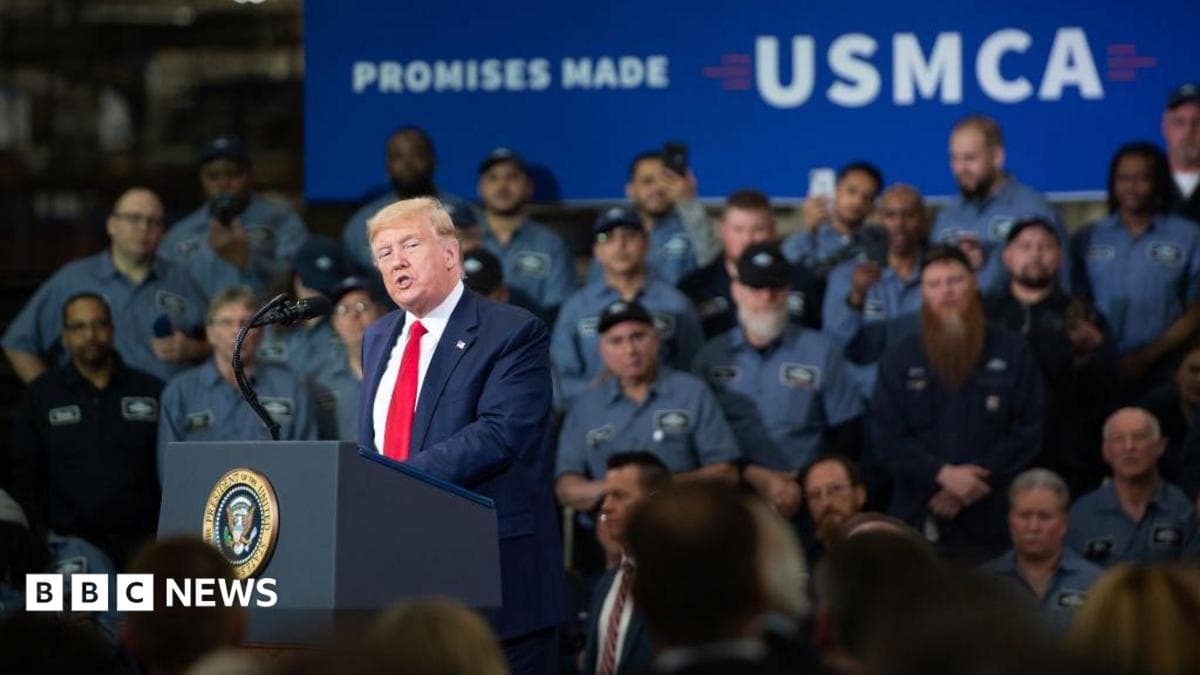
US President Donald Trump's administration declined to renew the free-trade agreement The US has declined to renew the landmark US-Mexico-Canada Agreement (USMCA) in its current form, according to a senior US official. This decision means the trilateral trade pact will miss out on an automatic 16-year extension . The official said the administration "chose not to rubber stamp a USMCA renewal without addressing existing issues" and that "the United States did not agree to renew the USMCA in its current form". If the countries fail to unanimously agree to renew the agreement, "it essentially sets a 10-year shot lock to termination", the official said. Under the pact guidelines, each country must decide whether to renew the agreement for another 16-year term. While the free-trade deal remains in place for now, the lack of a long-term commitment creates fresh economic uncertainty across North America. The agreement, which underpins around $2tn (£1.5tn) in trade each year, is facing pressure over unresolved disputes. US trade officials are pushing for major changes before committing to a long-term extension. Washington has consistently raised concerns over rules of origin for automobiles, dairy market access and stopping third-party countries like China from exploiting the regional agreement. Under the USMCA's original terms, unanimous agreement on an extension would have seen the trade deal kept in place until 2042. The US opting out will force the nations to meet every year to negotiate changes. Business groups across the continent had called for the pact to be extended. The decision also kicks off a 10-year countdown towards the deal expiring as early as 2036. The US Chamber of Commerce had warned that sectors such as manufacturing and agriculture relied heavily on cross-border certainty. However, US domestic trade groups such as the American Iron and Steel Institute and the Steel Manufacturers Association welcomed the shift, arguing annual reviews would give US negotiators leverage to fix parts of the deal . The friction comes six years after the USMCA entered into force, replacing the 1994 North American Free Trade Agreement (Nafta). It updated rules around digital trade, workers' rights and regional manufacturing, specifically requiring more vehicle parts to be made within North America.