US Open shows why golf is on guard against bad behaviour
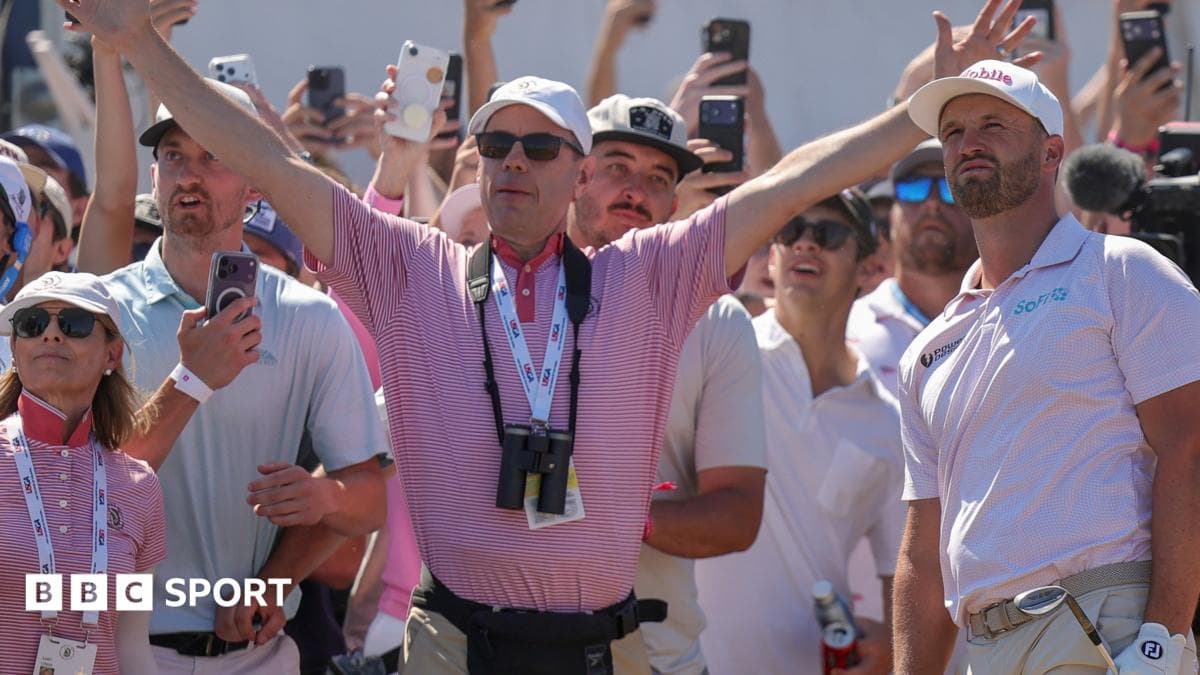
This video can not be played Clark beats Burns on closing holes of dramatic US Open US Opens drive players to distraction because the intention is always to test temperament as much as technique. The latest championship, won by Wyndham Clark at Shinnecock Hills on Sunday, did exactly that. But this edition will be remembered for its less savoury side. It was a tournament that reflected our golfing times, where deteriorating standards of behaviour inside and outside the ropes took precedence. The course was brilliantly set up to traditional US Open standards. It demanded the full gamut of shots, punishing any that fell short of perfection, and delivered a thrilling final day as Clark limped home. The champion showed steely sporting character to win his second title, after also triumphing in 2023, but he attracted more jeers than cheers while holding off the plucky Sam Burns and world number one Scottie Scheffler. Clark blocks out New York jeers to win US Open title Shinnecock Hills 'won the battle over me' - McIlroy Niemann first to get two-shot penalty for throwing club One of the reasons for Clark's unpopularity was his furious demolishing of two ancient locker doors in the Oakmont clubhouse after missing the cut at last year's US Open. It was an act of uncontrolled vandalism that speaks to the sense of entitlement that many perceive has spread through the upper echelons of the men's game. Players have never had it so good. They are richer and more pampered than ever before, yet for all that wealth and influence they have never seemed more unattractively angry. Every broadcast seems populated with commentators being forced to say sorry for players' bad language and the fact that it is the broadcaster rather than the golfer doing the apologising sums up a lack of accountability. This worsening malaise has prompted the majors to introduce its new code of conduct which resulted last week in Joaquin Niemann becoming the first player to receive a two-stroke penalty for throwing his club, while running up a nine on the par-four sixth in his first round. That nine became an 11. The Chilean fought back brilliantly to make the cut and ultimately finish tied for seventh. He would have been third with a guaranteed Masters invitation without the penalty. The United States Golf Association (USGA) hit him where it hurts most by adversely affecting his scorecard rather than a bulging bank balance with a meaningless fine. Many will feel such firm action, in general terms, is long overdue. "I really like what's happening here," former European Ryder Cup captain Paul McGinley told viewers of the Golf Channel. "We're in a game where we are seeing so much in favour of the players; so much entitlement, so much money going to the players, so much control. "The powers that be, the R&A and USGA, along with Augusta National, are making a very strong stance here about codes of conduct. "And about boundaries. And I think those boundaries have been stretched too far over the years. And its really good and refreshing to see those boundaries coming in." But Niemann's penalty sets a precedent that will be tough to fairly enforce because different players receive different levels of scrutiny. Potential punishments can influence leaderboards, cuts and careers. Next the spotlight will next fall on July's Open Championship at Royal Birkdale. R&A chief executive Mark Darbon told BBC Sport in April that he will be ready to impose shot penalties for bad behaviour. "You want passion from players, you want passion from spectators, but there's a fine line, and one of the amazing things about this sport are the values and integrity that underpin it," he said. "So we will watch that line very closely." Each group at The Open has an individual referee which should make it easier to enforce the code of conduct with consistency. The main tours, meanwhile, are still working out protocols that will be acceptable to their ultimate bosses - the players. Behaviour also needs careful management amid galleries of fans. Boorish individuals can repeatedly be heard yelling, at best, unfunny lines, and at worst abuse designed to influence an outcome. "Don't choke Wyndham," was the last thing Clark needed to hear as his six stroke lead was whittling away last Sunday. Yet such sentiments rang in his ears throughout the final day. Golf is played in an intimate arena, fans are privileged to share the stage. There is no escape for the players and it feels as though we are creeping towards a point where people could start yelling at the top of backswings to put off players while hitting. The proliferation of betting within the golf industry on both sides of the Atlantic does not help. And we saw the effects of partisan crowds at the Ryder Cup last autumn at Bethpage with abuse of European stars that was an absolute disgrace. Top level golf returned to Long Island last week and some members of the New York crowds again lived down to those depressingly deteriorating standards. And with The Open about to return to north-west England, it is worth remembering there were several individuals who behaved similarly as American Brian Harman won the 2023 Open at Hoylake when the championship was last in that region. Harman and Clark have plenty in common with what they endured among their finest hours on golf courses. Record crowds are expected at Birkdale and with high summer booze flowing, successfully policing them will be crucial. Last Sunday Clark and Burns, who came up just shy of a first major, produced a thrilling denouement played out on a great but maddening course. Despite the brilliance of the Shinnecock spectacle it also proved the sport has never been so angry or unruly. Those imposters have to be kept in check. Without its traditional civility, golf is much diminished.